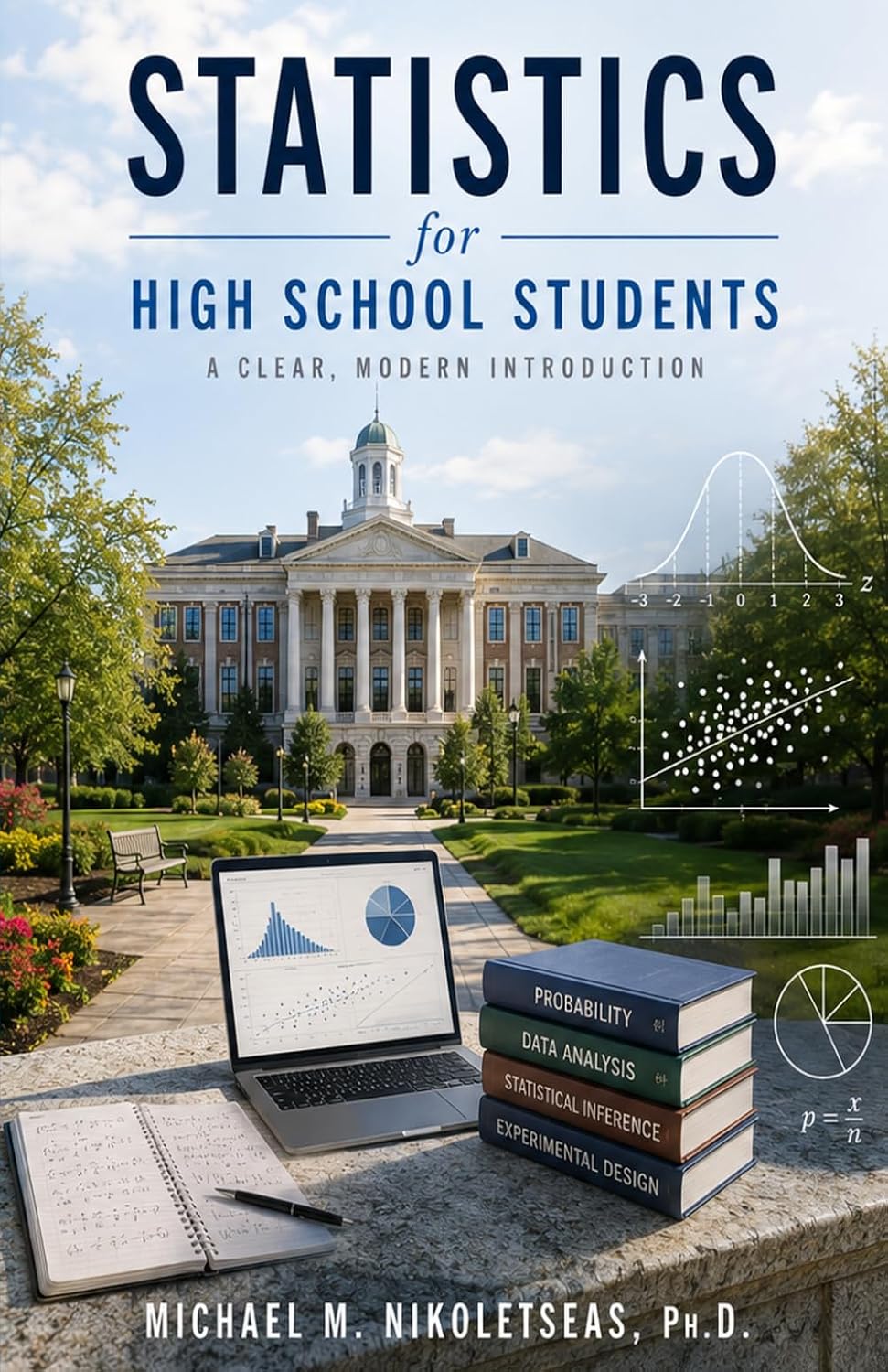
High School Statistics is an example-driven introduction to statistical thinking. It is written for students preparing for college who want clear explanations, readable math, and confidence with data. Throughout the book you will find short formulas (LaTeX rendered by MathJax), step-by-step examples, simple calculator or spreadsheet demonstrations, and live interactive practice, self-test quiz — always optional and always focused on understanding.
Who this book is for
• High school and early college students in introductory statistics courses
• Students in psychology, biology, education, or social science who need to understand data
• Self-learners who prefer short explanations followed by examples and visuals
What you need to know first
• Basic Math (add, subtract, multiply, divide), handle fractions, use square roots)
• Comfort with graphs (axes, slope, upward/downward trends)
• No calculus required; symbols are introduced gently and explained as they appear
How this book is organized
The text is structured as a Book in Drupal with three levels: Parts → Lessons → (occasional) Sub-lessons.
Part 1 — Theory • Concepts • Statistical Tests
Core ideas of descriptive and inferential statistics: averages and variability, the normal curve, standard error, t-tests, ANOVA, correlation, regression, chi-square, and non-parametric tests.
Part 2 — Lecture & Lab
Short lectures and lab-style lessons that connect mathematics to intuition through stories, visuals, and examples.
Part 3 — Statistical Design
Design-oriented lessons where you decide which statistical test fits each scenario.
Part 4 — Applications (Cases and Examples)
Worked examples showing how to pose statistical questions, run tests, interpret results, and evaluate conclusions.
Part 5 — Statistical Tests (Cookbook Style)
A quick-reference guide summarizing major tests, their formulas, assumptions, and when-to-use rules.
Part 6 — Modern Statistics: Data, AI, and Machine Learning
Big data, resampling, simulation, regression beyond the line, machine learning fundamentals, neural networks, and ethics in data and AI.
Part 7 — The Storyteller Statistician
Short thematic essays linking statistical reasoning to everyday intuition, narrative, and real-life thinking.
Part 8 — Appendices
Symbols and notation, math review, statistical tables, technology tips (Excel, R, Python, iPhone calculator), datasets, study advice, glossary, and formula sheet — each paired with small QR codes linking to interactive tools.
How to use this book
• When available, review the short learning goals or introductory overview at the start of each lesson.
• Read the key ideas and follow the worked examples step by step.
• Many lessons include brief practice problems or self-test questions—use them to check your understanding as you go.
• When QR codes or links are provided, use them to open calculators, datasets, and optional quizzes or tools.
• Consult the Appendices whenever you need quick notation, math review, statistical tables, datasets, or formula sheets.
Notation and conventions
Notation is light and consistent. Symbols are paired with plain-language explanations.
Symbolic formula: $$\bar{X} = \frac{\sum X}{n}$$
Formula in words: Mean = sum of scores ÷ number of scores.
Symbolic formula:
$$s^2 = \frac{\sum (X - \bar{X})^2}{n - 1}$$
Formula in words:
$$\text{Variance} = \frac{\text{sum of squared deviations from the mean}}{\text{number of scores} - 1}$$
What you will be able to do
• Summarize and visualize data clearly
• Quantify uncertainty with standard errors and confidence intervals
• Test hypotheses using t-tests, ANOVA, and chi-square procedures
• Recognize relationships with correlation and regression
• Use simulation and modern tools to explore real data
Technology and reproducibility
Many applied sections include optional calculations using Google Sheets, Excel, R, or Python (Colab). A collection of small, clear practice datasets is provided for hands-on exploration. You may follow along with the code or perform the calculations by hand — statistical thinking, not software mastery, is the goal.
Practice and self-check
Many lessons conclude with a Practice self-test quiz section containing short problems you can use to check your understanding. Quizzes and review questions reinforce the main ideas, and the practice datasets are small, realistic, and chosen for clarity rather than complexity.
Accessibility
• Math is rendered with MathJax and designed for display on phones and tablets
• Many figures include descriptive alternative text for screen readers
• Core formulas are presented symbolically and accompanied by plain-language explanations
A note on ethics
Data reflect people. Treat them with care. Respect privacy, avoid bias, and be honest about uncertainty. Replication and transparency make statistics trustworthy.
How to get help
• Review the examples and practice sets in each chapter
• Check the Glossary and Appendices for notation and quick refreshers
• Ask questions — in class, online, or through your course forum
Thanks
Thank you to the students and teachers who used early versions of this text and shared feedback. Your questions led to clearer examples, better visuals, and more practical explanations. If you notice an error or have a suggestion, please send it through the contact form on the site.
Practice self-test quiz
In the space below, please find practice problems and self-test quizzes. For full access, please signup free.