Lesson 1: What Is Statistics? Why Does It Matter?
Statistics is the science of learning from data. It provides the tools to decide whether what we observe is real or accidental, and whether a difference is large enough to matter.
When a scientist runs an experiment, or when a pollster surveys a group of voters, the results always vary. Statistics gives us a way to interpret that variation and to draw conclusions.
The Two Branches of Statistics
- Descriptive Statistics describe and summarize what we see.
Example: “The average score on the math test was 78.” - Inferential Statistics use a sample to make conclusions about a larger group.
Example: “Based on this sample, we estimate the average score for all students in the district.”
Definition:
- Descriptive statistics = picture of the data.
- Inferential statistics = prediction about the population.
Parametric vs. Non-parametric Statistics
There are two main families of tests:
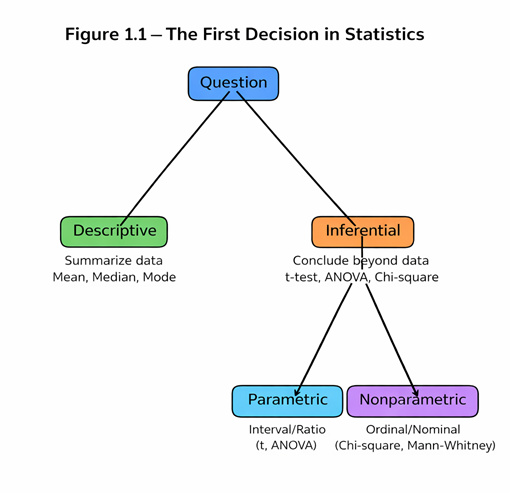
- Parametric tests (such as the t-test or ANOVA) assume certain conditions in the data, like normal distribution and interval/ratio measurement.
- Non-parametric tests (such as Chi-square or Mann–Whitney) require fewer assumptions and are used when data are ranks (ordinal) or categories (nominal).
Simple rule of thumb:
- If data are interval or ratio (e.g., test scores, heights), use parametric tests.
- If data are ordinal or nominal (e.g., ranks, categories), use non-parametric tests.
First Formula in Statistics: The Mean
The mean is our first step toward summarizing data.
Symbolic formula:
$$\bar{X} = \frac{\sum X}{n}$$
Formula in words:
$$\text{Mean} = \frac{\text{sum of scores}}{\text{number of scores}}$$
Where:
- $$\bar{X}$$ = mean (X bar)
- $$\sum X$$ = sum of all scores
- $$n$$ = number of scores
Example: Data: 6, 8, 10
$$\bar{X} = \frac{6 + 8 + 10}{3} = \frac{24}{3} = 8$$
So the mean is 8.
Visual
Figure 1.1 — The First Decision in Statistics. A flowchart: Descriptive vs. Inferential → Parametric vs. Non-parametric, with examples inside each box.
Why This Matters
Before you can choose the right statistical test, you must know:
- What kind of data you have (descriptive vs. inferential).
- How those data are measured (nominal, ordinal, interval, ratio).
- Which family of tests applies (parametric vs. non-parametric).
This chapter sets the stage. The rest of the book builds from here, using only a small set of simple formulas to unlock the logic of statistics.
Practice self-test quiz
In the space below, please find practice problems and self-test quizzes. For full access, please signup free.