Lecture 1 — Scales of Measurement
Before we can analyze data, we must know how it was measured.
The type of measurement determines which statistical test is appropriate.
Scientists and psychologists classify data into four scales of measurement: nominal, ordinal, interval, and ratio.
The Four Scales
- Nominal Scale
- Numbers are just labels or categories.
- Example: 1 = Male, 2 = Female.
- No arithmetic can be done.
- Ordinal Scale
- Numbers show order or rank, but not equal intervals.
- Example: 1st place, 2nd place, 3rd place.
- We know who is higher, but not by how much.
- Interval Scale
- Numbers have equal intervals, but no true zero.
- Example: Temperature in °C.
- 20°C is warmer than 10°C, but not “twice as hot.”
- Ratio Scale
- Numbers have equal intervals and a true zero.
- Example: Height, weight, reaction time.
- Ratios are meaningful: 20 kg is twice 10 kg.
Definition
- Nominal: categories only
- Ordinal: rank order
- Interval: equal intervals, no true zero
- Ratio: equal intervals, true zero
Drama Box — “My Kids, My Fingers”
A professor once explained measurement scales by holding up his hand.
- “I have five fingers. That’s a ratio scale — it’s a real count, and zero means none.”
- “If I say this finger is first, that’s an ordinal scale.”
- “If I call them One, Two, Three, that’s just labels — a nominal scale.”
- “If I measure temperature in Celsius on my skin, that’s interval — the numbers are spaced evenly, but zero doesn’t mean no heat.”
The story helps students remember: labels, ranks, intervals, ratios — the four levels of measurement.
Visuals
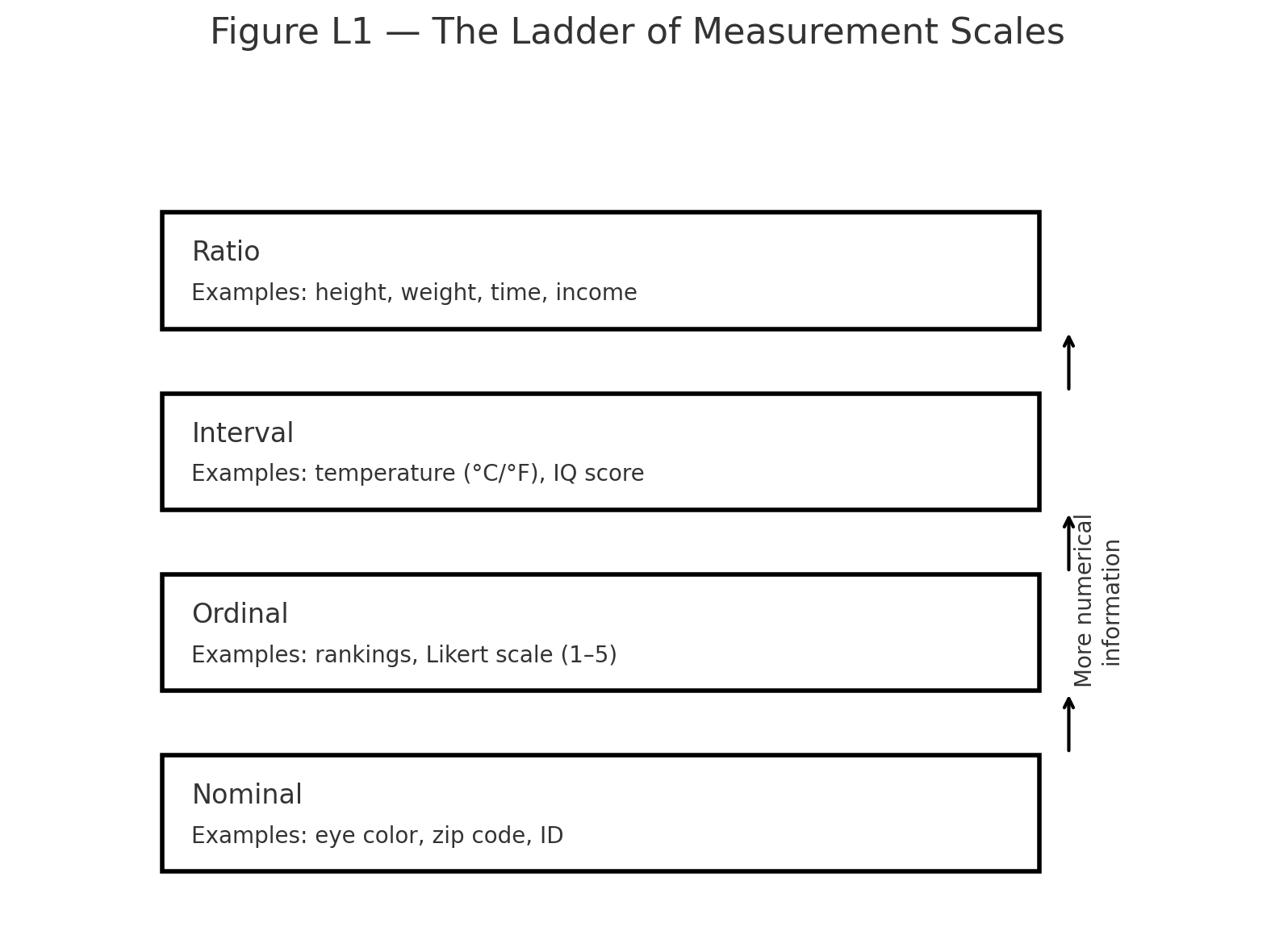
Figure L1 — The Ladder of Measurement Scales. Four rungs labeled: Nominal → Ordinal → Interval → Ratio, each with examples.
Why This Matters
- Nominal/Ordinal data → non-parametric tests
- Interval/Ratio data → parametric tests
This decision is the first step in statistics.
Before calculating a mean, a t-test, or an ANOVA, we must ask: How were the data measured?
Practice self-test quiz
In the space below, please find practice problems and self-test quizzes. For full access, please signup free.