Statistics 2nd ed

descriptive-statistics

Students

For Students: How to Use statisticstextbook.com

A simple guide for starting, studying in order, and reviewing.

Audience: Pre-college and high school students

1. What This Site Is

statisticstextbook.com is a free, page-by-page statistics textbook. You can read it in order like a print book, or use it as a reference when you need help with a topic.

Most students do best by moving from the foundations (data, variability, probability) into core tests (t-tests and ANOVA), and then into modern topics (resampling, big data, and an introduction to machine learning).

2. How to Use This Textbook

  1. Start with the first lesson.
  2. Follow the Next / Previous links. Each lesson ends with navigation links so you can keep the correct order without guessing what comes next.
  3. Keep a small “definitions” page in your notes. Write down the meaning of key terms (mean, variance, standard deviation, probability, distribution) as you encounter them.
  4. For each test, practice three skills. (1) what the question is, (2) the computation, (3) the interpretation in words.
  5. Use the review pages when you get stuck.

3. Reading the Math

Formulas are displayed with MathJax so they stay clear on different screens. If a formula looks unfamiliar, read it slowly and connect each symbol to a meaning in words.

4. Why This Format Helps

  • Clear sequence: lessons build from basic ideas to core tests.
  • Readable math: formulas render cleanly across devices.
  • Study-friendly: minimal distractions and no sign-in required.
  • Open access: free to use for learning and review.

5. Summary

Use the textbook in order if you are learning statistics for the first time, and use it as a reference when you need a quick explanation or a worked example. If you study steadily and keep your own notes of definitions and interpretations, the material becomes much easier over time.
© 2025. This page uses MathJax with LaTeX delimiters \(…\) and \[…\] in Drupal Full HTML.

Lecture 4 — Uses of the Normal Distribution

two normal curves

The normal distribution is not just a shape — it is a powerful tool.
It allows us to describe data, calculate probabilities, and make decisions about means and differences.

Here are four major uses of the normal curve.


1. Describing Data

The normal curve summarizes how scores are distributed.

  • Mean = center
  • Standard deviation = spread

It provides a reference point: where most scores fall, and where extremes occur.

Figure L4.1 — Normal Curve with mean and ±1σ, ±2σ, ±3σ marked.


2. Probability of a Score

We can use the normal curve to calculate the probability of observing a score above or below a certain value.

Formula for standardization:
$$z = \frac{x - \mu}{\sigma}$$

Formula in words:
$$z = \frac{\text{score} - \text{mean}}{\text{standard deviation}}$$

The z-score tells us how many standard deviations a score is from the mean.
With the z-table, we can find the probability of that score.

Figure L4.2 — Normal curve with shaded area above z = 1.5.


3. Reliability of a Mean (SEM)

If we take many samples, the means vary. The Standard Error of the Mean (SEM) tells us how much.

Formula:
$$\mathrm{SEM} = \frac{s}{\sqrt{n}}$$

Formula in words:
$$\text{SEM} = \frac{\text{standard deviation}}{\sqrt{\text{number of scores}}}$$

Smaller SEM means the sample mean is a more reliable estimate of the population mean.

Figure L4.3 — Distribution of sample means, narrower than distribution of raw scores.


4. Reliability of a Difference

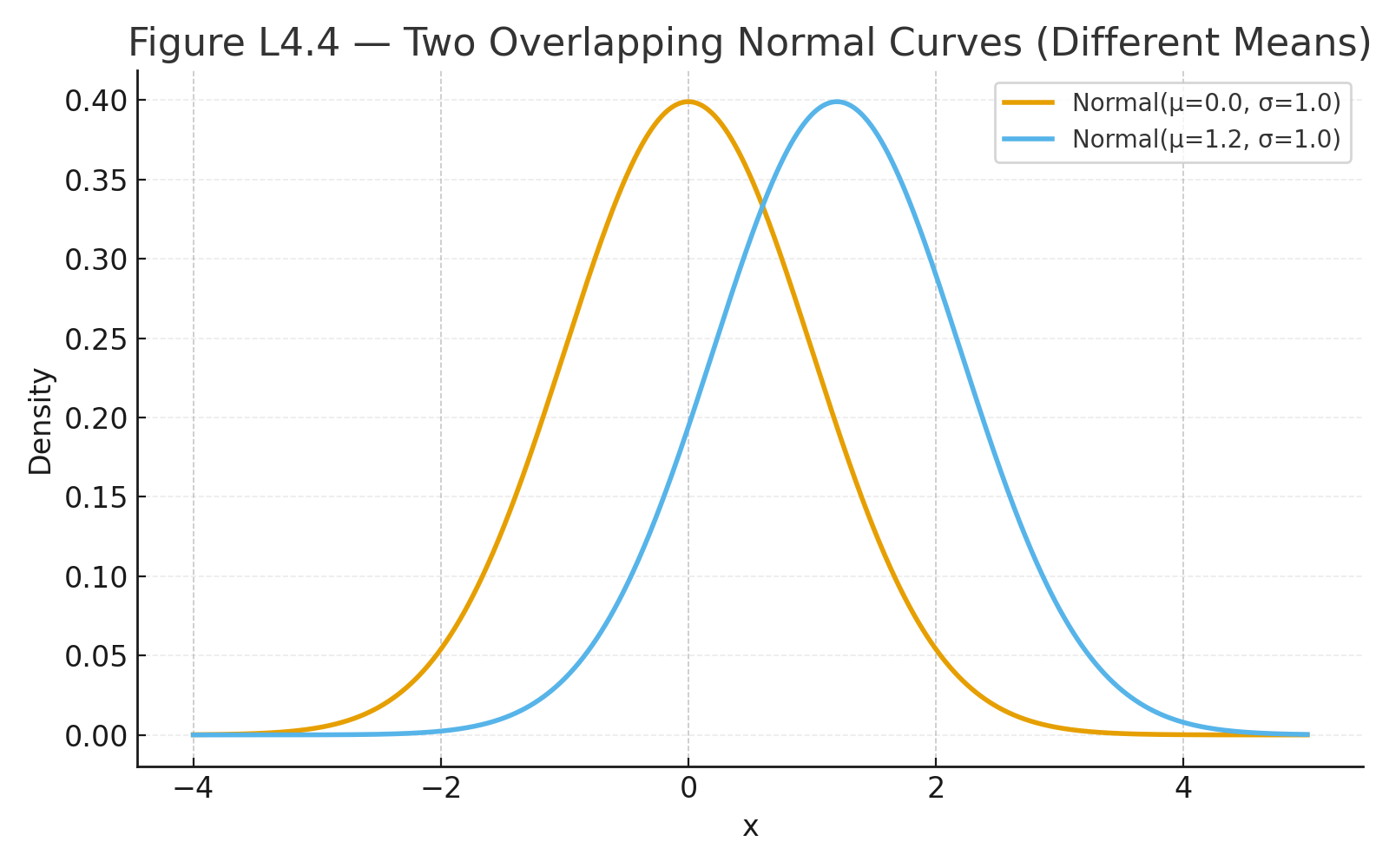
The normal distribution also underlies hypothesis testing — such as the t-test.
It allows us to compare two means and decide whether their difference is larger than expected by chance.

Figure L4.4 — Two overlapping normal curves with different means.


Why This Matters

The normal distribution is the foundation for:

  • Calculating probabilities
  • Estimating reliability of means
  • Testing hypotheses about differences

Understanding these uses prepares us for the transition from descriptive to inferential statistics.

Practice self-test quiz

In the space below, please find practice problems and self-test quizzes. For full access, please signup free.

Lecture 3 — Variance & Standard Deviation

variability

The mean tells us the “typical” score. But how tightly do scores cluster around the mean? Do they spread widely, or are they close together?

To answer, we measure variability. Two key measures are the variance and the standard deviation.


Variance

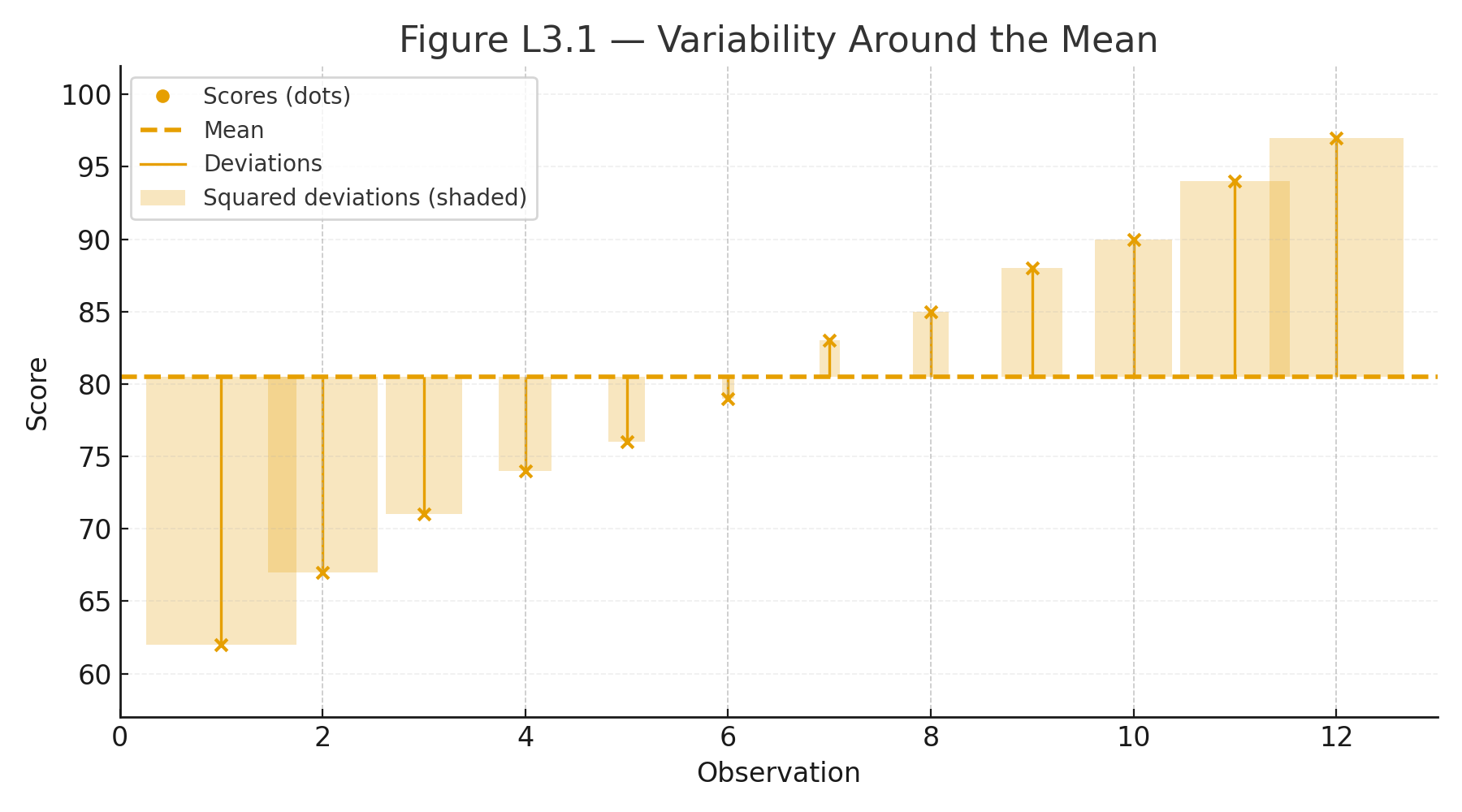
Variance is the average squared distance of scores from the mean.

Symbolic formula:
$$s^2 = \frac{\sum (X - \bar{X})^2}{n - 1}$$

Formula in words:
$$\text{Variance} = \frac{\text{sum of squared deviations from the mean}}{\text{number of scores} - 1}$$

Where:

  • $$s^2$$ = variance
  • $$X$$ = each score
  • $$\bar{X}$$ = mean
  • $$n$$ = number of scores

Standard Deviation

The standard deviation is the square root of the variance. It puts variability back into the same units as the data.

Symbolic formula:
$$s = \sqrt{\frac{\sum (X - \bar{X})^2}{n - 1}}$$

Formula in words:
$$\text{Standard deviation} = \sqrt{\frac{\text{sum of squared deviations from the mean}}{\text{number of scores} - 1}}$$


Example

Data: 6, 8, 10

  • Mean = 8
  • Deviations: –2, 0, 2
  • Squared deviations: 4, 0, 4
  • Sum = 8

Variance:
$$s^2 = \frac{8}{3-1} = 4$$

Standard deviation:
$$s = \sqrt{4} = 2$$

So, on average, scores are 2 units away from the mean.


Definition

  • Variance: average squared distance from the mean.
  • Standard Deviation: square root of variance; typical distance from the mean.

Visuals

Figure L3.1 — Variability Around the Mean. Dot plot of scores with the mean marked, vertical lines for deviations, and shaded boxes for squared deviations.


Why This Matters

Two sets of scores can have the same mean but very different spreads.
Variance and standard deviation give us the language to describe spread, and they are the building blocks for t-tests, ANOVA, and all inferential statistics.

Practice self-test quiz

In the space below, please find practice problems and self-test quizzes. For full access, please signup free.