Statistics 2nd ed

data-science

Students

For Students: How to Use statisticstextbook.com

A simple guide for starting, studying in order, and reviewing.

Audience: Pre-college and high school students

1. What This Site Is

statisticstextbook.com is a free, page-by-page statistics textbook. You can read it in order like a print book, or use it as a reference when you need help with a topic.

Most students do best by moving from the foundations (data, variability, probability) into core tests (t-tests and ANOVA), and then into modern topics (resampling, big data, and an introduction to machine learning).

2. How to Use This Textbook

  1. Start with the first lesson.
  2. Follow the Next / Previous links. Each lesson ends with navigation links so you can keep the correct order without guessing what comes next.
  3. Keep a small “definitions” page in your notes. Write down the meaning of key terms (mean, variance, standard deviation, probability, distribution) as you encounter them.
  4. For each test, practice three skills. (1) what the question is, (2) the computation, (3) the interpretation in words.
  5. Use the review pages when you get stuck.

3. Reading the Math

Formulas are displayed with MathJax so they stay clear on different screens. If a formula looks unfamiliar, read it slowly and connect each symbol to a meaning in words.

4. Why This Format Helps

  • Clear sequence: lessons build from basic ideas to core tests.
  • Readable math: formulas render cleanly across devices.
  • Study-friendly: minimal distractions and no sign-in required.
  • Open access: free to use for learning and review.

5. Summary

Use the textbook in order if you are learning statistics for the first time, and use it as a reference when you need a quick explanation or a worked example. If you study steadily and keep your own notes of definitions and interpretations, the material becomes much easier over time.
© 2025. This page uses MathJax with LaTeX delimiters \(…\) and \[…\] in Drupal Full HTML.

Lesson 19 — Ethics in Data and AI

ethics statistics

Modern statistics and AI are powerful.
They analyze millions of records, make predictions, and even guide decisions.
But with this power come ethical responsibilities.


Bias in Algorithms

Algorithms learn from data.
If the data are biased, the algorithm will repeat — or even amplify — the bias.

Example:

  • If past hiring data favored men, an AI trained on it may also favor men.

Lesson: Always ask, whose data are we using, and what history do they reflect?


Privacy and Data Use

Big data often comes from personal information: browsing, phones, sensors.
Students, patients, and citizens deserve protection.

  • Informed consent
  • Secure storage
  • Respect for anonymity

Transparency and Accountability

AI systems are sometimes black boxes.
Users may not know how a decision was made.

Ethical practice means:

  • Explaining decisions in plain language
  • Allowing appeals and corrections
  • Sharing responsibility between humans and machines

Example: Predictive Policing

  • Data show more arrests in certain neighborhoods
  • AI predicts more crime there → police increase presence
  • Result: cycle reinforces itself

This shows why ethical reflection is essential.


Guiding Principles

  • Fairness: avoid discrimination
  • Privacy: protect individual rights
  • Transparency: explain decisions
  • Accountability: humans must remain responsible

Visuals

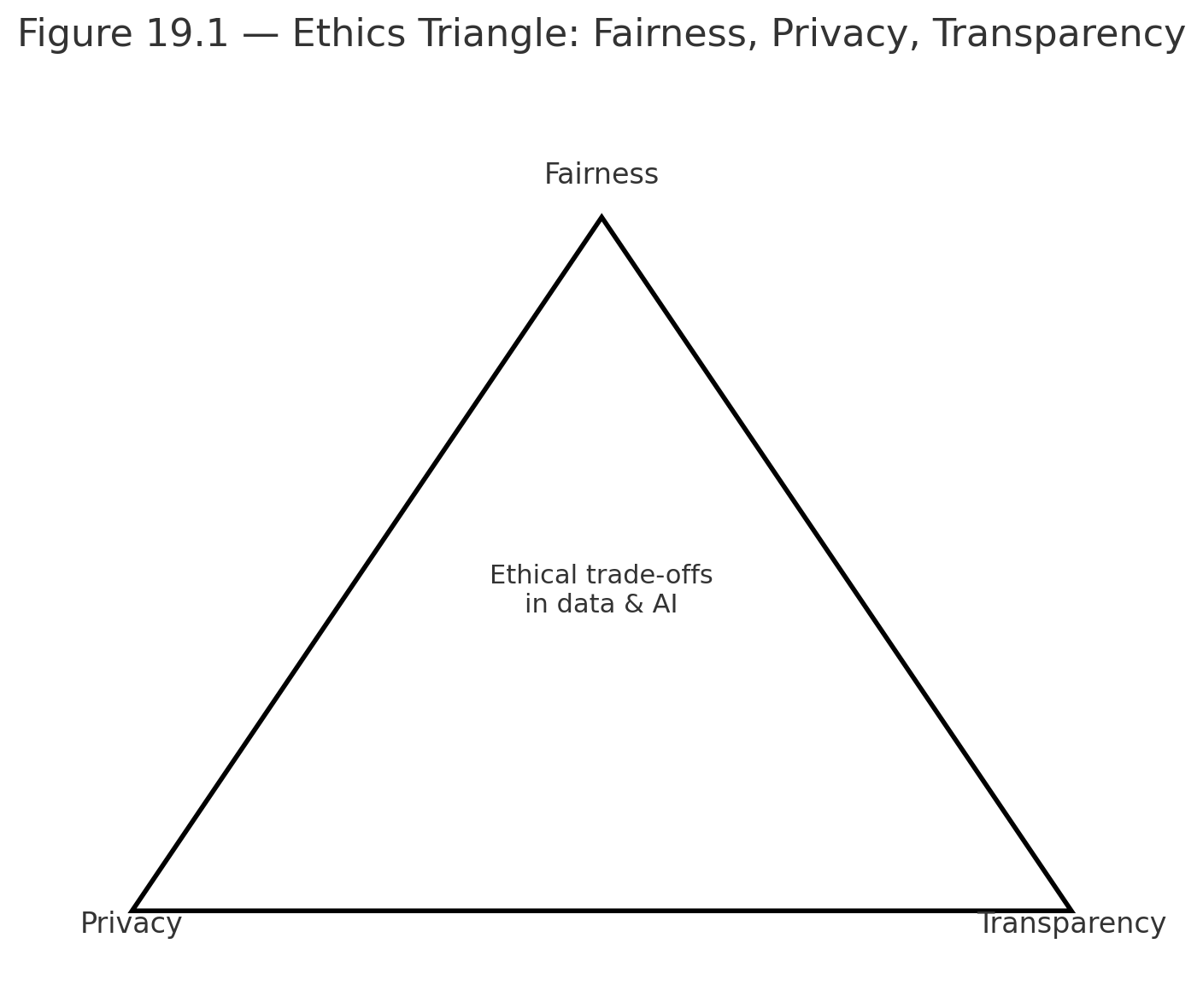
Figure 19.1 — Ethics Triangle: Fairness, Privacy, Transparency at the three corners.


Why This Matters

Statistics and AI are not only technical.
They are also social, cultural, and ethical.
Future scientists, teachers, and citizens must understand both the power and the responsibility of data.

Practice self-test quiz

In the space below, please find practice problems and self-test quizzes. For full access, please signup free.

Lesson 18 — AI and Neural Networks (Intro)

Artificial Intelligence (AI) aims to build systems that can learn, adapt, and make decisions.
One powerful tool is the neural network, inspired by the brain.


From Statistics to AI

  • Regression predicts Y from X
  • Logistic regression predicts probability (0–1)
  • Neural networks generalize this idea: many inputs, many layers, nonlinear patterns

The Structure of a Neural Network

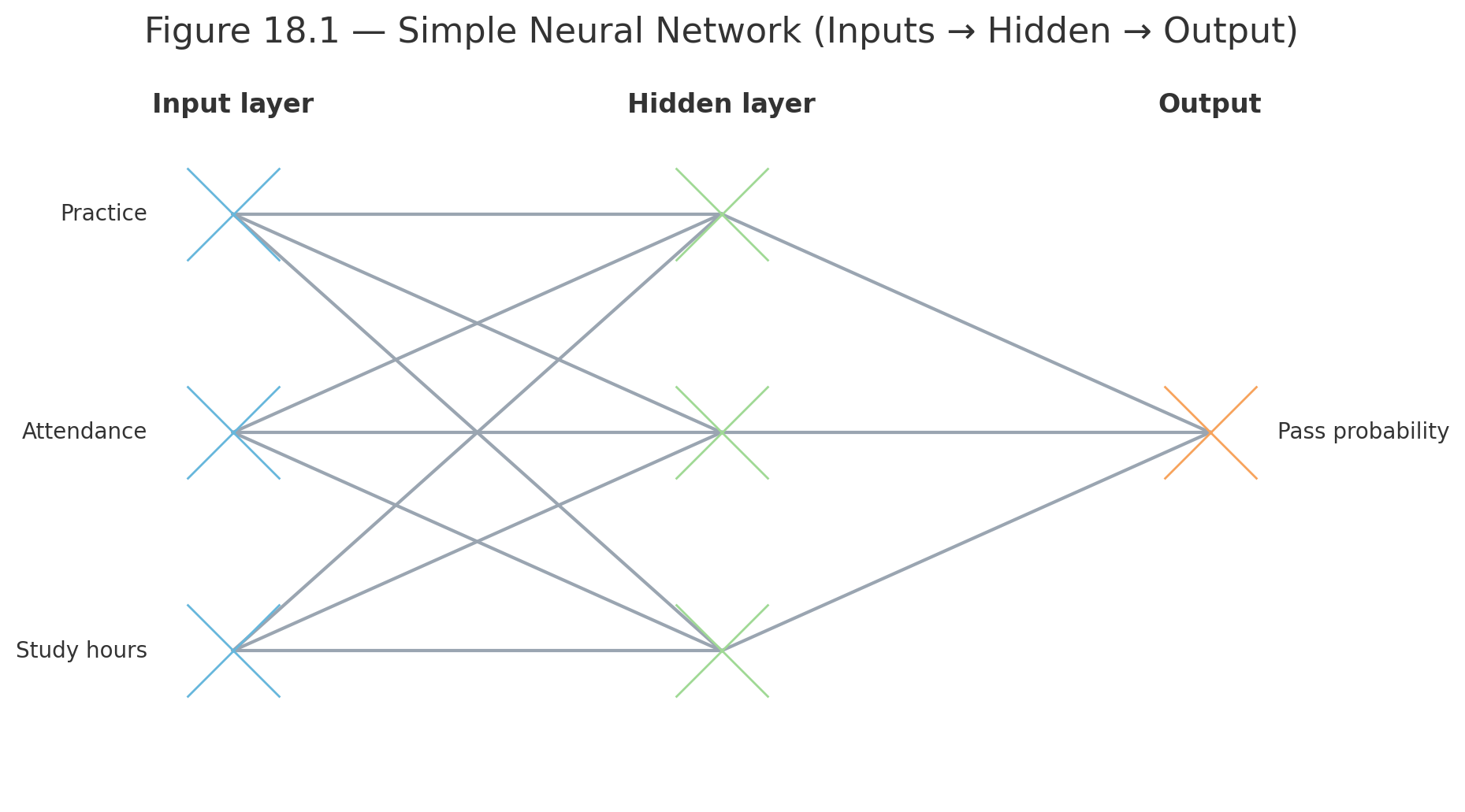
  1. Input layer — variables (X₁, X₂, …)
  2. Hidden layers — units that transform the input
  3. Output layer — prediction or classification

Each connection has a weight (like a slope in regression).


Formula for a Neuron

A single unit in the network:

$$z = \sum w_i X_i + b$$

$$y = f(z)$$

Where:

  • $$w_i$$ = weights
  • $$X_i$$ = inputs
  • $$b$$ = bias (like an intercept)
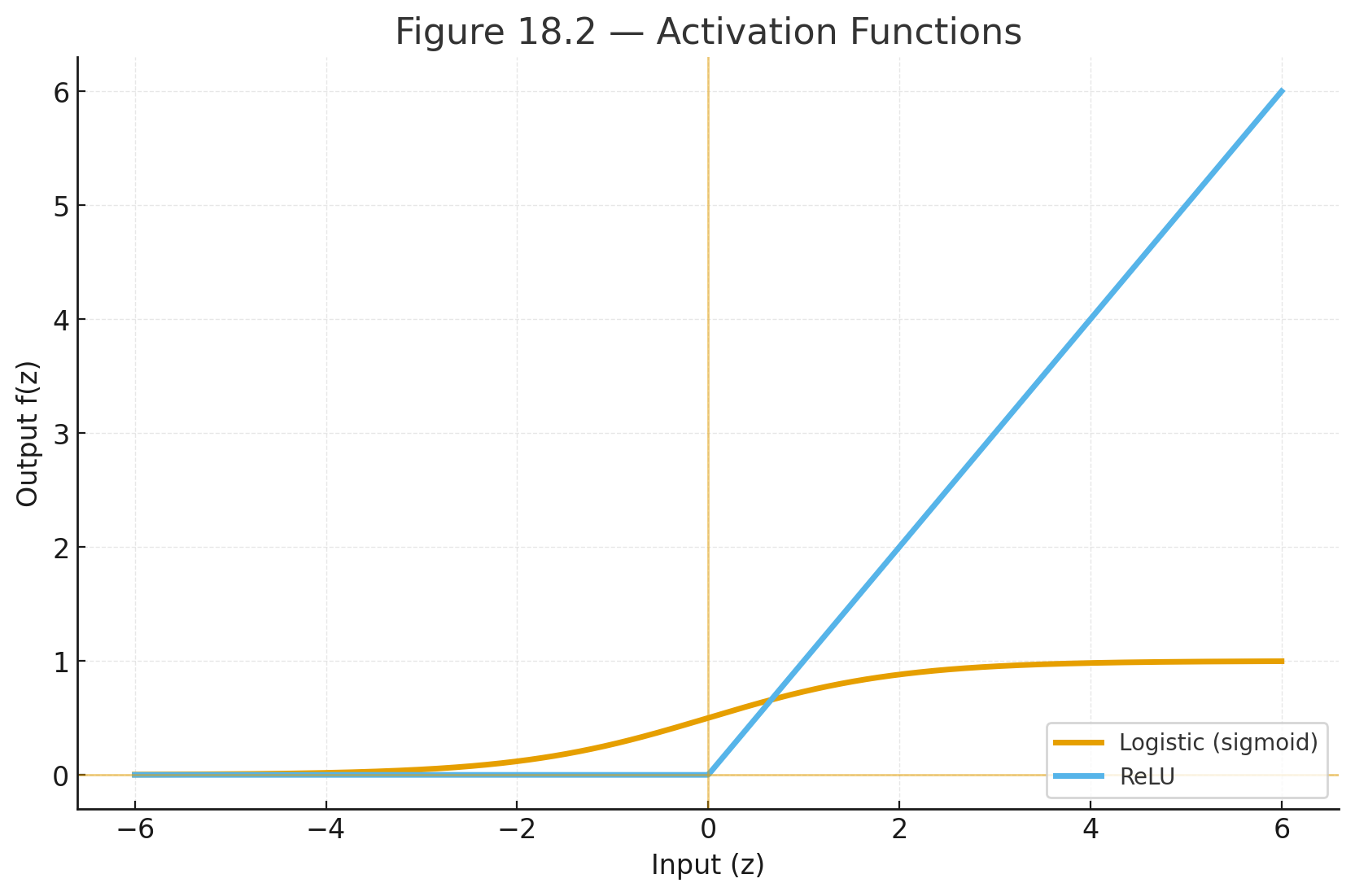
  • $$f(z)$$ = activation function (e.g., logistic, ReLU)

Learning in a Network

The network predicts outputs and compares them with the true answers.
The error is sent backward through the network to adjust weights.
This is called backpropagation.


Example

Predicting if a student will pass or fail based on:

  • Study hours
  • Attendance
  • Practice problems completed

Inputs → combined with weights → logistic activation → output: probability of passing.


Visuals

Simple neural network diagram

Figure 18.1 — Simple Neural Network (Inputs → Hidden → Output)

Activation functions: logistic and ReLU

Figure 18.2 — Activation Functions


Why This Matters

  • Neural networks extend regression and logistic regression.
  • They allow learning from large, complex datasets (images, speech, language).
  • Modern AI (translation, recognition, chatbots) is powered by these models.

Practice self-test quiz

In the space below, please find practice problems and self-test quizzes. For full access, please signup free.

Lesson 16 — Machine Learning Basics

supervised regression
unsupervised k means
overfitting vs generalization

Machine learning is where statistics meets computers.
Instead of only writing formulas, we teach a computer to learn patterns from data.


What is Machine Learning?

Machine learning uses algorithms to improve automatically with experience.

  • Supervised learning: the computer is given examples with correct answers.
  • Unsupervised learning: the computer finds patterns without answers.

Supervised Learning

Goal: predict Y from X.

Examples:

  • Predict exam scores from study hours
  • Predict house price from size, location, and age

Steps:

  1. Split data into training set and test set
  2. Train the model on training data
  3. Test accuracy on new (unseen) data

Formula (simple linear regression as machine learning):
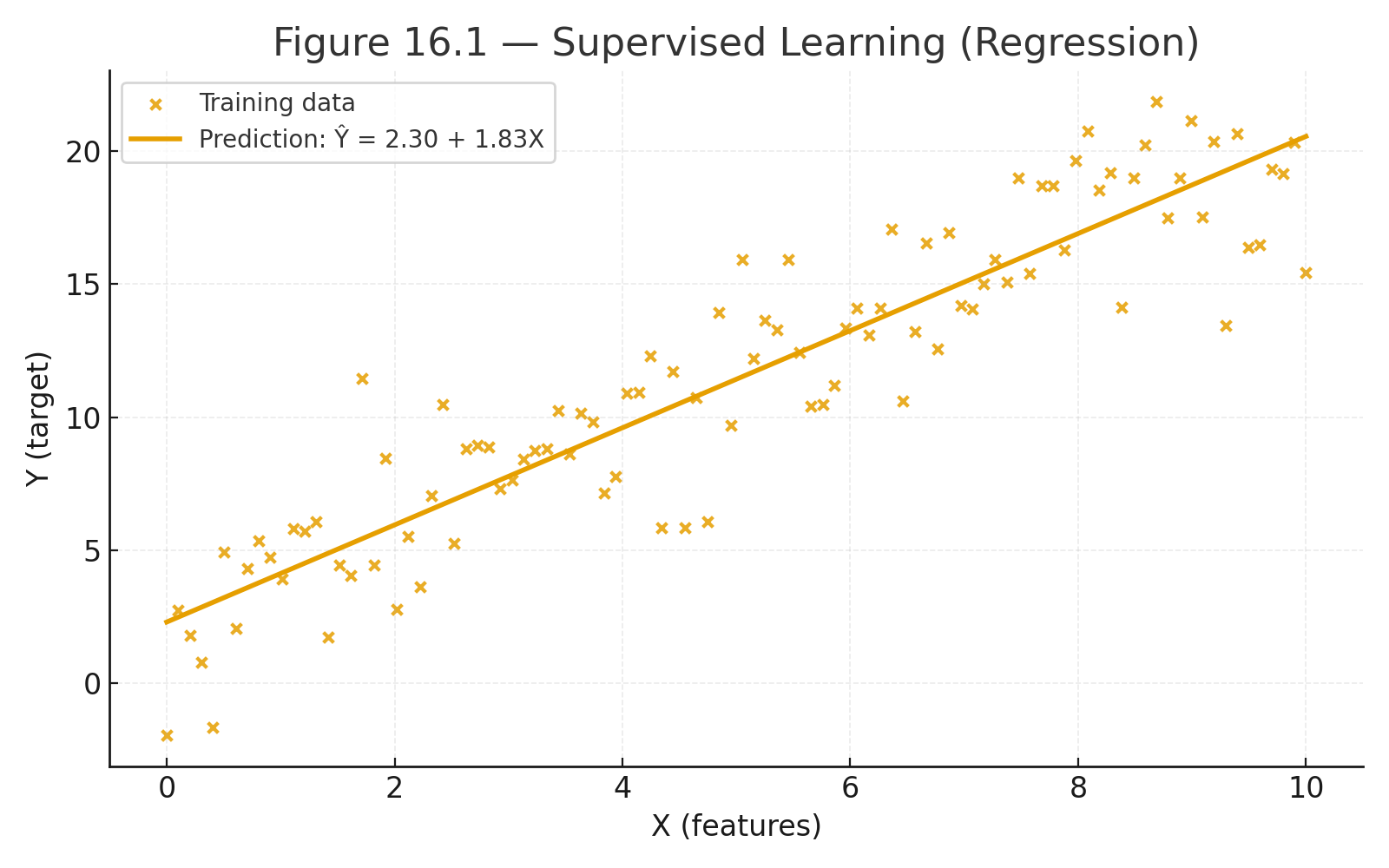
$$\hat{Y} = a + bX$$

Here, the computer “learns” $$a$$ and $$b$$ from the data.


Unsupervised Learning

Goal: find hidden structure in the data.

Examples:

  • Group students by study habits
  • Cluster shoppers by buying patterns

Algorithms:

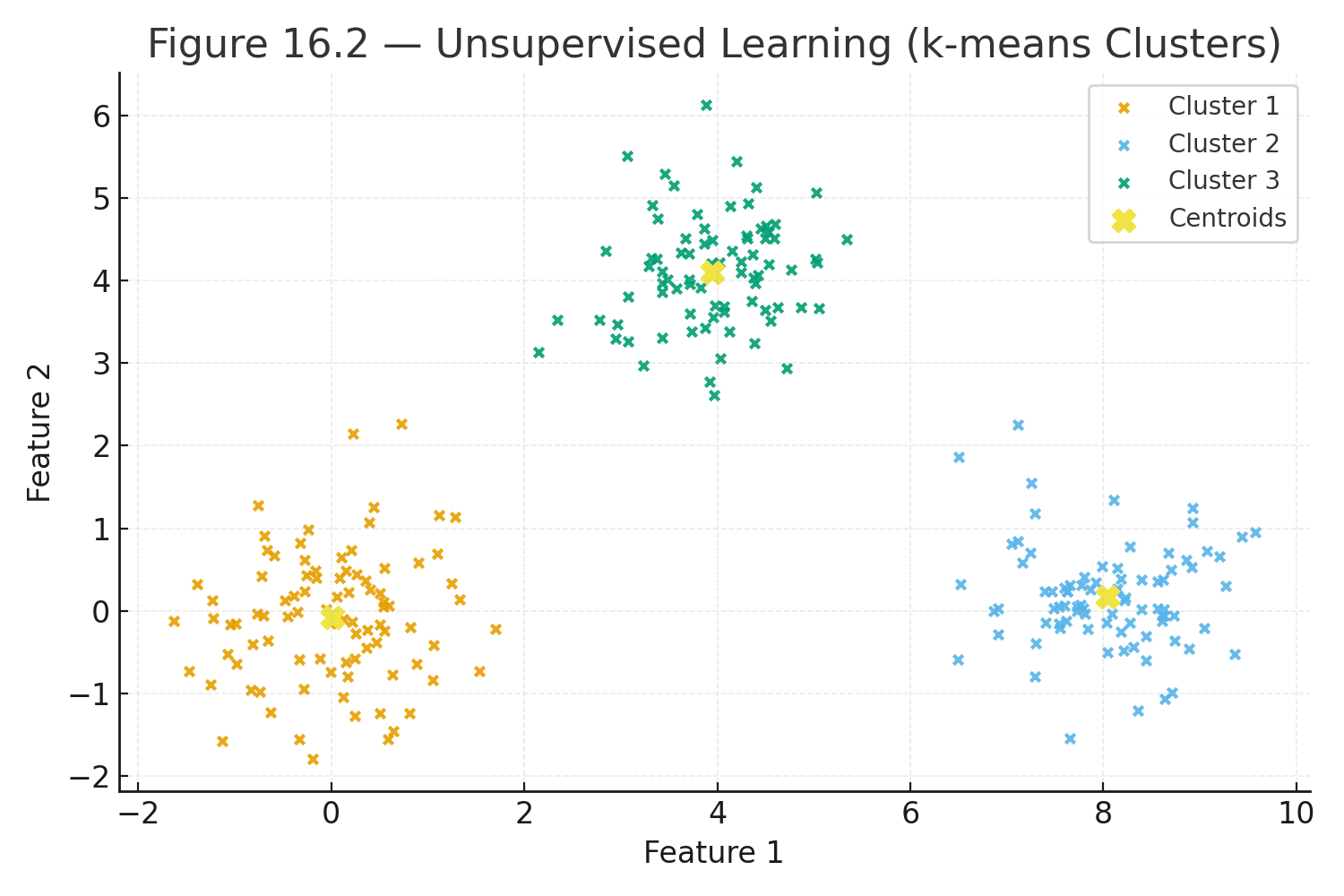
  • k-means clustering
  • Hierarchical clustering

No “correct answer” is given — the computer organizes the data.


Overfitting vs. Generalization

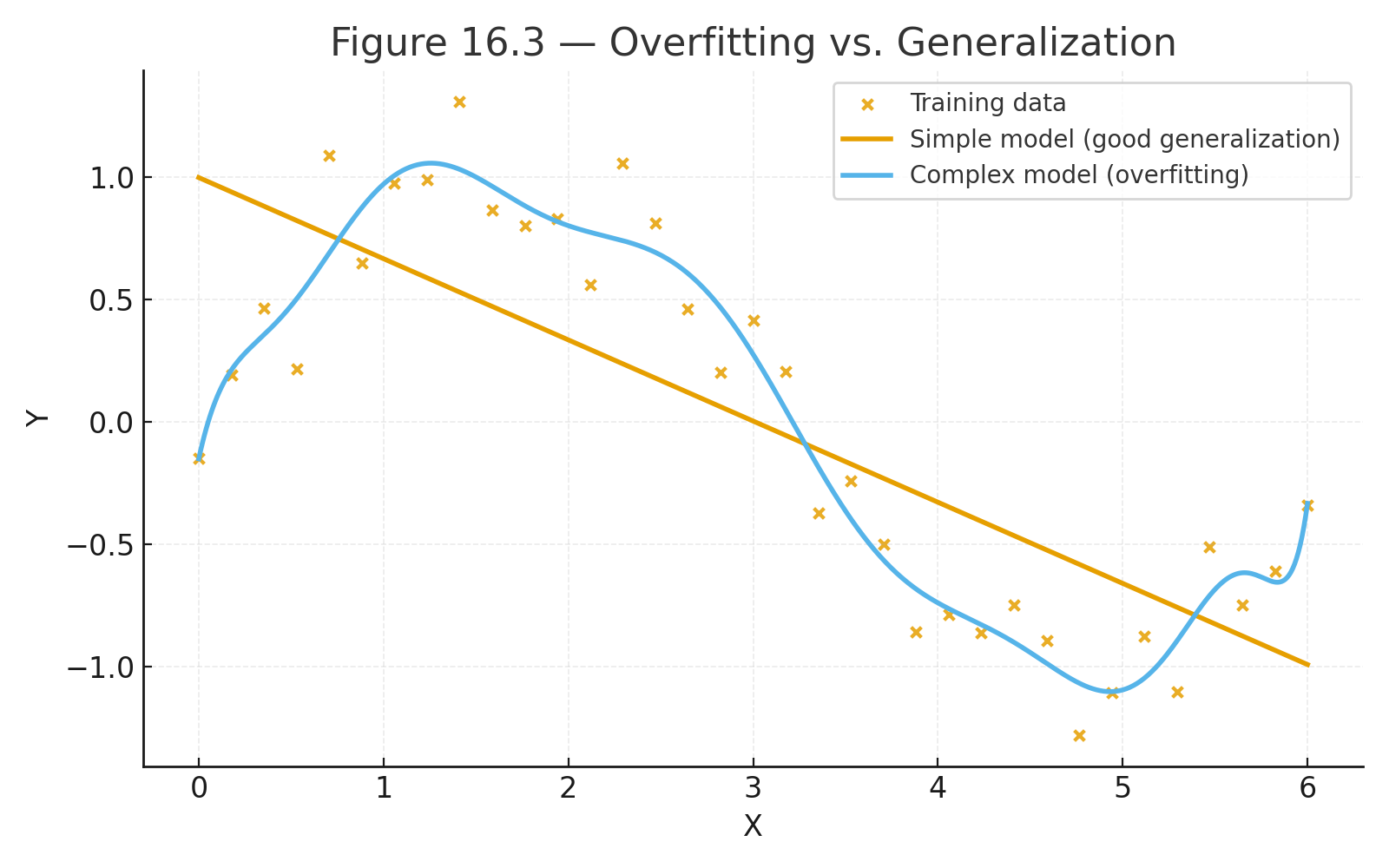
  • Overfitting: the model memorizes the training data but fails on new data.
  • Generalization: the model captures the underlying pattern and works on new data.

Example:
If a student memorizes past exam answers (overfit), they may fail a new test.
If they learn the concepts (generalize), they succeed.


Key Concepts

  • Training set: data used to build the model
  • Test set: data used to evaluate performance
  • Accuracy: how well the model predicts new data

Visuals

Figure 16.1 — Supervised learning example: regression line predicting Y from X.

Figure 16.2 — Unsupervised learning example: scatterplot with clusters (k-means).

Figure 16.3 — Overfitting vs. generalization: wiggly curve vs. smooth line.


Why This Matters

Machine learning grows directly out of statistics:

  • Regression → prediction
  • ANOVA → group classification
  • Clustering → organizing data

By learning the basics of ML, students see how statistics powers AI.

Practice self-test quiz

In the space below, please find practice problems and self-test quizzes. For full access, please signup free.

Lesson 15 — Resampling and Simulation

bootstrap
bootstrap randomization
monte carlo

Classical statistics uses formulas and tables.
Modern computing gives us another way: resampling and simulation.

Instead of relying only on theory, we let the computer generate thousands of samples and see what happens.


Bootstrapping

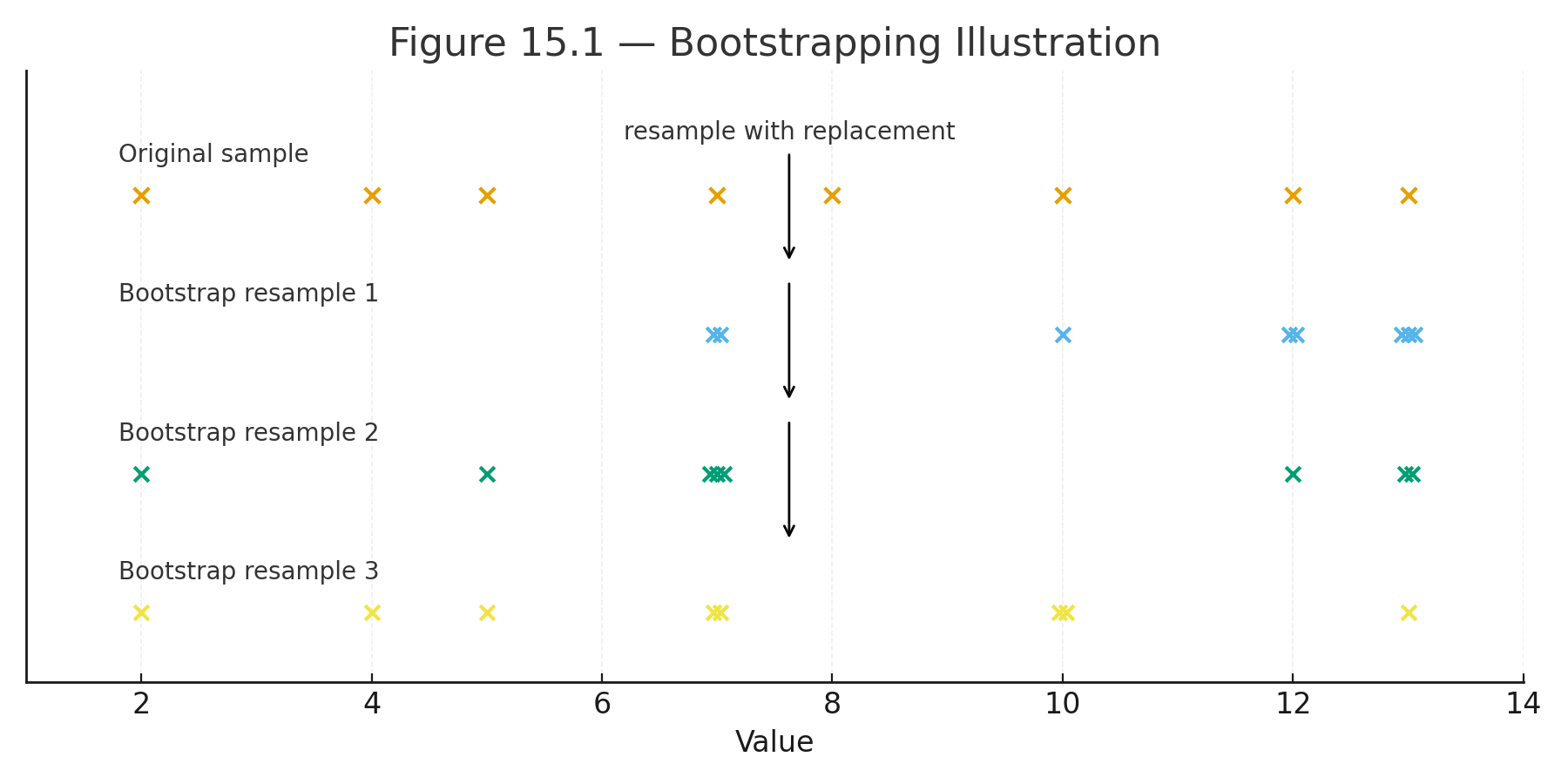
Bootstrapping means resampling with replacement from the original data.

Steps:

  1. Take a sample of size $$n$$ from the data (with replacement).
  2. Compute the statistic (mean, median, correlation).
  3. Repeat thousands of times.
  4. Use the distribution of resampled statistics to estimate confidence intervals.

Example:
Data = [5, 6, 7, 9].
Resample 1000 times, compute mean each time.
The distribution of means gives an estimate of the true mean’s variability.


Randomization (Permutation) Tests

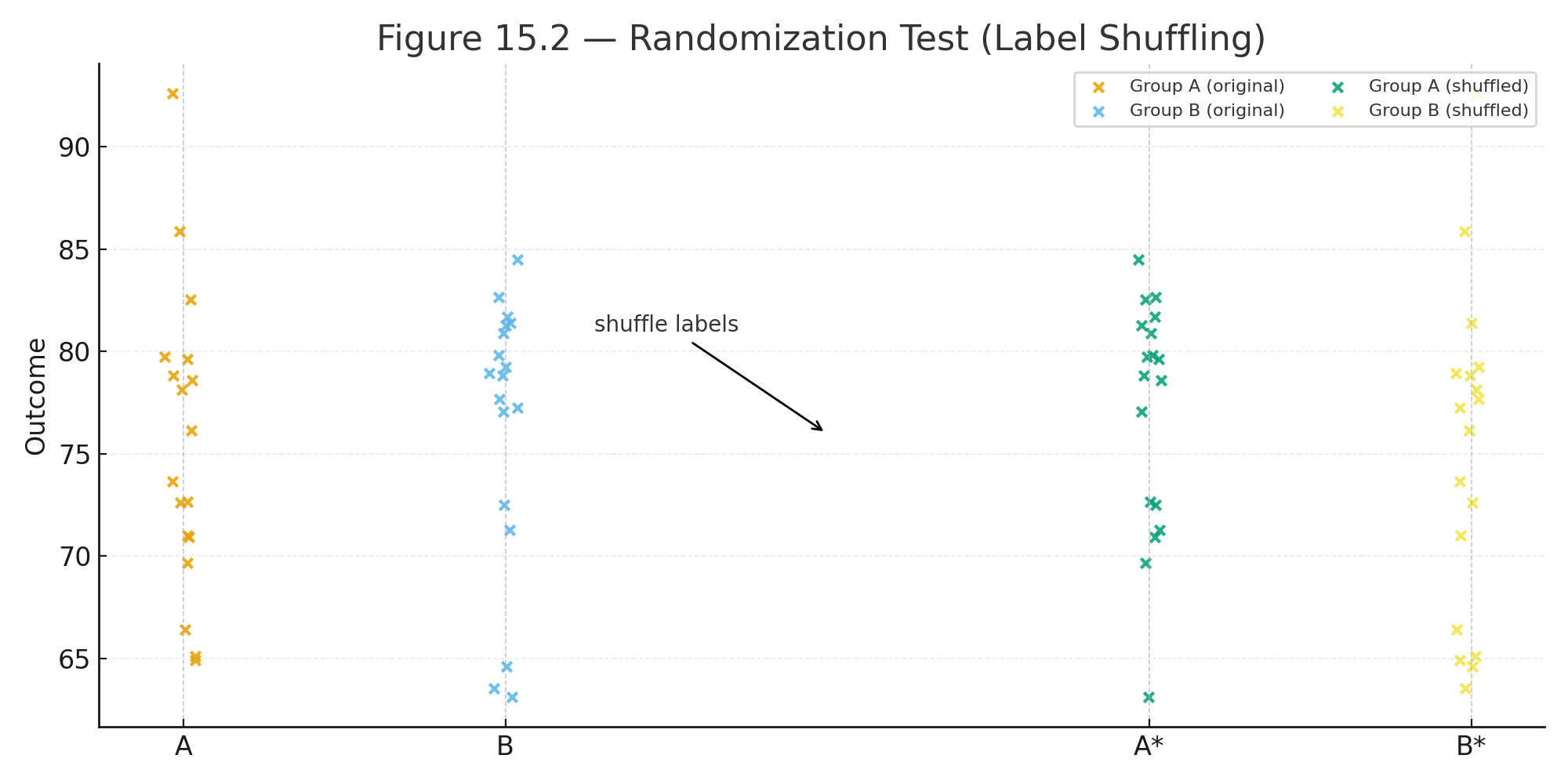
Used to test hypotheses by shuffling labels.

Steps:

  1. Combine all data.
  2. Randomly assign to groups.
  3. Compute the difference in means.
  4. Repeat thousands of times.
  5. Compare the observed difference to this distribution.

This shows whether the observed effect could be due to chance.


Monte Carlo Simulation

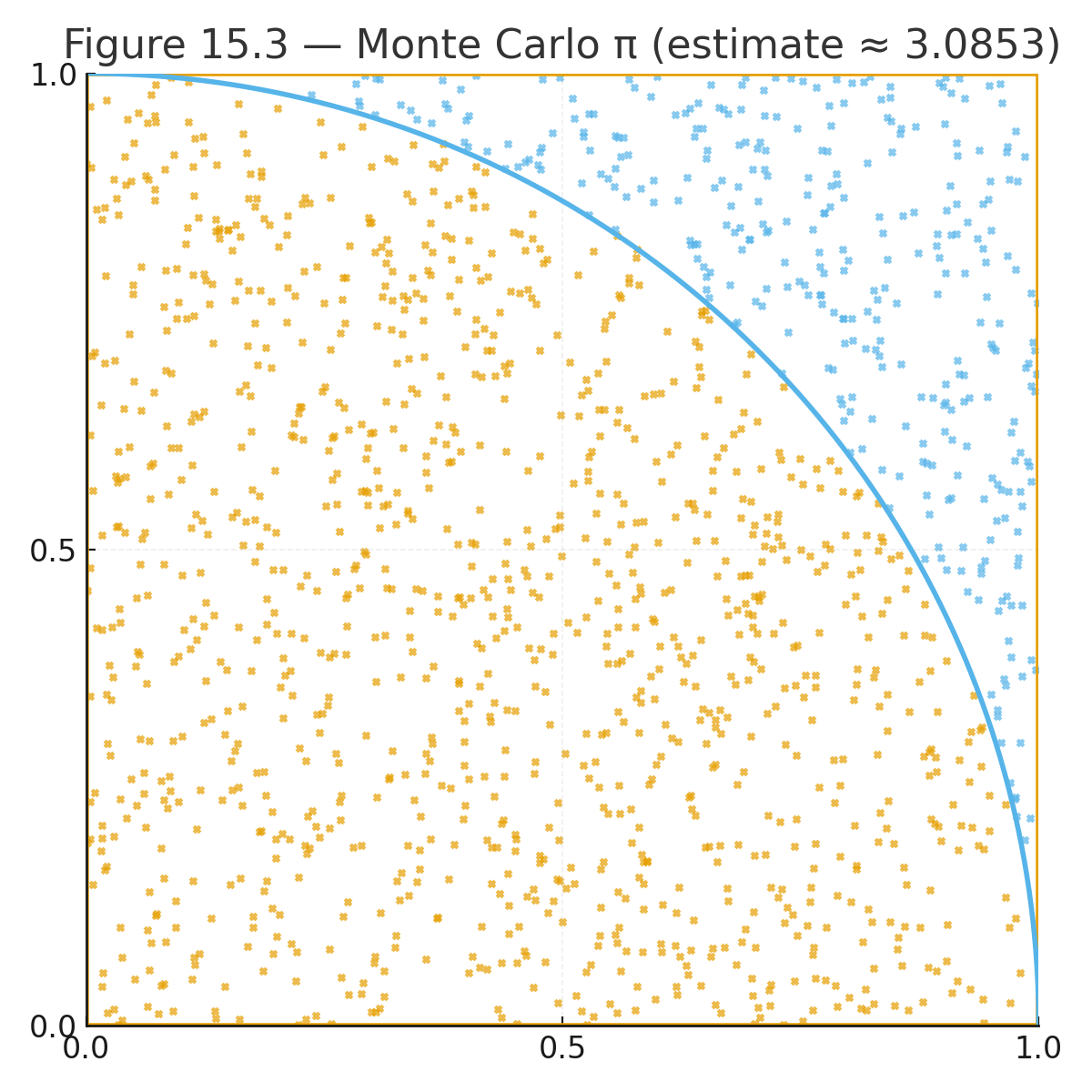
Monte Carlo methods use random numbers to model complex processes.

Example: Estimating $$\pi$$.

  • Randomly throw points into a square.
  • Count how many fall inside the circle quarter.
  • $$\pi \approx 4 \times \tfrac{\text{inside circle}}{\text{total points}}$$.

Why Resampling Works

Resampling uses the data itself as a model of the population.
It avoids assumptions (like normality) and adapts to modern computing power.


Visuals

Figure 15.1 — Bootstrapping illustration: resampling from a small dataset with replacement.

Figure 15.2 — Randomization test: labels shuffled between groups.

Figure 15.3 — Monte Carlo: random points filling a square and a quarter circle.


Why This Matters

Resampling and simulation show students that statistics is not only about formulas.
Computers allow us to see probability in action.
This approach prepares students for data science, where simulation is as important as theory.

Practice self-test quiz

In the space below, please find practice problems and self-test quizzes. For full access, please signup free.

Lesson 14 — Big Data

big data

In the past, statistics dealt with small datasets: 20 students in a class, 50 patients in a trial.
Today, we live in the age of big data: millions of tweets, billions of web pages, streams of data from phones, sensors, and satellites.

Big data changes the scale of statistics.


What is Big Data?

Big data is often described by the 3 Vs:

  1. Volume — enormous amounts of data (terabytes, petabytes)
  2. Velocity — data generated quickly (social media streams, stock markets)
  3. Variety — many forms (numbers, text, images, audio, video)

Sometimes a fourth V is added: Veracity (how reliable are the data?).


Why Big Data Matters

  • Traditional statistics assumes small, clean datasets.
  • With big data, we need algorithms and computers to process information.
  • Sampling becomes less important when entire populations are measured (e.g., all tweets in a week).
  • Visualization and summaries are critical to make sense of huge datasets.

Example

  • A teacher records grades for 30 students → small dataset.
  • YouTube collects billions of video views per day → big data.

Statistical tools remain the same (mean, median, regression), but the scale requires computational methods.


Tools for Big Data

  • Databases (SQL, NoSQL) to store data
  • Distributed computing (Hadoop, Spark) to process data
  • Statistical programming (R, Python) for analysis

Visuals

Figure 14.1 — Big Data and the 3 Vs. Diagram showing Volume, Velocity, Variety (and Veracity) in overlapping circles.


Why This Matters

Big data connects statistics to the modern world:

  • Online behavior, medical records, GPS signals, shopping patterns
  • Algorithms detect patterns too large for humans to see
  • Big data powers modern AI and machine learning

Practice self-test quiz

In the space below, please find practice problems and self-test quizzes. For full access, please signup free.