Lesson 16 — Machine Learning Basics
Machine learning is where statistics meets computers.
Instead of only writing formulas, we teach a computer to learn patterns from data.
What is Machine Learning?
Machine learning uses algorithms to improve automatically with experience.
- Supervised learning: the computer is given examples with correct answers.
- Unsupervised learning: the computer finds patterns without answers.
Supervised Learning
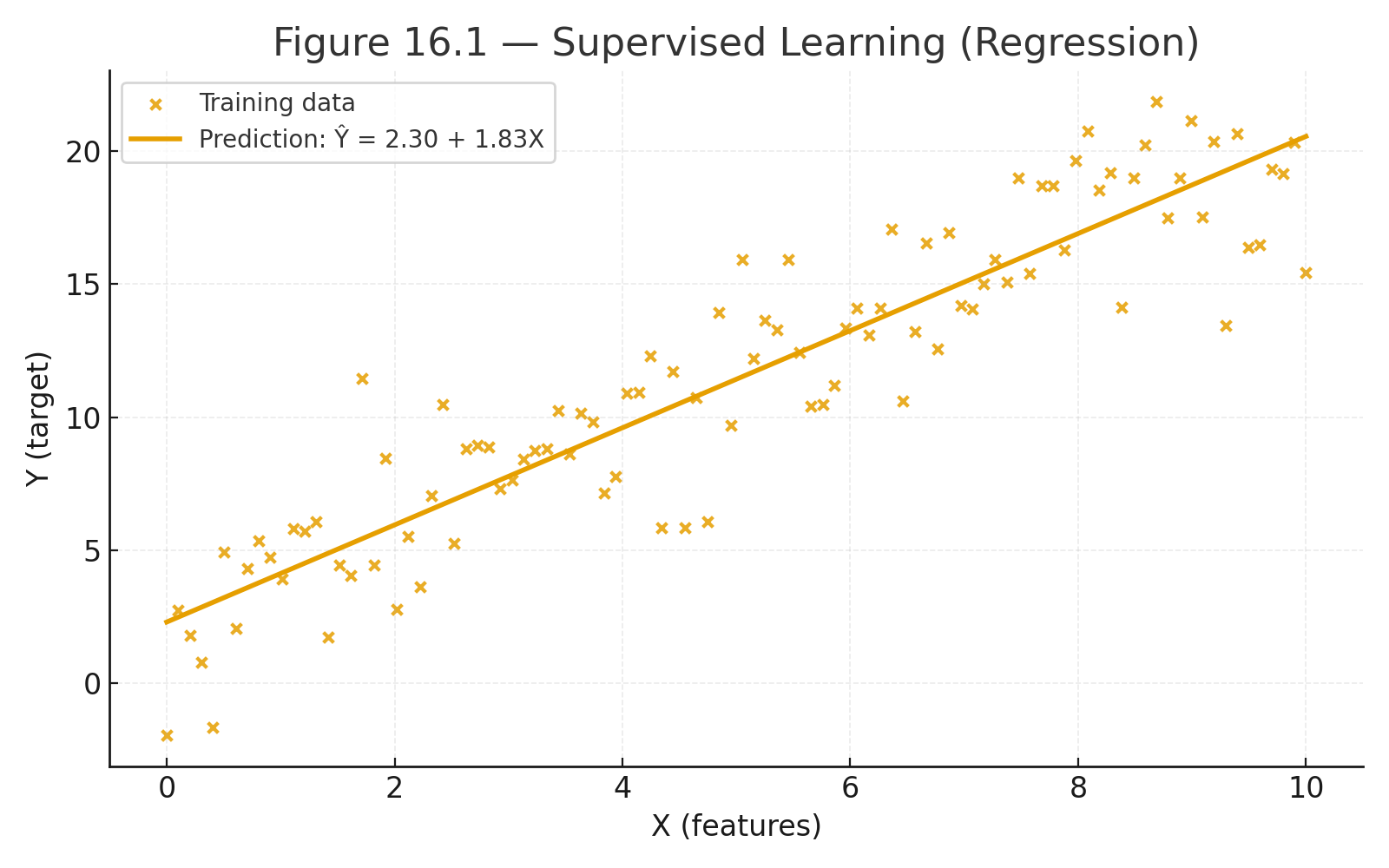
Goal: predict Y from X.
Examples:
- Predict exam scores from study hours
- Predict house price from size, location, and age
Steps:
- Split data into training set and test set
- Train the model on training data
- Test accuracy on new (unseen) data
Formula (simple linear regression as machine learning):
$$\hat{Y} = a + bX$$
Here, the computer “learns” $$a$$ and $$b$$ from the data.
Unsupervised Learning
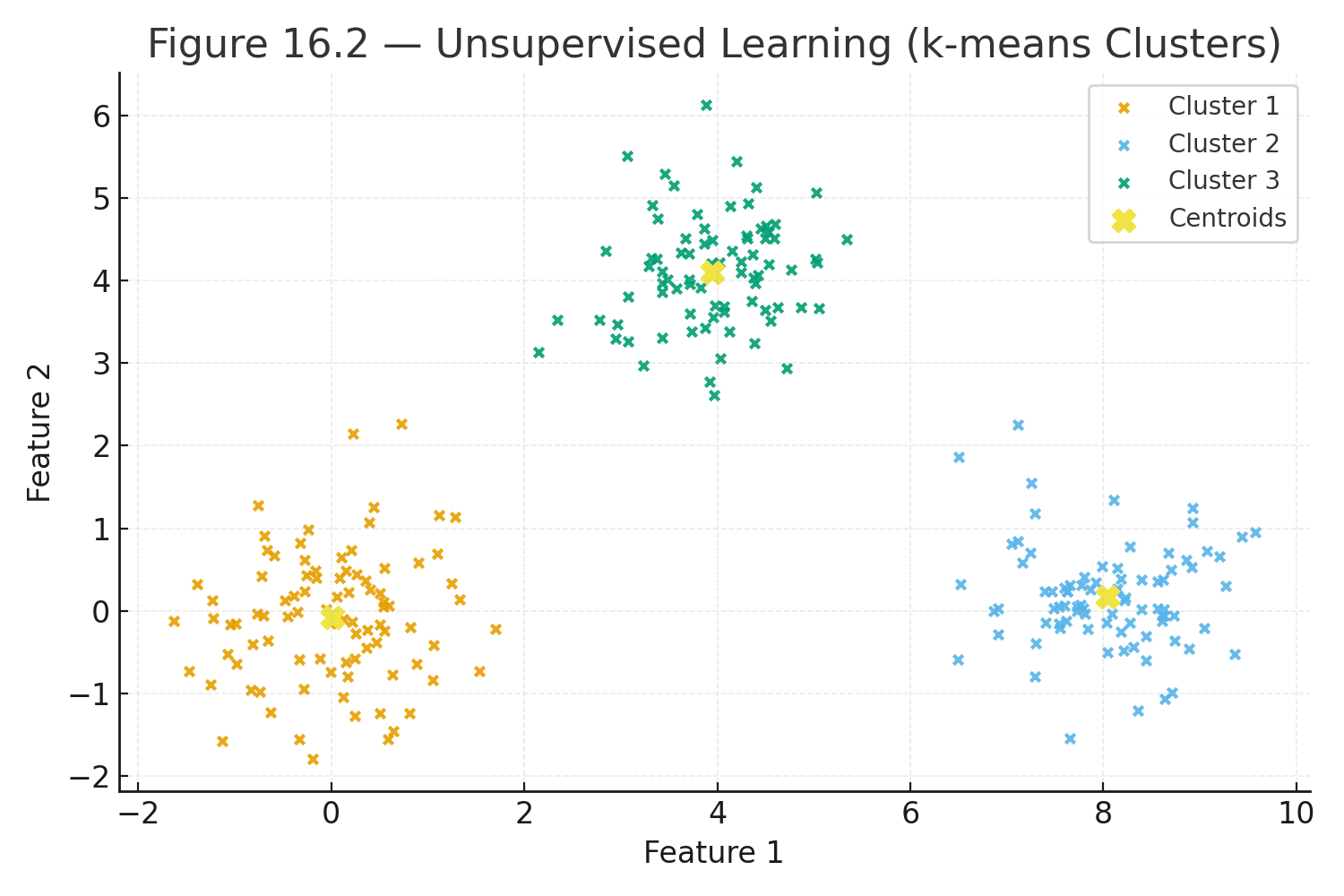
Goal: find hidden structure in the data.
Examples:
- Group students by study habits
- Cluster shoppers by buying patterns
Algorithms:
- k-means clustering
- Hierarchical clustering
No “correct answer” is given — the computer organizes the data.
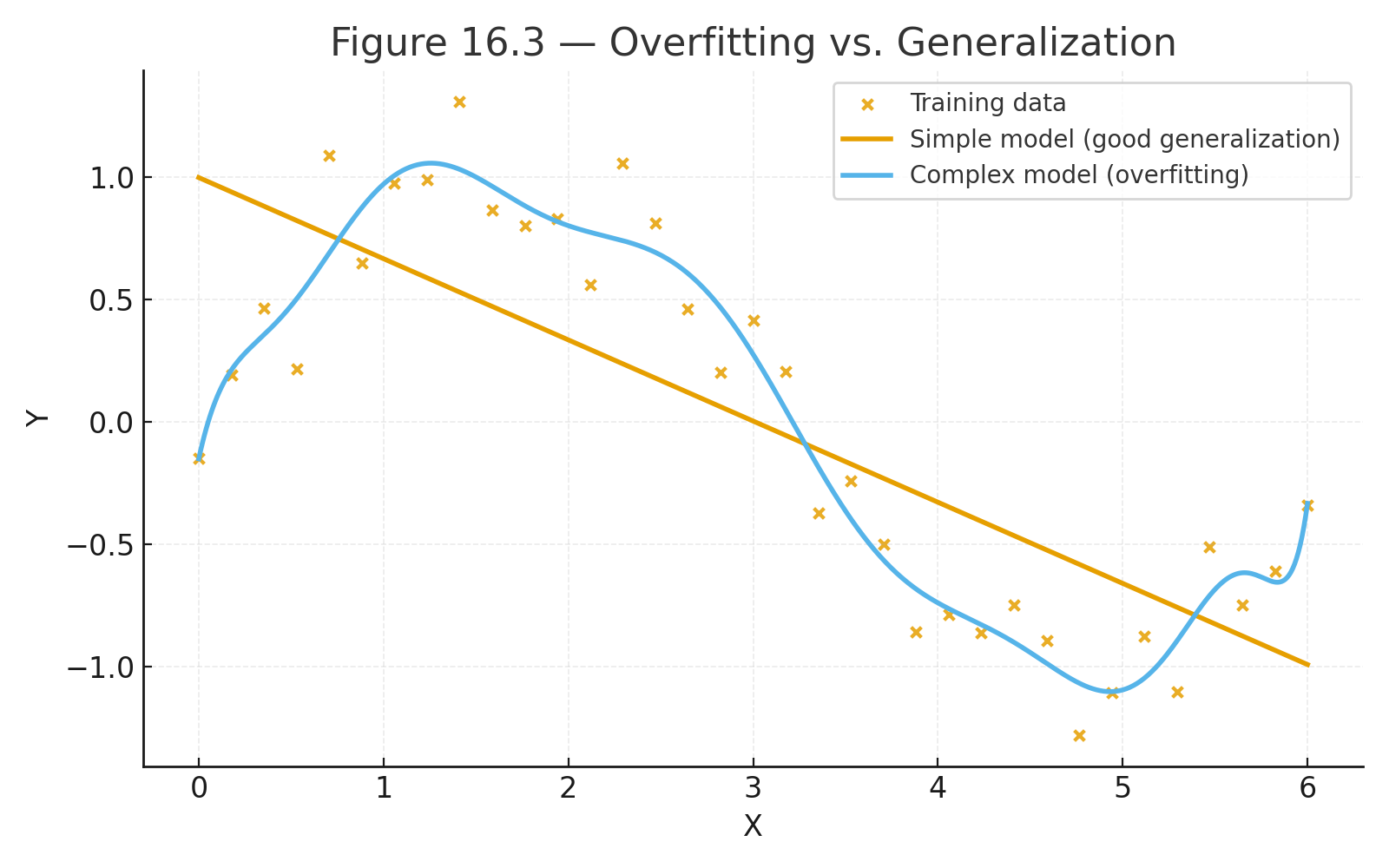
Overfitting vs. Generalization
- Overfitting: the model memorizes the training data but fails on new data.
- Generalization: the model captures the underlying pattern and works on new data.
Example:
If a student memorizes past exam answers (overfit), they may fail a new test.
If they learn the concepts (generalize), they succeed.
Key Concepts
- Training set: data used to build the model
- Test set: data used to evaluate performance
- Accuracy: how well the model predicts new data
Visuals
Figure 16.1 — Supervised learning example: regression line predicting Y from X.
Figure 16.2 — Unsupervised learning example: scatterplot with clusters (k-means).
Figure 16.3 — Overfitting vs. generalization: wiggly curve vs. smooth line.
Why This Matters
Machine learning grows directly out of statistics:
- Regression → prediction
- ANOVA → group classification
- Clustering → organizing data
By learning the basics of ML, students see how statistics powers AI.
Practice self-test quiz
In the space below, please find practice problems and self-test quizzes. For full access, please signup free.