Statistics 2nd ed

standardization

Appendix 4 — Using the z-table
Using the z-table
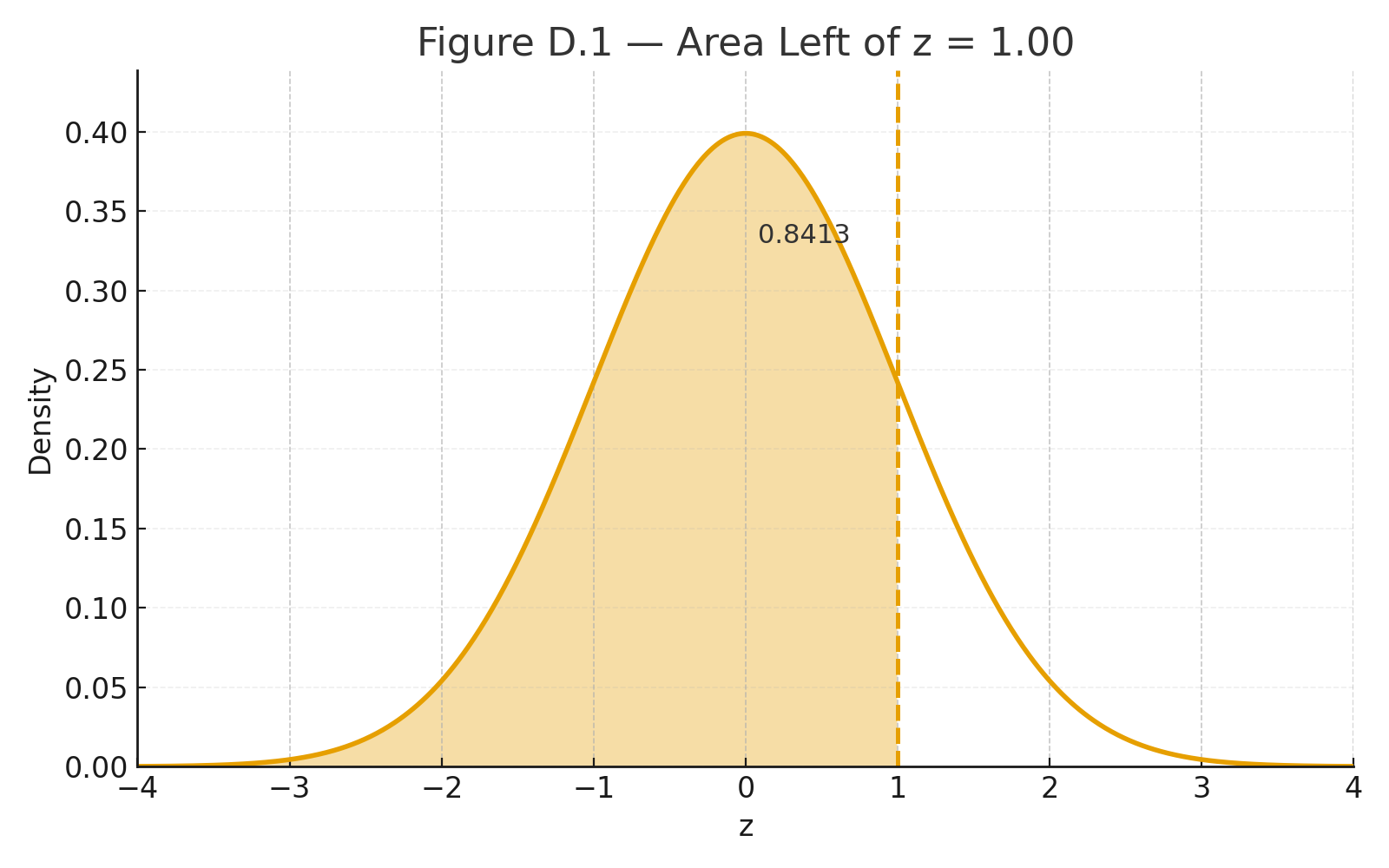
Area Left of z = 1.00
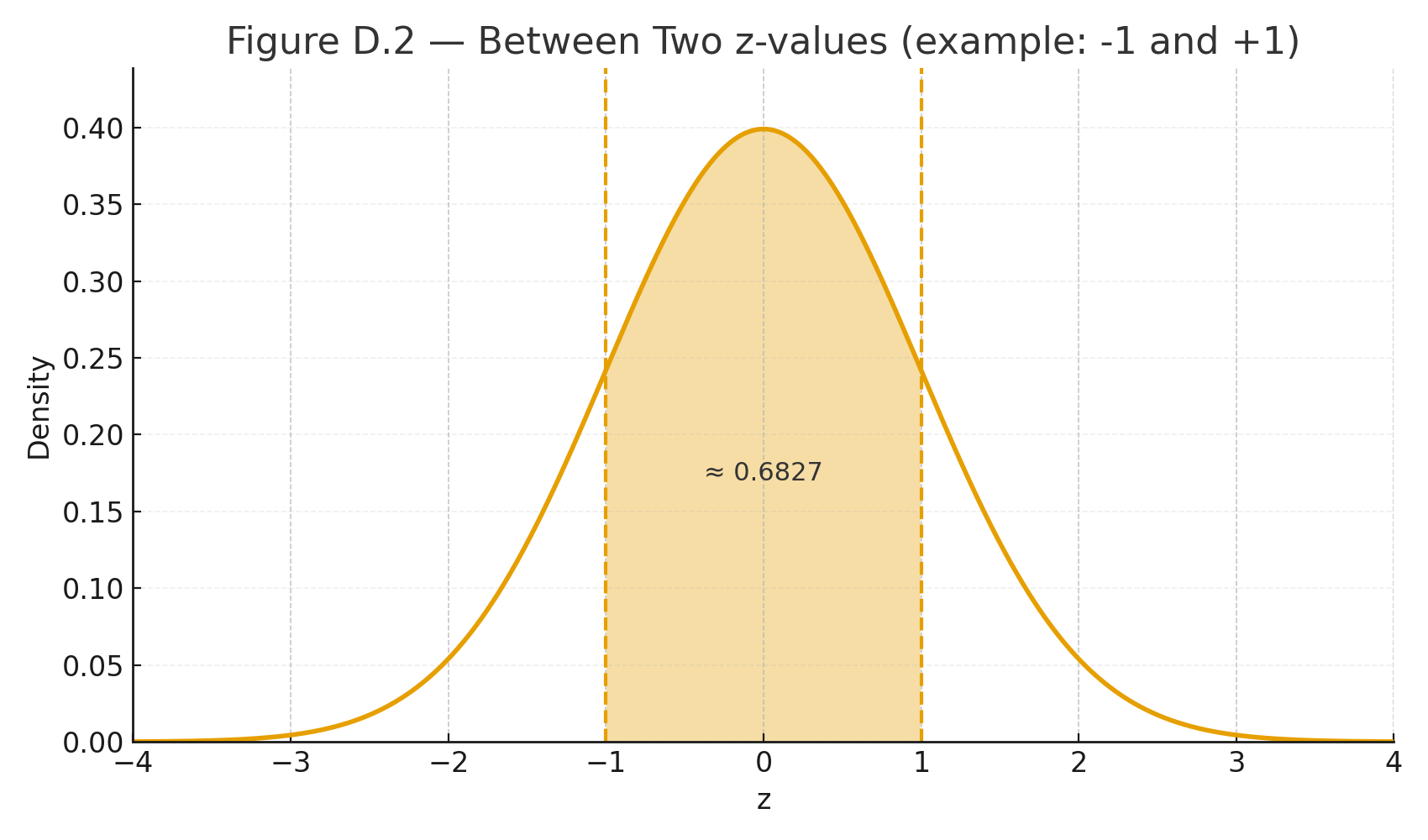
area Between Two z-values

The z-table gives areas (probabilities) under the standard normal curve (mean $$\mu=0$$, SD $$\sigma=1$$).
Use it after you standardize a score:

Standardization (z-score):
$$z=\frac{x-\mu}{\sigma}$$
In words: $$z=\frac{\text{score} - \text{mean}}{\text{standard deviation}}$$


What the z-table shows

Most tables list the area to the left of a z value (cumulative probability).

  • Left area at $$z=0$$ is 0.5000 (half the curve).
  • Far left (negative big z) approaches 0; far right (positive big z) approaches 1.

Quick recipes

1) Probability below a score (left tail)
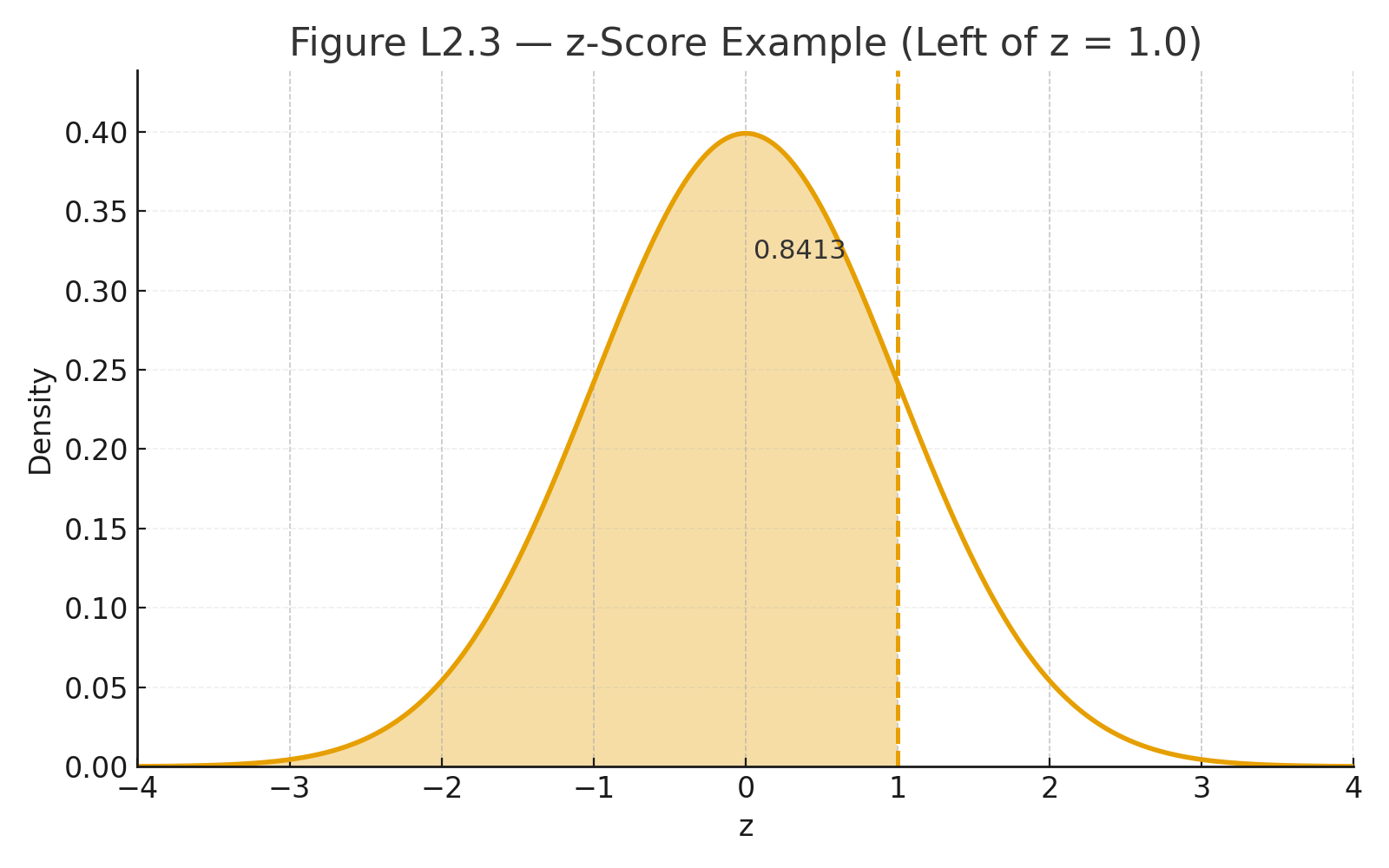
Example: $$z=1.00$$ → table gives 0.8413.
Interpretation: $$P(Z \le 1.00)=0.8413$$ (84.13% below).

2) Probability above a score (right tail)
Use complement: $$P(Z \ge z)=1-\text{left area}$$.
Example: $$z=1.00 \Rightarrow P(Z \ge 1.00)=1-0.8413=0.1587.$$

3) Probability between two scores
Subtract left areas.
Example: between $$z= -0.50$$ (left area 0.3085) and $$z=1.20$$ (0.8849):
$$P(-0.50 \le Z \le 1.20)=0.8849-0.3085=0.5764.$$

4) From a raw score to probability
Test scores: $$\mu=100, \ \sigma=15$$. What % are below 115?
Standardize: $$z=\frac{115-100}{15}=1.00 \Rightarrow 0.8413 \ (\text{84.13%}).$$

5) From probability to raw score (percentile)
What score is the 90th percentile?
Find z with left area ≈ 0.9000 → $$z \approx 1.2816$$.
Convert back: $$x=\mu+z\sigma=100+(1.2816)(15)=119.22.$$


Tips

  • For negative z, use the table’s symmetry: left area at $$-z$$ equals 1 − left area at $$+z$$.
  • Rounding: two decimals is common (e.g., 1.23).
  • Modern tools (calculator/Sheets/Python) can give exact p-values directly.

Visuals

Figure D.1 — Normal curve with area left of z = 1.00 shaded (0.8413).
Figure D.2 — Two-z shaded band for “between” probability.


📱 QR: Online z-calculator (type z or x, get areas instantly)

Practice self-test quiz

In the space below, please find practice problems and self-test quizzes. For full access, please signup free.
Lecture 2 — The Goddess Normal Curve

normal curve
normal curvre 68 95
z score 1.0

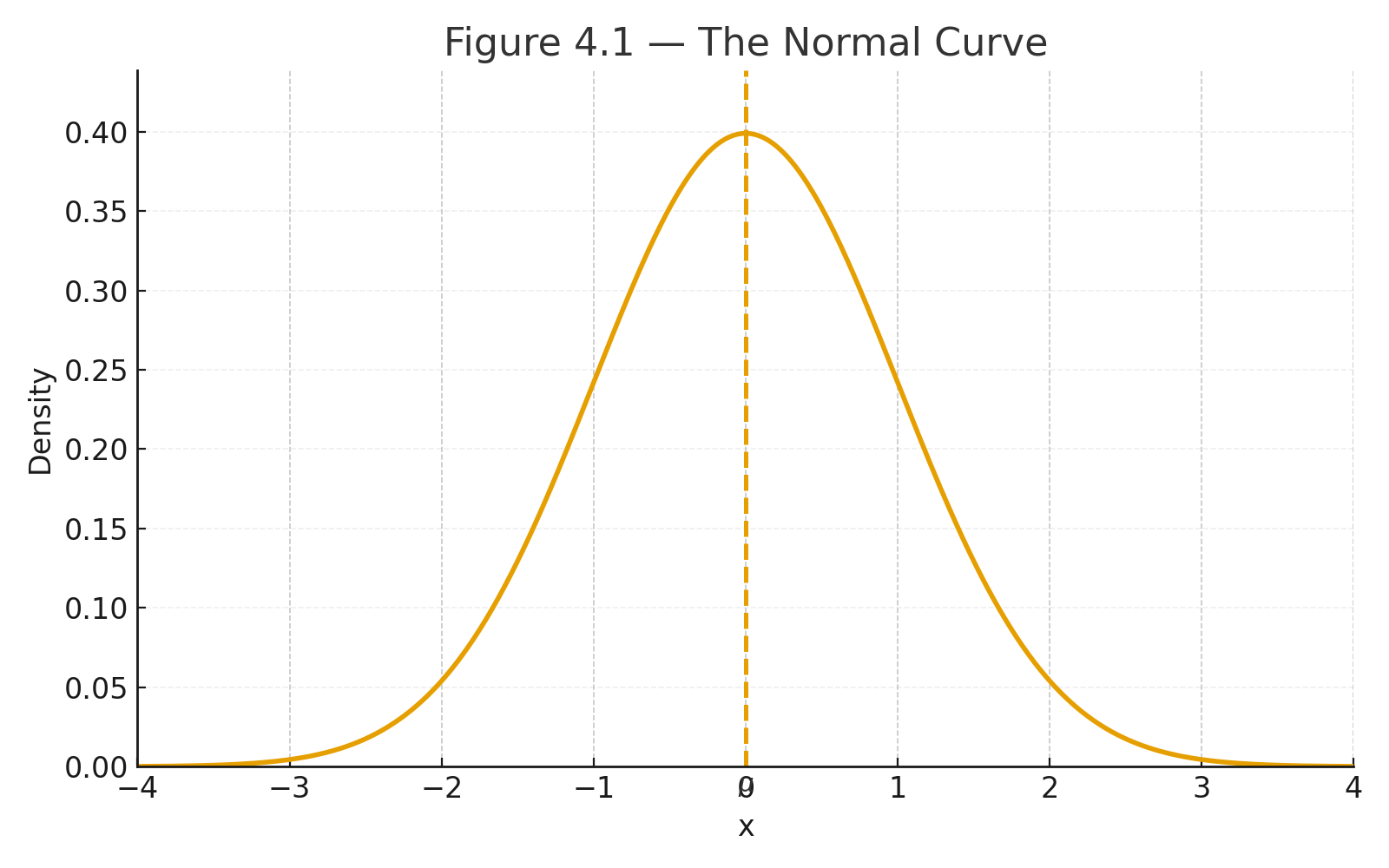
The normal curve (bell curve) is one of the most important concepts in statistics.
It is elegant, symmetrical, and central to probability and inference.
It appears whenever many small, independent factors combine: height, exam scores, measurement errors.


Properties of the Normal Curve

  1. Symmetrical around the mean
  2. One peak (unimodal)
  3. Mean = Median = Mode
  4. Total area under the curve = 1 (100%)

Formula for the Normal Distribution

Symbolic formula:
$$f(x) = \frac{1}{\sigma \sqrt{2\pi}} e^{-\frac{(x - \mu)^2}{2\sigma^2}}$$

Formula in words:
$$\text{Probability density} = \frac{1}{\text{standard deviation} \times \sqrt{2\pi}} \times e^{-\frac{(\text{score} - \text{mean})^2}{2 \times (\text{standard deviation})^2}}$$

Where:

  • $$\mu$$ = mean
  • $$\sigma$$ = standard deviation
  • $$x$$ = a score

Standardization (z-scores)

Symbolic formula:
$$z = \frac{x - \mu}{\sigma}$$

Formula in words:
$$z = \frac{\text{score} - \text{mean}}{\text{standard deviation}}$$

A z-score tells us how many standard deviations a score is above or below the mean.


Key Percentages

Under the normal curve:

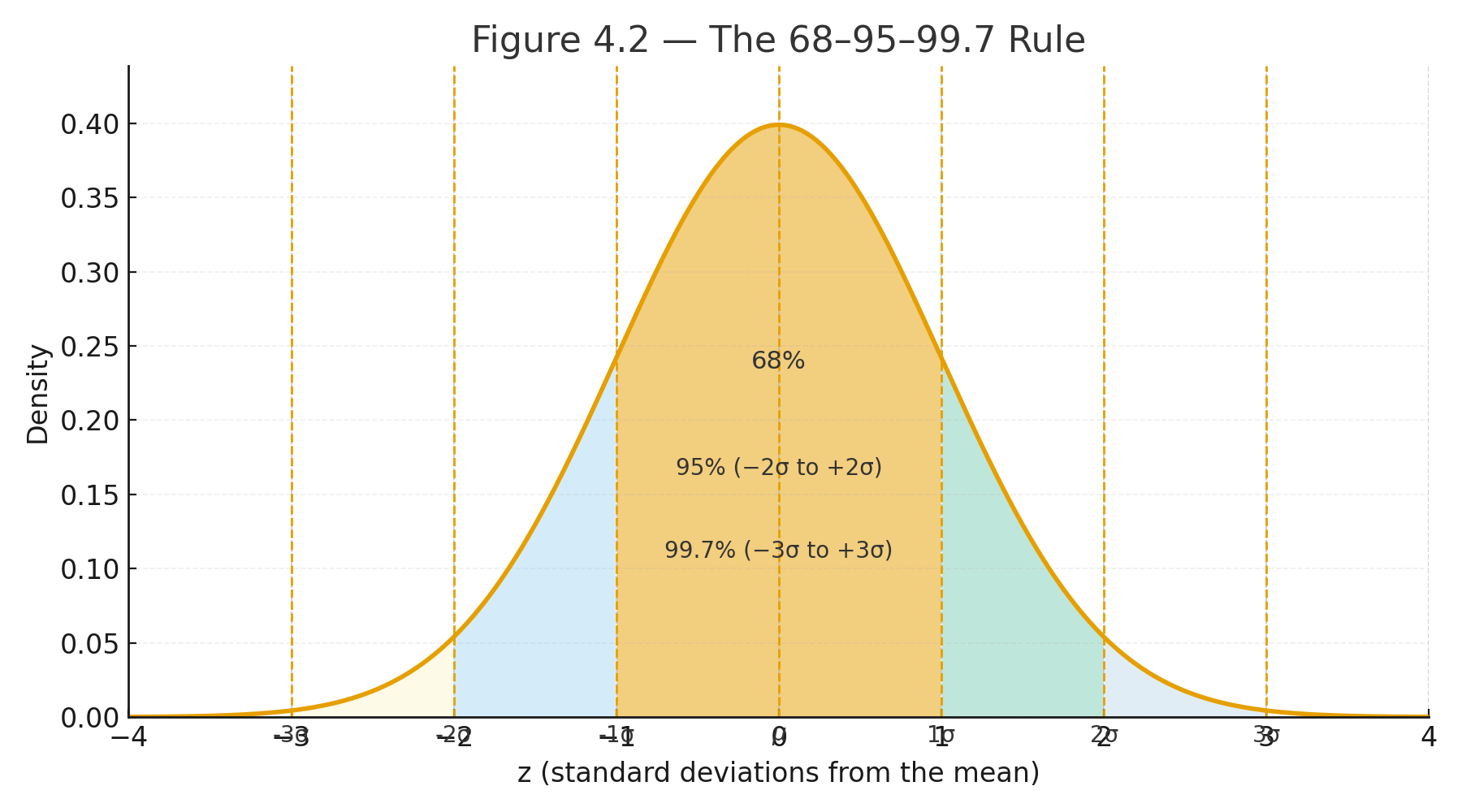
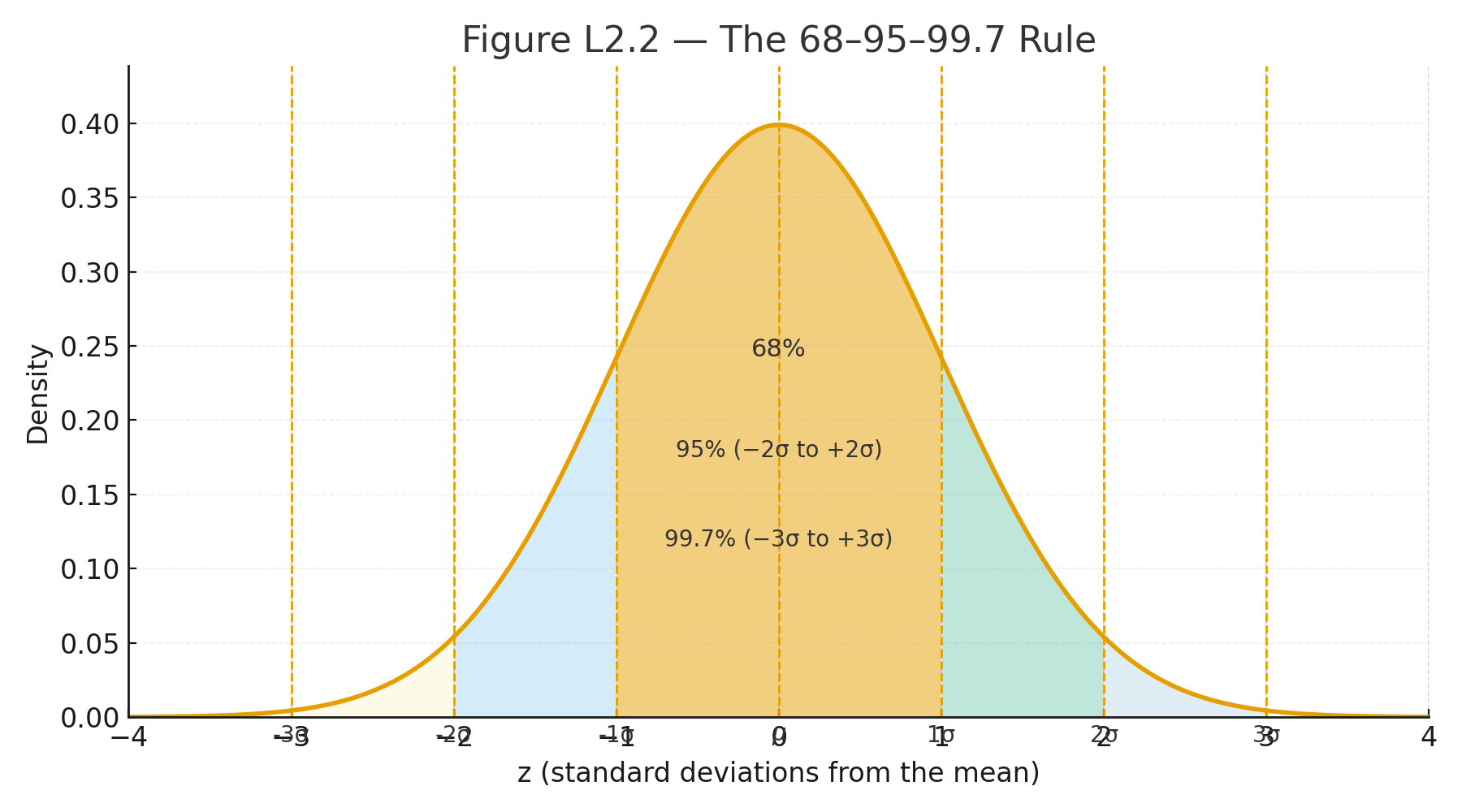
  • About 68% of scores are within 1 standard deviation of the mean
  • About 95% are within 2 standard deviations
  • About 99.7% are within 3 standard deviations

This is called the 68–95–99.7 rule.


Drama Box — “The Goddess Normal Curve”

Imagine a temple where a perfect curve stands tall — balanced and symmetrical.

  • At the center is the mean, the balance point.
  • Half of the people (data) stand on each side.
  • As you move further away, fewer remain.
  • The Goddess teaches fairness: most scores are near the center, extreme scores are rare.

This image helps students remember the normal curve not as a dry formula, but as a principle of balance and probability.


Visuals

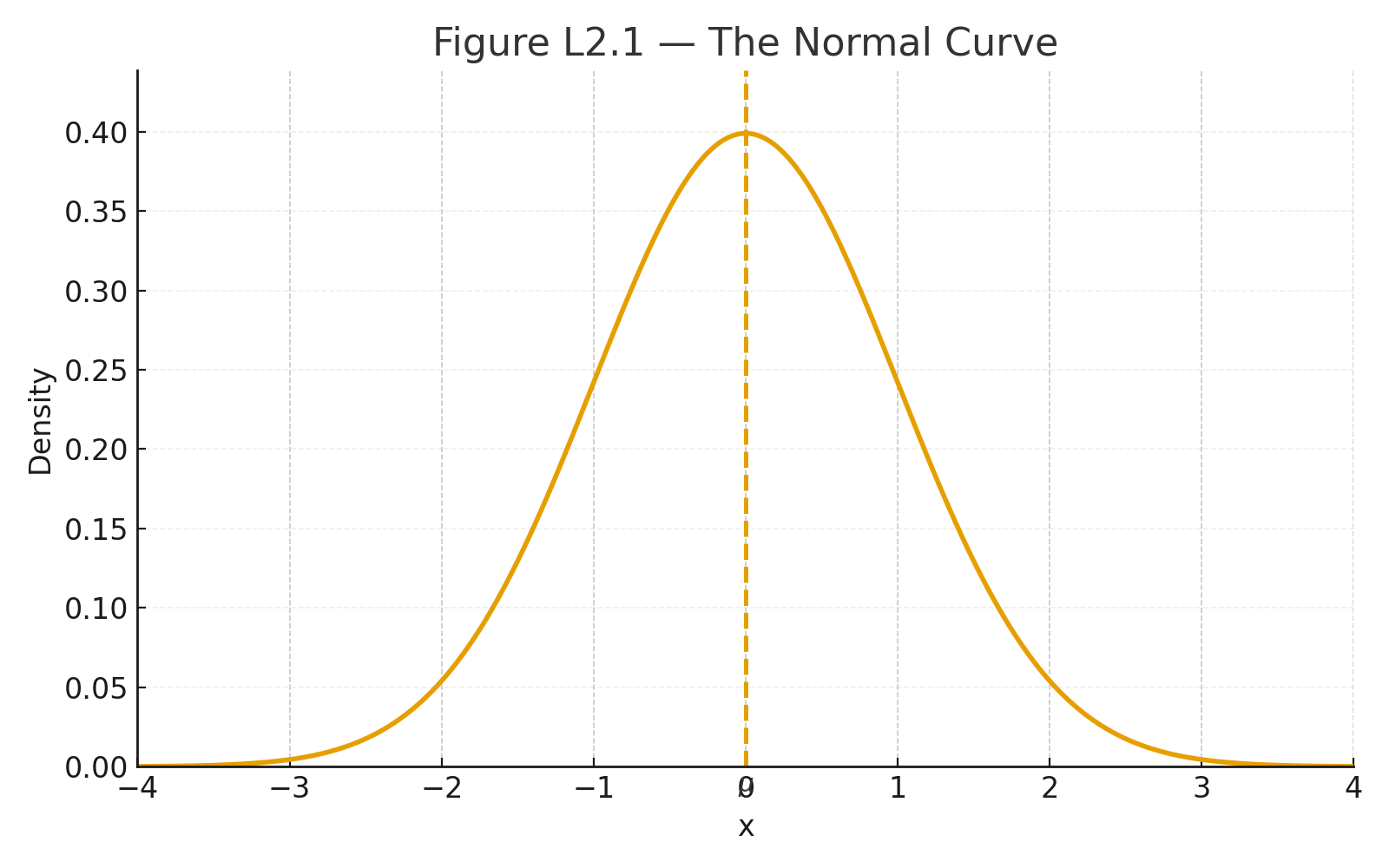
Figure L2.1 — The Normal Curve. Bell-shaped curve centered at the mean (μ).

Figure L2.2 — The 68–95–99.7 Rule. Normal curve with shaded regions ±1σ, ±2σ, ±3σ.

Figure L2.3 — z-score Example. Normal curve with shaded area to the left of z = 1.0, labeled 0.8413.


Why This Matters

The normal curve is the foundation of inferential statistics.

  • It allows us to calculate probabilities.
  • It underlies t-tests, ANOVAs, and confidence intervals.
  • It lets us compare scores across different tests and scales.

Practice self-test quiz

In the space below, please find practice problems and self-test quizzes. For full access, please signup free.
Lesson 4 — The Standard Normal Curve

z score
The normal curve. The 68 95 99 rule
The normal curve

The normal curve (bell curve) is one of the most important shapes in statistics. It appears when many small, independent factors combine: height, test scores, measurement errors.

For a simple, intuitive presentation go to Part 2


Properties of the Normal Curve

  1. Symmetrical around the mean
  2. Unimodal (one peak)
  3. Mean = Median = Mode
  4. The total area under the curve = 1 (or 100%)

Formula for the Normal Distribution

Unless you are in Mathematical Statistics, you will never be asked to reproduce it, or otherwise work with it.

Symbolic formula:
$$f(x) = \frac{1}{\sigma \sqrt{2\pi}} e^{-\frac{(x - \mu)^2}{2\sigma^2}}$$

Formula in words:
$$\text{Probability density} = \frac{1}{\text{standard deviation} \times \sqrt{2\pi}} \times e^{-\frac{(\text{score} - \text{mean})^2}{2 \times (\text{standard deviation})^2}}$$

Where:

  • $$\mu$$ = mean
  • $$\sigma$$ = standard deviation
  • $$x$$ = a value on the curve

Standardization (z-scores)

Symbolic formula:
$$z = \frac{x - \mu}{\sigma}$$

Formula in words:
$$z = \frac{\text{score} - \text{mean}}{\text{standard deviation}}$$

A z-score tells us how many standard deviations a score is above or below the mean.


Key Percentages

Under the normal curve:

  • About 68% of scores are within 1 standard deviation of the mean
  • About 95% are within 2 standard deviations
  • About 99.7% are within 3 standard deviations

This is called the 68–95–99.7 rule.


Example

Suppose test scores are normally distributed with

  • $$\mu = 100$$
  • $$\sigma = 15$$

What is the z-score for a student who scored 115?

$$z = \frac{115 - 100}{15} = \frac{15}{15} = 1$$

This means the student is 1 standard deviation above the mean.


Visuals

Figure 4.1 — The Normal Curve. A bell-shaped curve centered at the mean (μ).

Figure 4.2 — The 68–95–99.7 Rule. A normal curve with shaded regions for ±1σ, ±2σ, ±3σ.

Figure 4.3 — z-Score Example. Normal curve with shaded area to the left of z = 1.0, labeled 0.8413.


Why This Matters

The normal curve is the foundation of inferential statistics.

  • It allows us to compute probabilities.
  • It underlies the t-test, ANOVA, and confidence intervals.
  • By using z-scores, we can compare scores across different tests and distributions.

Practice self-test quiz

In the space below, please find practice problems and self-test quizzes. For full access, please signup free.