Statistics 2nd ed

repeated-measures-anova

Repeated-Measures ANOVA
rm profile
rm sem
rm partitioning var
f distrib
rm sphericity

Goal. Test whether performance changes across four conditions measured on the same participants.

Design & Experiment

  • Within-subjects factor: Condition with 4 levels (C1, C2, C3, C4).
  • s = 8 participants measured in k = 4 conditions ⇒ total observations \(N = s \times k = 32\).
  • Example context: the same students take four weekly quizzes after different study activities.

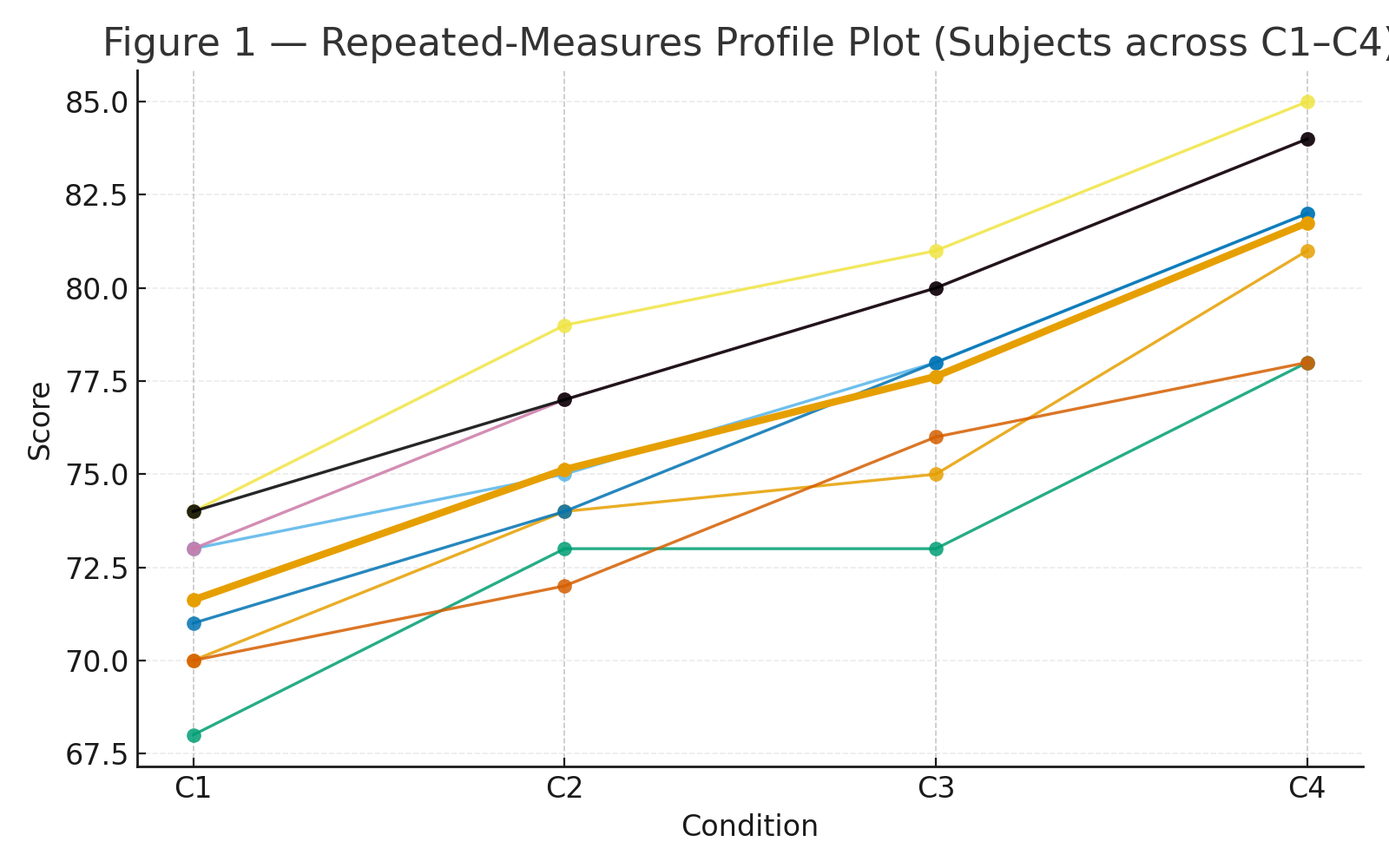
Figure 1: Profile plot (each subject as a line across the four conditions).


Data

Scores (rows = participants S1–S8; columns = conditions C1–C4):

SubjectC1C2C3C4Row sumRow mean
S17074758130075.00
S27375788230877.00
S36873737829273.00
S47479818531979.75
S57174788230576.25
S67072767829674.00
S77377808431478.50
S87477808431578.75
Column sums573601621654Grand sum = 2449Grand mean \( \bar X = 2449/32 = 76.53125 \)

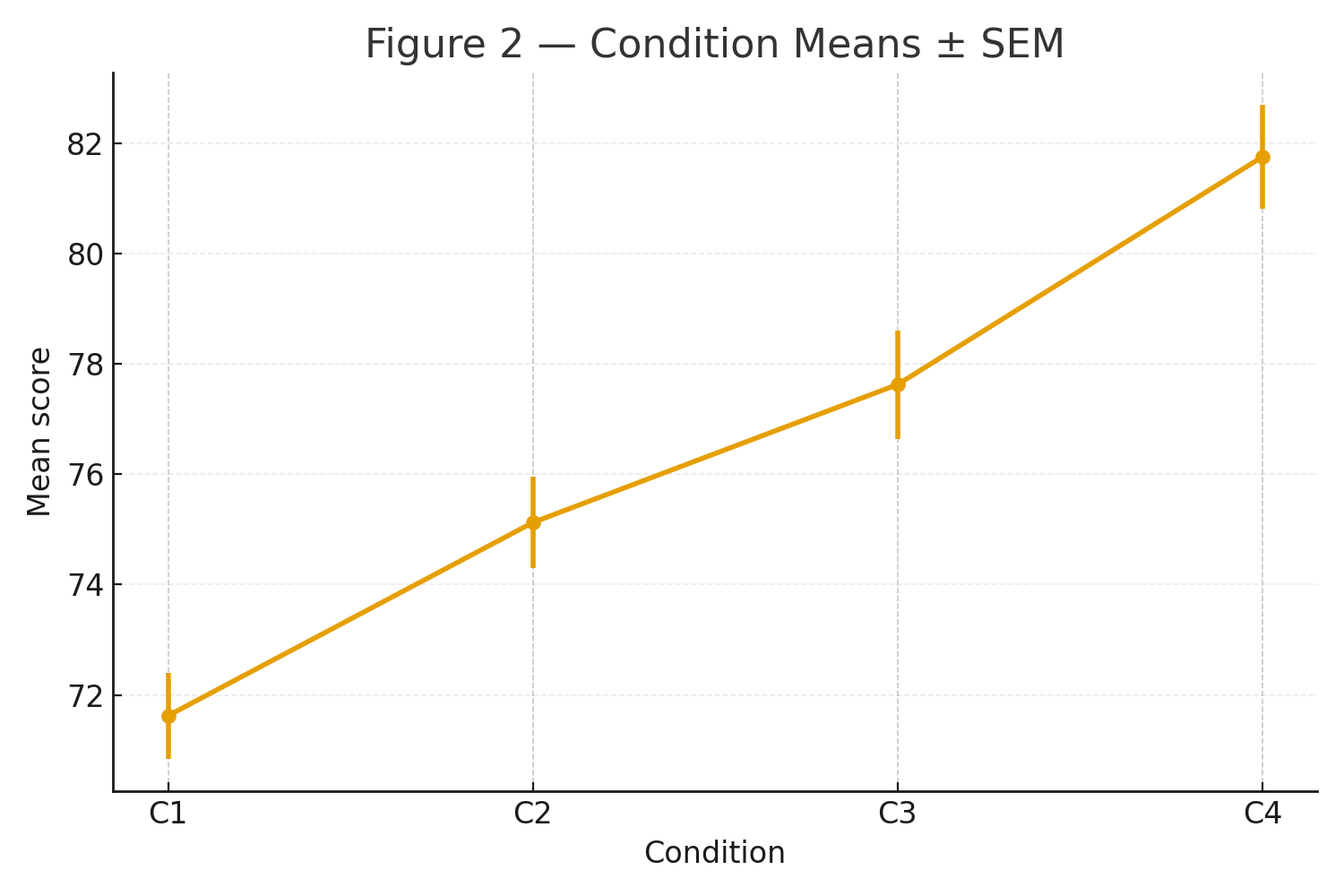
Figure 2: Means ± SEM for C1–C4 (bar/line).


Step 1 — Condition Means (and sample variances)

\[ \begin{aligned} \bar X_{\mathrm{C1}} &= 573/8 = 71.625, \quad & s^2_{\mathrm{C1}} &= 4.8393 \\ \bar X_{\mathrm{C2}} &= 601/8 = 75.125, \quad & s^2_{\mathrm{C2}} &= 5.5536 \\ \bar X_{\mathrm{C3}} &= 621/8 = 77.625, \quad & s^2_{\mathrm{C3}} &= 7.6964 \\ \bar X_{\mathrm{C4}} &= 654/8 = 81.750, \quad & s^2_{\mathrm{C4}} &= 7.0714 \end{aligned} \]


Step 2 — Sums of Squares

Notation: \(s=8\) subjects, \(k=4\) conditions, grand mean \( \bar X = 76.53125\).

2A. Total

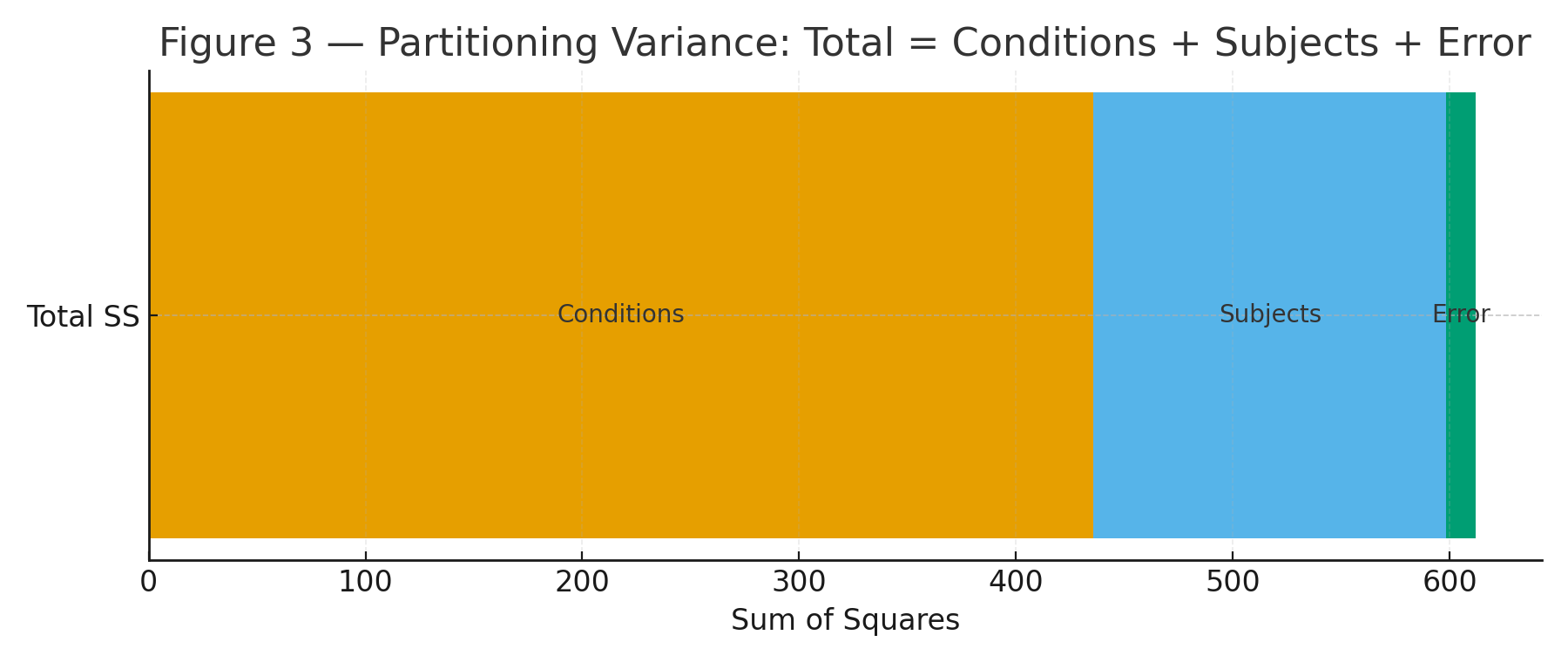
\[ SS_{\text{total}}=\sum_{i=1}^{s}\sum_{j=1}^{k}\bigl(X_{ij}-\bar X\bigr)^2 =\mathbf{611.96875}. \]

2B. Conditions (Treatment)

\[ SS_{\text{cond}}= s \sum_{j=1}^{k}\bigl(\bar X_{\cdot j}-\bar X\bigr)^2 = 8 \left[(71.625-76.53125)^2 + (75.125-76.53125)^2 + (77.625-76.53125)^2 + (81.75-76.53125)^2\right] =\mathbf{435.84375}. \]

2C. Subjects

\[ SS_{\text{subj}}= k \sum_{i=1}^{s}\bigl(\bar X_{i\cdot}-\bar X\bigr)^2 = 4 \sum_{i=1}^{8}\bigl(\bar X_{i\cdot}-76.53125\bigr)^2 =\mathbf{162.71875}. \]

2D. Error (Residual)

\[ SS_{\text{error}}= SS_{\text{total}} - SS_{\text{cond}} - SS_{\text{subj}} = 611.96875 - 435.84375 - 162.71875 =\mathbf{13.40625}. \]

Figure 3: Partitioning variance diagram (Total → Conditions + Subjects + Error).


Step 3 — Degrees of Freedom & Mean Squares

\[ \begin{aligned} df_{\text{cond}} &= k-1 = 3, \\ df_{\text{subj}} &= s-1 = 7, \\ df_{\text{error}} &= (s-1)(k-1) = 7\times3 = 21, \\ df_{\text{total}} &= sk-1 = 31. \end{aligned} \]

\[ MS_{\text{cond}} = \frac{SS_{\text{cond}}}{df_{\text{cond}}} =\frac{435.84375}{3}=\mathbf{145.28125},\qquad MS_{\text{error}} = \frac{SS_{\text{error}}}{df_{\text{error}}} =\frac{13.40625}{21}=\mathbf{0.6383928571}. \]


Step 4 — Test Statistic & p-value

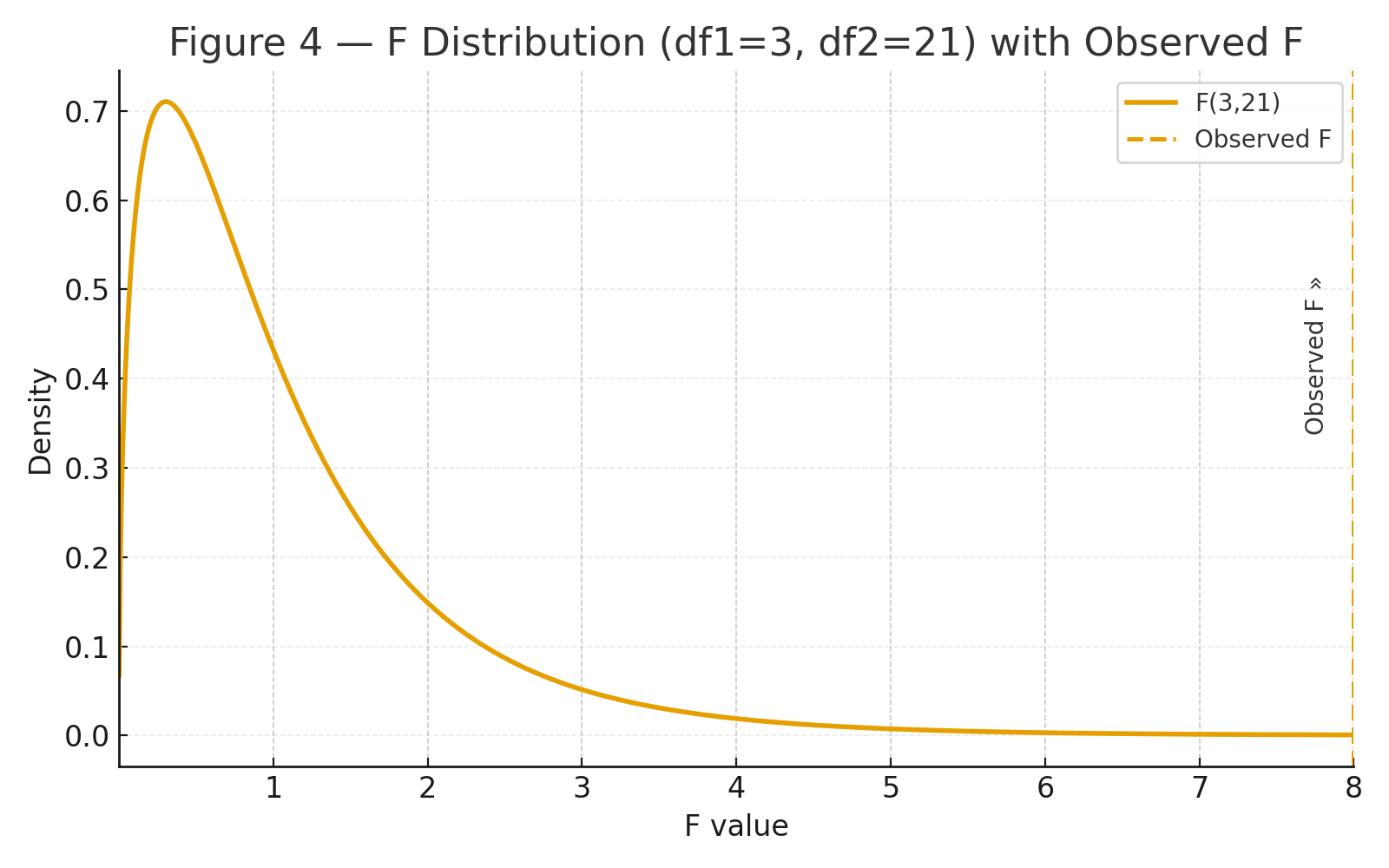
\[ F = \frac{MS_{\text{cond}}}{MS_{\text{error}}} = \frac{145.28125}{0.6383928571} =\mathbf{227.5734}. \] With \(df_1=3\) and \(df_2=21\), this is extremely large. The right-tail p-value is effectively \(p \lt 10^{-12}\) (i.e., \(p \ll .001\)).

Figure 4: F distribution with observed F marked and right-tail region shaded.


Repeated-Measures ANOVA Summary Table
SourceSSdfMSFp
Conditions (within)435.843753145.28125227.5734< 1e-12
Subjects162.71875723.24554
Error (residual)13.40625210.63839
Total611.9687531

Interpretation

Mean performance increases steadily from C1 → C4, and the repeated-measures ANOVA shows a highly significant effect of Condition, \(F(3,21)=227.57,\, p\ll .001\). Follow-ups (e.g., paired t-tests with Bonferroni/Holm) can localize which pairs of conditions differ.

Assumptions (checklist)

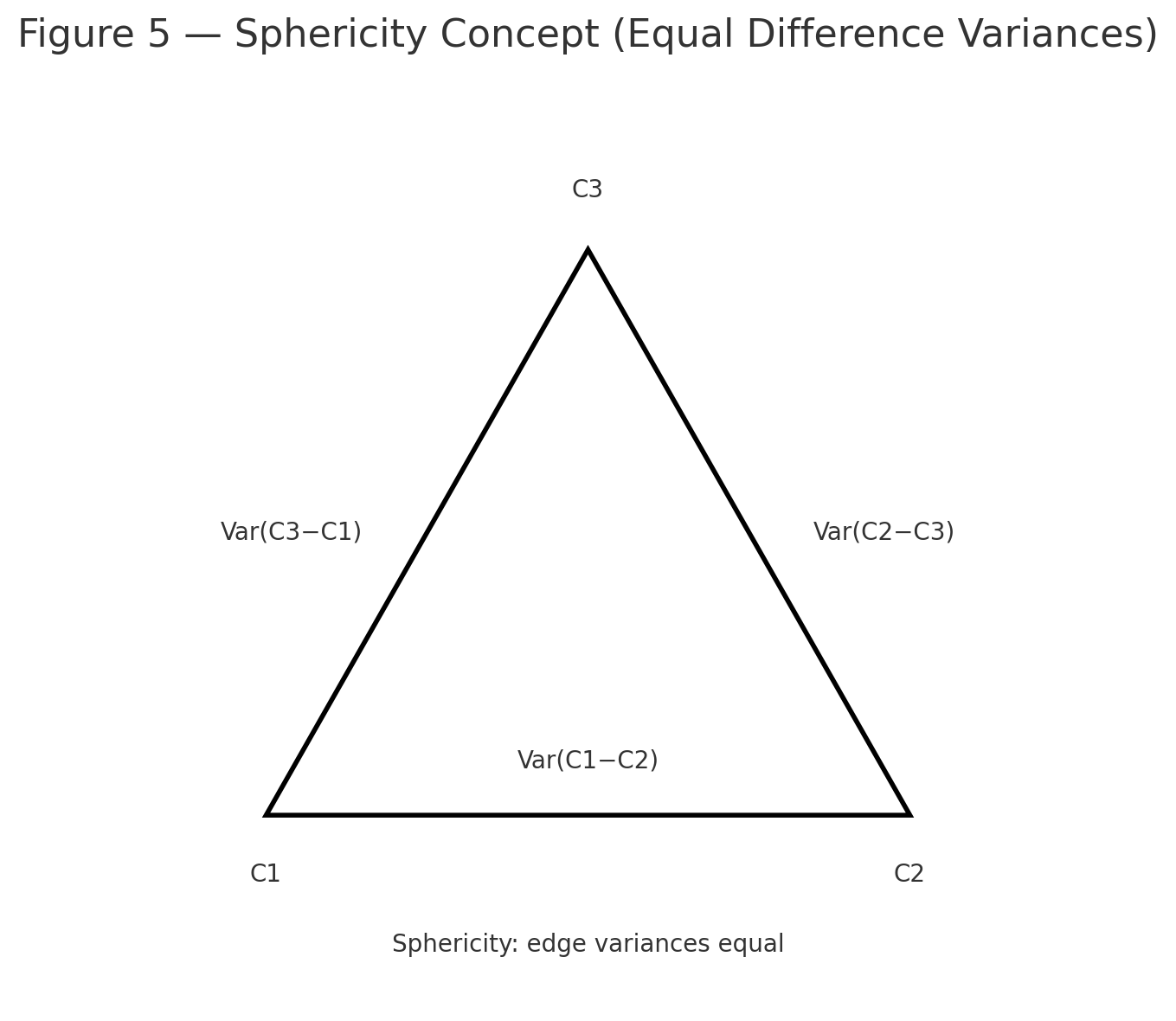
  • Sphericity (equal variances of the differences between condition pairs). If violated, apply Greenhouse–Geisser or Huynh–Feldt correction to \(df\).
  • Approximately normal scores within each condition.
  • No carryover/fatigue effects that confound order (counterbalancing helps).

Figure 5: Sphericity concept sketch (pairwise difference variances).

Practice self-test quiz

In the space below, please find practice problems and self-test quizzes. For full access, please signup free.

Lesson 13 — Degrees of Freedom Cookbook

Every statistical test requires degrees of freedom (df).
Degrees of freedom tell us how many independent pieces of information are available once totals or means are fixed.
They determine which row of the t-table or F-table we use.

General rule:

$$df = \text{number of observations} - \text{number of constraints}$$


t-tests

  • One-sample t-test:
    $$df = n - 1$$
  • Independent-samples t-test:
    $$df = n_1 + n_2 - 2$$
  • Paired-samples t-test:
    $$df = n - 1$$

One-way ANOVA

  • Between groups:
    $$df_{\text{between}} = k - 1$$
  • Within groups:
    $$df_{\text{within}} = N - k$$
  • Total:
    $$df_{\text{total}} = N - 1$$

Where $$k$$ = number of groups, $$N$$ = total number of scores.


Factorial ANOVA (2 × 2 Example)

  • Factor A: $$df_A = a - 1$$
  • Factor B: $$df_B = b - 1$$
  • Interaction: $$df_{A \times B} = (a-1)(b-1)$$
  • Error: $$df_{\text{within}} = N - ab$$

Repeated-Measures ANOVA
  • Rows (subjects): $$df_{\text{rows}} = n - 1$$
  • Columns (conditions): $$df_{\text{columns}} = k - 1$$
  • Error: $$df_{\text{error}} = (n - 1)(k - 1)$$

Where $$n$$ = number of subjects, $$k$$ = number of conditions.


Mixed (Split-Plot) ANOVA

  • Between factor: $$df_{\text{between}} = a - 1$$
  • Subjects within groups: $$df_{\text{subjects}} = N - a$$
  • Within factor: $$df_{\text{within}} = b - 1$$
  • Interaction: $$df_{A \times B} = (a-1)(b-1)$$

Chi-square

  • Goodness-of-fit: $$df = k - 1$$
  • Independence: $$df = (r - 1)(c - 1)$$

Where $$k$$ = number of categories, $$r$$ = rows, $$c$$ = columns.


Visuals

Degrees of Freedom — Quick Cookbook
Test / Designdf formulaNotes
One-sample t-test\( df = n - 1 \)Single group vs. constant.
Independent-samples t-test\( df = n_1 + n_2 - 2 \)Equal-variance (pooled) case.
Paired-samples t-test\( df = n - 1 \)Based on the \( n \) differences.
One-way ANOVA — Between\( df_{\text{between}} = k - 1 \)\( k \) groups.
One-way ANOVA — Within (Error)\( df_{\text{within}} = N - k \)\( N \) total scores.
One-way ANOVA — Total\( df_{\text{total}} = N - 1 \)Sum of between + within df.
Factorial ANOVA — Factor A\( df_A = a - 1 \)\( a \) levels of A.
Factorial ANOVA — Factor B\( df_B = b - 1 \)\( b \) levels of B.
Factorial ANOVA — Interaction\( df_{A\times B} = (a-1)(b-1) \)Interaction A×B.
Factorial ANOVA — Error (Within)\( df_{\text{within}} = N - ab \)\( ab \) cells total.
Repeated-measures ANOVA — Subjects (Rows)\( df_{\text{rows}} = n - 1 \)\( n \) subjects.
Repeated-measures ANOVA — Conditions (Columns)\( df_{\text{columns}} = k - 1 \)\( k \) conditions.
Repeated-measures ANOVA — Error\( df_{\text{error}} = (n - 1)(k - 1) \)Subjects × conditions.
Mixed (Split-Plot) ANOVA — Between factor\( df_{\text{between}} = a - 1 \)\( a \) groups (between-subjects).
Mixed (Split-Plot) ANOVA — Subjects within groups\( df_{\text{subjects}} = N - a \)\( N \) subjects total.
Mixed (Split-Plot) ANOVA — Within factor\( df_{\text{within}} = b - 1 \)\( b \) repeated levels.
Mixed (Split-Plot) ANOVA — Interaction\( df_{A\times B} = (a-1)(b-1) \)Between × within.
Chi-square — Goodness-of-fit\( df = k - 1 \)\( k \) categories.
Chi-square — Independence\( df = (r - 1)(c - 1) \)\( r \) rows, \( c \) columns.

Variables: \( n \)=sample size, \( n_1,n_2 \)=group sizes, \( N \)=total scores, \( k \)=# of groups/conditions, \( a,b \)=levels of factors A,B, \( r,c \)=rows, columns.


Why This Matters

Degrees of freedom link sample size to critical values.
They tell us how much room for variability exists in the data.
With this quick cookbook, you can locate the right df for any test.

Practice self-test quiz

In the space below, please find practice problems and self-test quizzes. For full access, please signup free.

Part 5 — Statistical Tests (Cookbook Style)


Welcome to Part 5 — Statistical Tests (Cookbook Style) of this free online high school statistics textbook. This practical quick-reference section provides concise, cookbook-style guides to major parametric and non-parametric statistical tests, including detailed formulas, assumptions, degrees of freedom, step-by-step procedures, and real-world examples. High school students and teachers can quickly review when to use each test—perfect for AP Statistics exam preparation, homework help, or reinforcing concepts from earlier parts.

Ideal for quick lookups on ANOVA variants, non-parametric alternatives, and multi-group comparisons, Part 5 delivers clear explanations of one-way ANOVA, factorial ANOVA, repeated-measures ANOVA, mixed ANOVA, Mann-Whitney U, Wilcoxon, Kruskal-Wallis, and Friedman tests in an accessible format with worked examples.

Statistical Tests Covered in Part 5

  1. One-Way ANOVA – Comparing means across three or more independent groups, with formula, degrees of freedom, and example.
  2. Factorial ANOVA (Two-Way) – Analyzing main effects and interactions in 2×2 or larger designs, including df partition and example.
  3. Repeated-Measures ANOVA – Handling multiple measurements on the same subjects, with formula and example.
  4. Mixed (Split-Plot) ANOVA – Combining between-subjects and within-subjects factors, with formula and example.
  5. Mann-Whitney U Test – Non-parametric alternative for two independent samples, with formula and example.
  6. Wilcoxon Signed-Rank Test – Non-parametric option for paired or one-sample data, with procedure and example.
  7. Kruskal-Wallis Test – Non-parametric one-way ANOVA for three or more groups, with formula and example.
  8. Friedman Test – Non-parametric repeated-measures ANOVA, with formula and example.

A practice self-test quiz is available to test your understanding (optional signup for full interactive access). Use this free high school statistics resource as your go-to cookbook for statistical tests formulas, ANOVA examples, non-parametric tests guides, and quick reference during hypothesis testing!

One-way ANOVA

When to Use:

  • Compare means across 3 or more independent groups.
  • Interval/ratio data, groups independent, variances roughly equal.

Formula:
$$F = \frac{MS_{\text{between}}}{MS_{\text{within}}}$$

In words:
$$F = \frac{\text{mean square between groups}}{\text{mean square within groups}}$$

Example:
Three groups with means = 70, 75, 85.

  • $$SS_{\text{between}} = 300, , df_{\text{between}} = 2, , MS_{\text{between}} = 150$$
  • $$SS_{\text{within}} = 200, , df_{\text{within}} = 12, , MS_{\text{within}} = 16.7$$

$$F = \frac{150}{16.7} = 9.0, \quad df = (2, 12)$$


Factorial ANOVA (Two-way)

When to Use:

  • Two or more factors studied at once.
  • Tests main effects and interactions.

Formula (df partition):

  • $$df_A = a - 1, \quad df_B = b - 1$$
  • $$df_{A \times B} = (a-1)(b-1)$$
  • $$df_{\text{within}} = N - ab$$

Example:
2 × 2 design (Method: Lecture, Online × Time: Morning, Afternoon).

  • Lecture: Morning = 70, Afternoon = 90
  • Online: Morning = 80, Afternoon = 80

Interaction: Lecture improves over time, Online flat → non-parallel lines.


Repeated-Measures ANOVA

When to Use:

  • Same participants tested under multiple conditions.
  • Controls for subject variability.

Formula:
$$F = \frac{MS_{\text{conditions}}}{MS_{\text{error}}}$$

Degrees of Freedom:

  • $$df_{\text{rows}} = n - 1$$
  • $$df_{\text{columns}} = k - 1$$
  • $$df_{\text{error}} = (n-1)(k-1)$$

Example:
Five students tested across 3 conditions. Mean scores rise steadily from 70 → 75 → 80.


Mixed (Split-Plot) ANOVA

When to Use:

  • Combines a between-subjects factor with a within-subjects factor.
  • Common in psychology and education.

Formula (general):
$$F = \frac{MS_{\text{effect}}}{MS_{\text{error}}}$$

Degrees of Freedom:

  • $$df_{\text{between}} = a - 1$$
  • $$df_{\text{subjects}} = N - a$$
  • $$df_{\text{within}} = b - 1$$
  • $$df_{A \times B} = (a-1)(b-1)$$

Example:
Two groups (Drug, Placebo) × three weeks (repeated).
Drug scores rise each week, Placebo flat → interaction.


Mann–Whitney U Test

When to Use:

  • Compare two independent groups when data are ordinal or not normally distributed.
  • Non-parametric alternative to independent t-test.

Formula:
$$U = n_1 n_2 + \frac{n_1 (n_1 + 1)}{2} - R_1$$

Where $$R_1$$ = sum of ranks for group 1.

Example:
Two classrooms ranked by teacher ratings. Test whether distributions differ.


Wilcoxon Signed-Rank Test

When to Use:

  • Compare the same group measured twice (before vs. after).
  • Ordinal or non-normal data.
  • Non-parametric alternative to paired t-test.

Procedure:

  1. Compute differences (After – Before).
  2. Rank absolute differences.
  3. Assign signs.
  4. Test statistic = smaller of the two signed sums.

Example:
Five students’ skill ranks before vs. after training. Test whether median rank improved.


Kruskal–Wallis Test

When to Use:

  • Compare 3+ independent groups when data are ordinal or non-normal.
  • Non-parametric alternative to one-way ANOVA.

Formula:
$$H = \frac{12}{N(N+1)} \sum \frac{R_j^2}{n_j} - 3(N+1)$$

Where:

  • $$R_j$$ = sum of ranks for group j
  • $$n_j$$ = number of observations in group j
  • $$N$$ = total number of observations

Example:
Three therapy groups (n = 10 each) ranked by improvement scores.


Friedman Test

When to Use:

  • Compare 3+ related groups (repeated measures, ordinal data).
  • Non-parametric alternative to repeated-measures ANOVA.

Formula:
$$Q = \frac{12}{nk(k+1)} \sum R_j^2 - 3n(k+1)$$

Where:

  • $$R_j$$ = sum of ranks for each condition
  • $$n$$ = number of subjects
  • $$k$$ = number of conditions

Example:
Ten students ranked across 3 types of training tasks.

Practice self-test quiz

In the space below, please find practice problems and self-test quizzes. For full access, please signup free.

Part 4 — Applications (Cases and Examples)


Welcome to Part 4 — Applications (Cases and Examples) of this free online high school statistics textbook. This hands-on section brings statistical concepts to life through detailed, worked-out case studies and real-world examples. High school students explore complete applications of hypothesis testing—including t-tests, ANOVA designs, chi-square tests, and non-parametric methods—covering everything from formulating research questions and selecting the appropriate test to performing calculations, interpreting results, and drawing meaningful conclusions.

Ideal for AP Statistics practice and pre-college preparation, Part 4 features 10 comprehensive cases with step-by-step explanations, formulas, data examples, and practical scenarios (e.g., comparing teaching methods, stress reduction programs, and categorical associations). These worked examples reinforce descriptive statistics, inferential statistics, and critical statistical thinking in an engaging, example-driven format.

Case Studies in Part 4: Applications

  1. Case 1: Independent t-Test – Comparing two independent groups (e.g., different teaching methods).
  2. Case 2: Paired t-Test – Analyzing before-and-after data in the same subjects.
  3. Case 3: One-Way ANOVA – Testing differences across three or more groups.
  4. Case 4: Factorial ANOVA (2×2 Design) – Examining main effects and interactions.
  5. Case 5: Repeated-Measures ANOVA – Handling multiple measurements on the same subjects.
  6. Case 6: Mixed ANOVA – Combining between-subjects and within-subjects factors.
  7. Case 7: Chi-Square Goodness-of-Fit – Assessing observed vs. expected frequencies.
  8. Case 8: Chi-Square Test of Independence – Exploring relationships in categorical data.
  9. Case 9: Mann-Whitney U Test – Non-parametric alternative for two independent samples.
  10. Case 10: Wilcoxon Signed-Rank Test – Non-parametric option for paired data.

A practice self-test quiz is also available to reinforce learning (optional signup for full interactive access). Dive into these free high school statistics applications for real-world insight into hypothesis testing, statistical analysis examples, and building confidence with data interpretation!

Case 1 — Independent t-test (Two Groups)

Scenario: A teacher compares math scores of students taught by lecture vs. interactive software.

Question: Are the two teaching methods different in average score?

Design/Test: Independent-samples t-test.

Worked Example:

  • Group A (Lecture): mean = 78, SD = 10, n = 20
  • Group B (Software): mean = 85, SD = 12, n = 20

Formula:
$$t = \frac{\bar{X}_1 - \bar{X}_2}{\sqrt{\tfrac{s_1^2}{n_1} + \tfrac{s_2^2}{n_2}}}$$

In words:
$$t = \frac{\text{mean}_1 - \text{mean}_2}{\sqrt{\tfrac{\text{variance}_1}{n_1} + \tfrac{\text{variance}_2}{n_2}}}$$

Plugging in values:
$$t = \frac{78 - 85}{\sqrt{\tfrac{100}{20} + \tfrac{144}{20}}} = \frac{-7}{\sqrt{12.2}} = \frac{-7}{3.49} = -2.01$$

Degrees of freedom = 38.


Case 2 — Paired t-test (Before and After)

Scenario: Students take a memory test before and after a week of practice.

Question: Did scores improve after training?

Design/Test: Paired-samples t-test.

Worked Example:

Differences (After – Before): 2, 4, 3, 5, 6

  • Mean difference:
    $$\bar{D} = \frac{2+4+3+5+6}{5} = 4$$
  • Standard deviation of differences: $$s_D = 1.58$$

Formula:
$$t = \frac{\bar{D}}{s_D / \sqrt{n}}$$

Plugging in values:
$$t = \frac{4}{1.58/\sqrt{5}} = \frac{4}{0.71} = 5.63$$

Degrees of freedom = 4.


Case 3 — One-way ANOVA (Three Groups)

Scenario: A psychologist tests meditation, exercise, and music as stress-reduction methods.

Question: Do the methods differ in mean stress score?

Design/Test: One-way ANOVA.

Worked Example:

  • Group means: Meditation = 65, Exercise = 70, Music = 80
  • $$SS_{\text{between}} = 300, , df_{\text{between}} = 2, , MS_{\text{between}} = 150$$
  • $$SS_{\text{within}} = 200, , df_{\text{within}} = 12, , MS_{\text{within}} = 16.7$$

Formula:
$$F = \frac{MS_{\text{between}}}{MS_{\text{within}}}$$

$$F = \frac{150}{16.7} = 9.0, \quad df = (2,12)$$


Case 4 — Factorial ANOVA (2 × 2 Design)

Scenario: A researcher studies teaching method (Lecture vs. Online) × Time of Day (Morning vs. Afternoon).

Question: Do method, time, or their interaction affect performance?

Design/Test: Two-way (factorial) ANOVA.

Worked Example (summary):

  • Lecture: Morning = 70, Afternoon = 90
  • Online: Morning = 80, Afternoon = 80

Interaction: Lecture scores rise with time, Online stays flat.

Formulas:

  • $$df_A = a - 1, , df_B = b - 1, , df_{A \times B} = (a-1)(b-1), , df_{\text{within}} = N - ab$$

Case 5 — Repeated-Measures ANOVA

Scenario: Five students are tested across three conditions.

Question: Do scores differ across conditions?

Design/Test: Repeated-measures ANOVA.

Worked Example (summary):

  • Means increase steadily: 70 → 75 → 80
  • df:
    $$df_{\text{rows}} = n - 1, \quad df_{\text{columns}} = k - 1, \quad df_{\text{error}} = (n-1)(k-1)$$

Formula:
$$F = \frac{MS_{\text{columns}}}{MS_{\text{error}}}$$


Case 6 — Mixed ANOVA

Scenario: Two groups (Drug, Placebo) tested across three weeks.

Question: Is there an effect of group, time, or interaction?

Design/Test: Mixed (split-plot) ANOVA.

Worked Example (summary):

  • Drug: 70 → 80 → 90
  • Placebo: 70 → 72 → 74
  • Drug improves over time, Placebo stays flat.

Formula:
$$F = \frac{MS_{\text{effect}}}{MS_{\text{error}}}$$


Case 7 — Chi-square Goodness-of-Fit

Scenario: A survey asks students to choose a favorite subject: Math, Science, or English.

Question: Is the distribution of responses different from equal chance?

Design/Test: Chi-square goodness-of-fit test.

Formula:
$$\chi^2 = \sum \frac{(O - E)^2}{E}$$

In words:
$$\chi^2 = \frac{\text{(Observed - Expected)}^2}{\text{Expected}}, , \text{summed across categories}$$


Case 8 — Chi-square Test of Independence

Scenario: A researcher tests whether gender (Male, Female) is related to sport preference (Soccer, Basketball, Tennis).

Question: Is there an association between gender and sport?

Design/Test: Chi-square test of independence.

Formula:
$$\chi^2 = \sum \frac{(O - E)^2}{E}$$


Case 9 — Mann–Whitney U Test

Scenario: Students in two different schools are ranked by teacher ratings.

Question: Do the two groups differ in median rank?

Design/Test: Mann–Whitney U test (non-parametric).

Formula:
$$U = n_1 n_2 + \frac{n_1 (n_1 + 1)}{2} - R_1$$

Where $$R_1$$ = sum of ranks for group 1.


Case 10 — Wilcoxon Signed-Rank Test

Scenario: The same students are ranked before and after training.

Question: Did the ranks change?

Design/Test: Wilcoxon signed-rank test (non-parametric).

Formula (summary):

  • Compute differences (After – Before).
  • Rank the absolute differences.
  • Assign signs and sum.
  • Test statistic = smaller of the two signed sums.

Practice self-test quiz

In the space below, please find practice problems and self-test quizzes. For full access, please signup free.

Lecture 9 — Mixed (Split-Plot) ANOVA

mixed anova summary table
mixed ANOVA split plot interaction
mixed anova summary table

A mixed design combines a between-subjects factor (different groups of participants) with a within-subjects factor (the same participants measured repeatedly).
It is also called a split-plot design.

This design is common in psychology, education, and medicine.
Example: groups of patients (between factor) measured at different time points (within factor).


Structure of the Design

  • Between-subjects factor: separate groups of participants (e.g., Drug vs. Placebo).
  • Within-subjects factor: repeated measures on each participant (e.g., Week 1, Week 2, Week 3).
  • Interaction: tests whether the effect of the within factor depends on the between factor.

Degrees of Freedom

For a design with:

  • $$a$$ levels of the between-subjects factor
  • $$b$$ levels of the within-subjects factor
  • $$n$$ subjects in total
  • Between: $$df_{\text{between}} = a - 1$$
  • Subjects (within groups): $$df_{\text{subjects}} = N - a$$
  • Within: $$df_{\text{within}} = b - 1$$
  • Interaction: $$df_{A \times B} = (a-1)(b-1)$$
  • Error terms depend on design partitioning.

Example

Two groups of students (Drug, Placebo) are tested across three weeks.

GroupWeek 1Week 2Week 3
Drug708090
Placebo707274
  • Between factor (Group): Drug vs. Placebo
  • Within factor (Time): Weeks 1–3
  • Interaction: Drug improves over time, Placebo stays flat

Symbolic Formula

$$F = \frac{MS_{\text{effect}}}{MS_{\text{error}}}$$

Where $$\text{effect}$$ may be between, within, or interaction, depending on the hypothesis.


Definition

  • Mixed (split-plot) ANOVA: combines a between factor (different groups) and a within factor (repeated measures).
  • Use: tests real-world designs where groups are compared across time or conditions.

Visuals

Figure L9.1 — Mixed ANOVA Layout. Two groups (Drug, Placebo) × three repeated measures (Weeks 1–3).

Figure L9.2 — Mixed ANOVA Interaction Plot. Drug group line rises sharply; Placebo line flat.

Figure L9.3 — ANOVA Summary Table for mixed design.


Why This Matters

Mixed designs are realistic and powerful.
They reflect how experiments are often run: groups compared across time.
This design unites the logic of between- and within-subjects testing.

Practice self-test quiz

In the space below, please find practice problems and self-test quizzes. For full access, please signup free.

Lecture 8 — Repeated-Measures ANOVA

repeated measures profile
repeated measures anova summary

In a repeated-measures design, the same participants are tested under multiple conditions.
This reduces error, because each person serves as their own control.
It is more powerful than a one-way ANOVA with independent groups.


Structure of the Design

  • Rows (subjects): variation due to individual differences
  • Columns (conditions): variation due to treatments
  • Error: leftover variability after accounting for rows and columns

Degrees of Freedom

  • $$df_{\text{rows}} = n - 1$$
  • $$df_{\text{columns}} = k - 1$$
  • $$df_{\text{error}} = (n - 1)(k - 1)$$

Where:

  • $$n$$ = number of subjects
  • $$k$$ = number of conditions

Example

Five students are tested under three conditions:

SubjectCond 1Cond 2Cond 3
S1707580
S2687479
S3727783
S4697378
S5717682
  • Means increase steadily across conditions.
  • ANOVA will partition the variance into Rows, Columns (treatments), and Error.

Symbolic Formula

$$F = \frac{MS_{\text{columns}}}{MS_{\text{error}}}$$

Formula in words:
$$F = \frac{\text{mean square for conditions}}{\text{mean square for error}}$$


Definition

  • Repeated-measures ANOVA: compares means of the same group measured under different conditions.
  • Advantage: controls for subject differences, increases statistical power.

Visuals

Figure L8.1 — Repeated-Measures Profile Plot. Each subject shown as a line across conditions.

Figure L8.2 — ANOVA Summary Table for repeated measures. Rows | Columns | Error.


Why This Matters

Repeated-measures designs are common in psychology, neuroscience, and medicine.
They allow researchers to detect changes over time or across treatments with fewer subjects and greater sensitivity.

Practice self-test quiz

In the space below, please find practice problems and self-test quizzes. For full access, please signup free.