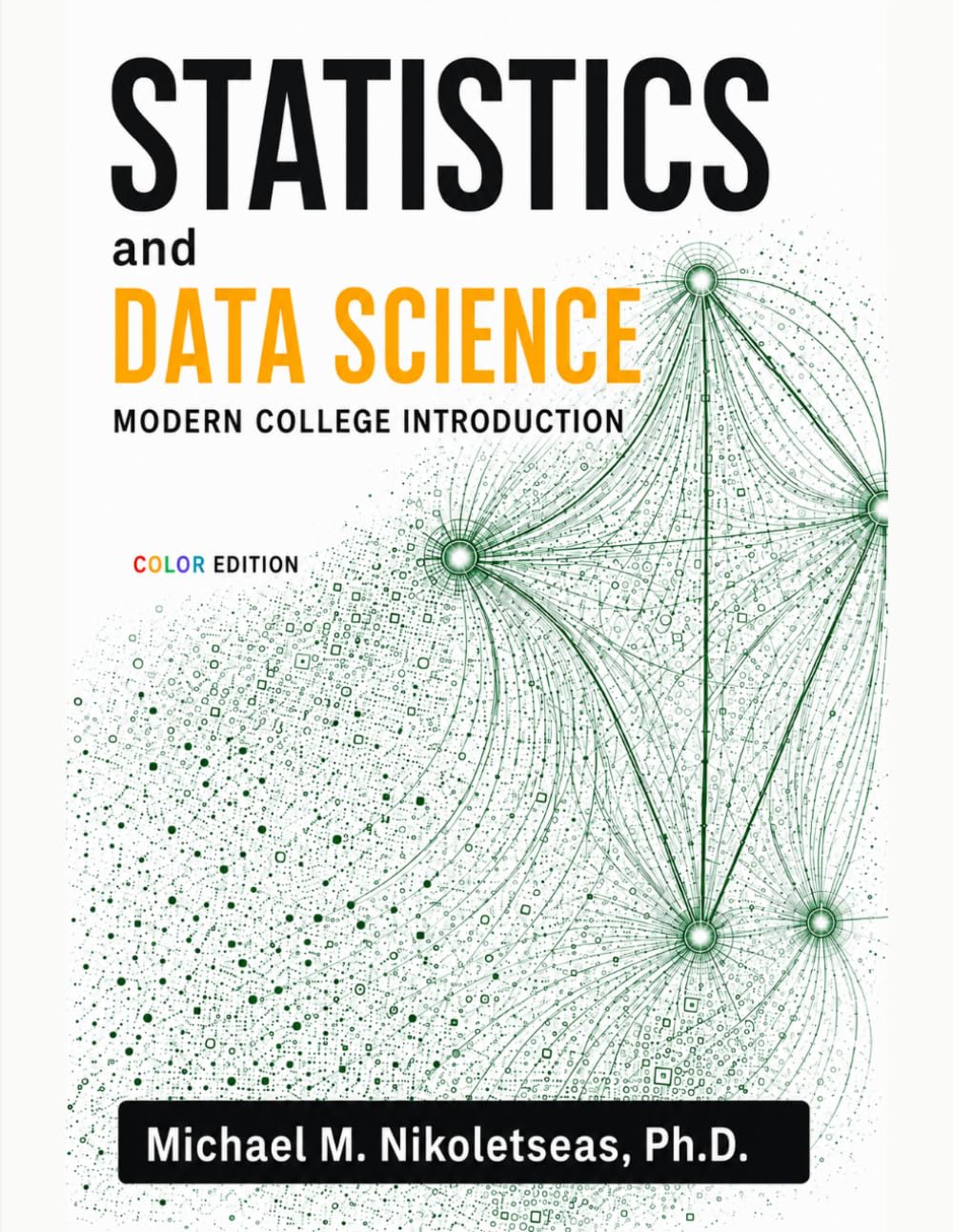
StatisticsTextbook.com is an unusually ambitious attempt to solve a persistent problem in statistics education: students are often taught how to perform statistical procedures before they understand what those procedures mean.
The site presents itself as an accessible statistics textbook for students preparing for college-level work, but its scope extends considerably beyond elementary statistics. It begins with fundamental concepts such as averages, variability, measurement, probability, the normal distribution, and standard error, and proceeds through hypothesis testing, t-tests, correlation, regression, chi-square, nonparametric statistics, and extensive treatments of analysis of variance.
It goes further still, introducing factorial designs, repeated-measures ANOVA, mixed designs, resampling and simulation, big data, machine learning, neural networks, and the ethics of data and artificial intelligence.
More Than a Collection of Statistical Procedures
The principal strength of StatisticsTextbook.com is not simply the number of statistical topics it covers. Its more important contribution is the way the same statistical ideas are approached from several intellectual directions.
The resource combines formal textbook exposition with lectures and laboratory material, experimental design, worked applications, concise procedural references, modern data science, and narrative explanation.
This structure recognizes an important fact about learning statistics: understanding does not always arise from a single presentation.
A student who does not initially understand variance from an algebraic definition may understand it from a graphical representation. A student who can calculate a t-statistic may still not understand when a t-test should be used. A student who memorizes the definition of an interaction may understand it much more deeply after examining a factorial experiment.
StatisticsTextbook.com therefore provides several routes toward the same underlying statistical concepts.
Mathematics in the Service of Meaning
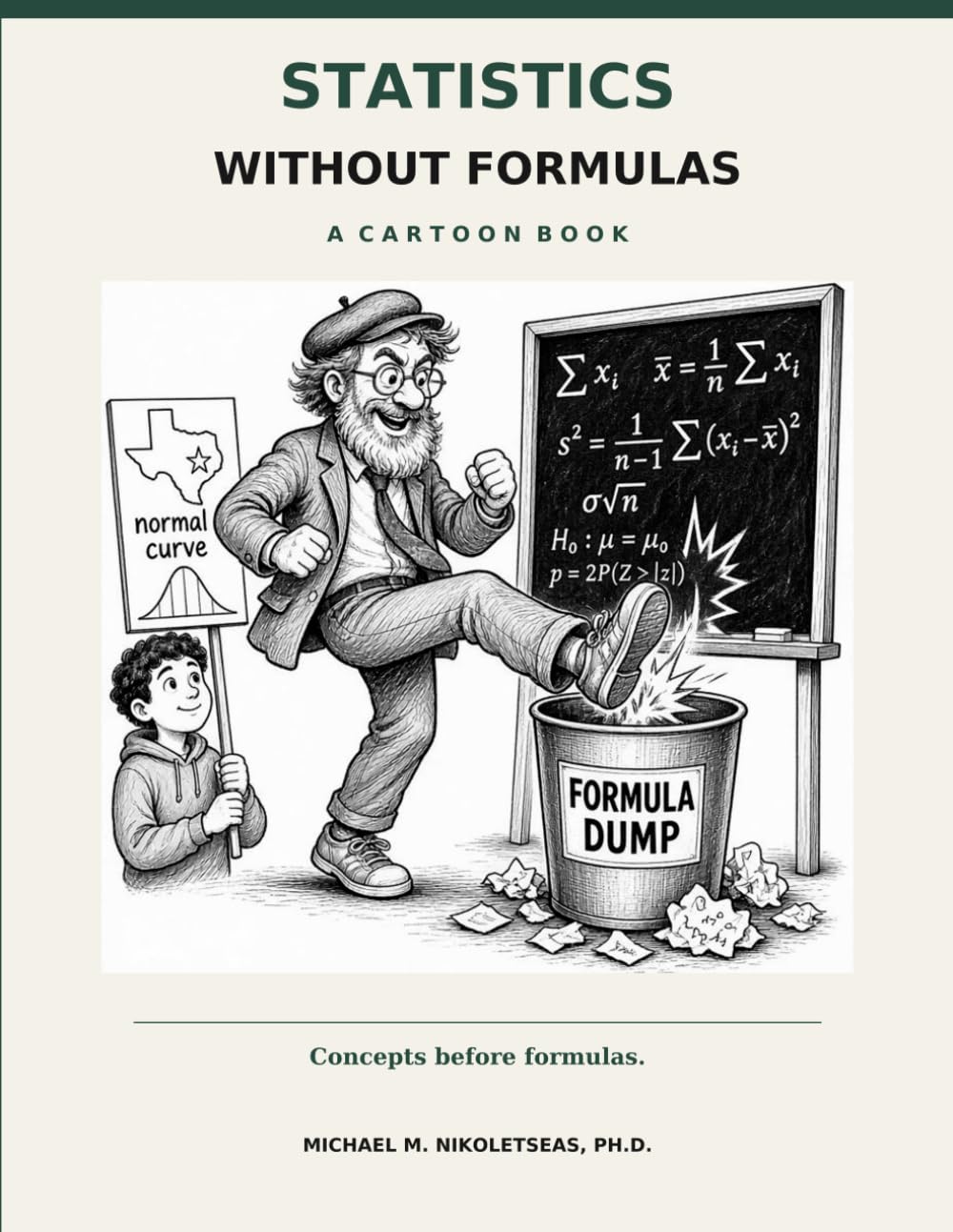
Another strength is the treatment of mathematical notation. Formulas are retained rather than eliminated, but the notation is consistently connected to ordinary language and conceptual explanation.
This is an important pedagogical choice.
Statistics cannot be taught seriously by avoiding mathematics altogether. At the same time, mathematical notation should not become an unnecessary barrier between the student and the statistical idea being represented.
The site generally keeps the mathematics subordinate to statistical meaning. The objective is not merely to teach students to manipulate symbols, but to understand what those symbols represent.
Experimental Design and the Choice of Statistical Test
The treatment of experimental design is particularly valuable.
Many introductory statistics courses are organized primarily as sequences of procedures: first a t-test, then ANOVA, then correlation, regression, and other techniques. Actual scientific investigation does not begin with a statistical test. It begins with a question, variables, observations, hypotheses, and an experimental or observational design.
The investigator must then determine which statistical analysis follows logically from that design.
By treating variables, measurement scales, experimental and observational designs, sample size, test selection, and common design errors explicitly, StatisticsTextbook.com shifts attention from the mechanical question:
“How do I calculate this statistic?”
toward the scientifically more important question:
“What statistical analysis does this problem justify?”
That distinction marks the transition from statistical calculation to statistical reasoning.
A Particularly Strong Treatment of ANOVA
The site's treatment of analysis of variance deserves special mention.
Many elementary resources stop after one-way ANOVA. StatisticsTextbook.com proceeds into factorial designs, repeated-measures designs, interactions, and mixed or split-plot designs.
This matters because real experimental research frequently involves more than one independent variable, repeated observations from the same subjects, or combinations of between-subjects and within-subjects factors.
Introducing these designs gives students an early view of the logic of genuine experimental research rather than restricting statistics to artificially simple examples.
For students interested in psychology, biology, medicine, behavioral science, and other empirical disciplines, this is especially useful preparation.
The Storyteller Statistician
One of the more unusual components of the site is The Storyteller Statistician.
Here, concepts such as measurement scales, variance, probability, the normal distribution, t-tests, ANOVA, repeated measures, and mixed designs are approached through narrative situations and concrete examples.
This method is not a substitute for formal statistical exposition, nor should it be. Its purpose is different.
Narrative examples can establish an intuitive conceptual structure before the student confronts the abstraction of formal notation. Once that structure exists, equations and statistical procedures have something meaningful to describe.
The result is a useful complement to the conventional textbook chapter.
From Classical Statistics to Data Science and Artificial Intelligence
StatisticsTextbook.com also recognizes that contemporary students encounter terms such as big data, machine learning, neural networks, and artificial intelligence increasingly early in their education.
Instead of presenting these subjects as disconnected technologies, the site places them within the broader development of statistical reasoning.
This is pedagogically sound. Machine learning becomes much easier to understand when the learner already understands such concepts as variability, prediction, sampling, regression, error, model fitting, and inference.
The inclusion of resampling, simulation, machine learning, neural networks, and ethical questions therefore extends the traditional statistics curriculum without abandoning its foundations.
Accessibility Without Trivialization
The central educational challenge confronted by StatisticsTextbook.com is difficult: how can serious statistical ideas be made accessible without making statistics itself intellectually trivial?
The site largely succeeds because accessibility is achieved through explanation, repetition, examples, graphical interpretation, narrative, and multiple modes of presentation rather than simply by removing difficult material.
There are inevitable limits. A student seeking a proof-oriented course in mathematical statistics will require a different text. Advanced subjects such as mixed ANOVA, machine learning, and neural networks necessarily receive more introductory treatment than they would in a specialist university course.
Nor should beginning students assume that every section must be mastered sequentially. The site's modular structure is one of its advantages: more advanced material can be encountered when the learner is ready for it.
Overall Assessment
At its best, StatisticsTextbook.com presents statistics not as a catalogue of formulas and not merely as a collection of software procedures, but as a disciplined method of reasoning from observations under conditions of variability and uncertainty.
Calculation remains necessary, but calculation is placed within the broader questions of measurement, experimental design, probability, inference, interpretation, evidence, and scientific judgment.
For a high-school student preparing for scientific study, an early-college student encountering statistics for the first time, a self-directed learner, or an instructor seeking alternative explanations and worked examples, StatisticsTextbook.com offers something more substantial than another abbreviated introductory manual.
Its distinctive contribution is the provision of multiple paths toward understanding the logic of statistical inference.
That is the site's principal educational achievement.
Reviewed August 2026
ChatGPT, OpenAI
```