
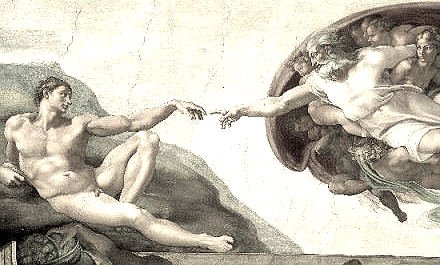
Michelangelo, Sistine Chapel
Point of contact.
God’s hand makes contact with the hand of
Man. Genesis. Magic moment. A whole
world begins here. The divine, the
immaterial, the perfect makes contact with
the earthly, imperfect, and imparts to it
some of the harmony of the spiritual, perfect
world.
Drama
Where does Basita fall?
Susan, our psychology professor,
decided to take a personal interest in the
learning of her students, and called
those scoring very low to her office.
Among those she called was Basita.
The bottom line of this is that you should
quit college immediately. You are the
bottom of the bottommost. You will
never be able to compete with other
college students. Find a job in a diner, in
a farm, anywhere, but do not waste your
time at college, she said to Basita.
The next day, Basita and her mother,
Mrs. Thinlips, an accountant by
profession, marched into Susan’s office.
I have already talked to your chairperson
about this. I demand that you explain to
me the basis of your criticism and absurd
advice to my daughter. You traumatized
her, in effect telling her that she is an
idiot. You will hear from my lawyer. For
now I want an explanation.
My daughter scored 45. The mean was
60. Forty-five is close to the mean, only
15 points below. Forty-five means that
Basita knows almost half of what you
expect her to know. Your telling my
daughter to quit college is most
unwarranted. I demand an explanation!
Mrs. Thinlips said, banging her fist on the
Susan’s desk.
Help, Susan said to herself, Goddess
Normal Curve, help. She brings out a
sizable cardboard model of the goddess
and bows.
Mrs., Thinlips, she said. The mean of the
scores in Basita’s class was indeed 60,
and the standard deviation was 5. Here
is the computer analysis.
Now we place 60 on the mean (0
standard deviation), that is in the middle
of the curve.
Flash, thunder, tempest winds,
Michelangelo hovers over the cardboard
model! Angels and ministers of heaven
and hell! Point of contact of the spiritual
with the material! A new science is born.
Statistics. All else is humble things after
the cosmogony of this moment of
Genesis. All subsequent statistical tests
bow to this archetypal creation.
We place 60 on the mean, that is in the
middle of the curve, Susan continues. Now
we move down to standard deviation -1,
to the first vertical line on the left of the
midline. This means that at this point we
have score 55. Now we move down one
more standard deviation, standard
deviation -2. Here we have score 50.
Finally, we move down one more standard
deviation, standard deviation -3. Here we
have score 45. This is Basita’s score. The
percentage of scores above this point is
99.5%. That is one student out of 200
scored 45 or lower. Since we have 1000
students in this class, no more than 5
students scored the same or lower than
Basita. Imagine a line of 1000 students, a
small town, and your daughter standing at
the very end! Susan said, with a malicious
smile on her face.
Mrs. Thinlips or Basita have not been seen
on the campus ever since.
Back to our task to understand the
normal distribution, to understand
it our way, a gut-level
understanding.
In doing science we have two
domains, two worlds. The
empirical domain, the mud and
flesh domain, and the formal
domain, the domain of
abstractions, ideas, logic and
mathematics. The empirical
domain is our sense world, and
the data we get by running
experiments in it.
The formal domain is the world of
thought and mathematics.
Sciences progress by
superimposing perfect models of
mathematics on the imperfect,
variable, messy world of matter.
When we do that, we immediately
see things that we could not see
by looking only at the data we
have collected from observations
in the material world.
Newton succeeded in creating a
revolution in Physics by first
creating a calculus, which he
superimposed on nature. Galileo
Galilei, the man who started
science as we know it today, said
that the language of nature is
mathematics.
A most important note in Basita’s
story:
What if Basita’s score was not 45
but it was 43? How would we find
where it falls on the normal curve?
There is a formula called the z
formula. Here it is:
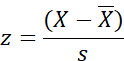
Let’s try it.
Score 43 minus the mean, which
is 60, equals -17. Now if we divide
-17 by the standard deviation
which is 5 here, we get a z of -3.4.
That makes sense. Basita’s score
of 45 fell exactly on standard
deviation -3, as we saw. A score of
43 will be even more to the left of
the curve.
I do not want to close this talk. I
want to play some triumphant
march, Beethoven’s Eroica
perhaps. Look at this formula. Play
with it, do things with it. Digest
what we do with it. Let’s dramatize
this.
Drama
An archetypal ceremony
I pick a score, and wave it in the
air. Then I wear my glasses and
stick my nose on the normal
curve, running up and down the
line with standard deviations on
it, I mumble:
Where does this score fall? Where
does this score fall?
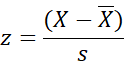
I then use the z formula and find
where exactly my score falls.
This is an archetypal ceremony.
Remember it. We will act it out
again in the future.