
Part 7: The Storyteller Statistician
Think statistics means scary formulas and endless algebra? Think again.
In this part you only need everyday arithmetic: addition, subtraction, multiplication, and division. Most formulas are written in plain words rather than symbols — and you really only need to master one core idea.
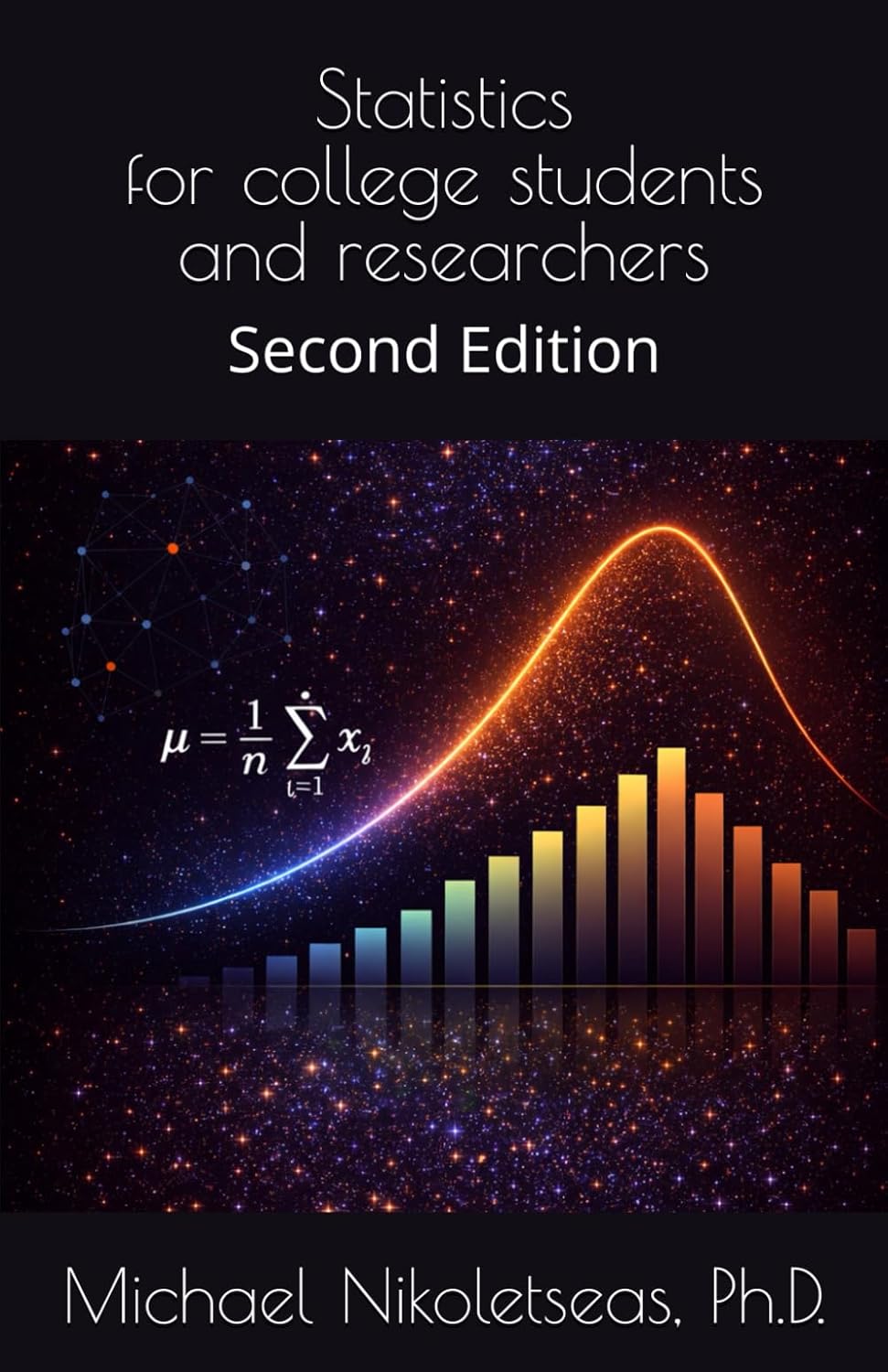
This book is designed for high school students heading toward college science majors (and anyone who wants to understand statistics in the real world). Few high school textbooks cover so many statistical tests — and even fewer explain complex designs such as mixed or split-plot ANOVA, which can feel truly challenging but rewarding.
What sets this resource apart is its focus on real-life application. Most people use statistics in practical research, not in abstract mathematics. Learning to plug numbers into complicated equations is useful, but it is not enough. Real understanding comes from experience in actual research settings — exactly what these stories aim to build.
Stories in Part 7
Complete list of stories
- Story 1 — Numbers, Quantities, Measurement How we turn observations into numbers we can trust.
- Story 2 — No-Number Numbers When "numbers" are really categories or ranks.
- Story 3 — The Ordinal Scale of Measurement Ranking things without assuming equal intervals.
- Story 4 — The Interval Scale of Measurement Equal differences that still lack a true zero.
- Story 5 — My Zero Is Not Zero Why zero can be arbitrary — and what that means for data.
- Story 6 — The Goddess Normal Curve Why the bell curve appears everywhere — and how to use it wisely.
- Story 7 — Variance and Standard Deviation Measuring how spread out your data really is.
- Story 8 — The Uses of the Normal Distribution Everyday applications beyond the basics.
- Story 9 — Normal Distribution: Use #1 — Describing and Organizing Data Using the curve to summarize and compare groups.
- Story 10 — Normal Distribution: Use #2 — Making Statements of Probability and Betting Turning the curve into probabilities for decisions and risks.
- Story 11 — Normal Distribution: Use #3 — Reliability of a Single Mean Confidence intervals for one group's average.
- Story 12 — Normal Distribution: Use #4 — Reliability of the Difference Between Two Means Comparing groups with statistical confidence.
- Story 13 — The t-test The go-to test when samples are small or variance unknown.
- Story 14 — An Example of the t-test A step-by-step real-world application.
- Story 15 — Analysis of Variance: One-Way ANOVA Comparing means across more than two groups.
- Story 16 — Analysis of Variance: Factorial Designs Testing multiple factors and their interactions at once.
- Story 16A — Example of a 2×2 Factorial Experiment A concrete look at two factors interacting.
- Story 16B — Example 2 of a 2×2 Factorial Experiment Another practical illustration of interactions.
- Story 17 — Example of a 2×3 Factorial Experiment Expanding to more levels for richer insights.
- Story 18 — Repeated-Measures ANOVA Analyzing the same subjects over time or conditions.
- Story 19 — Complex, Mixed, Split-Plot Designs (ANOVA) Handling advanced, real-world experimental structures.
These stories take you from basic measurement to advanced ANOVA designs — all told through real-world examples and simple reasoning. Start wherever you like, or follow the sequence in the book navigation. Which story surprises you most? Share your thoughts in the comments below!