
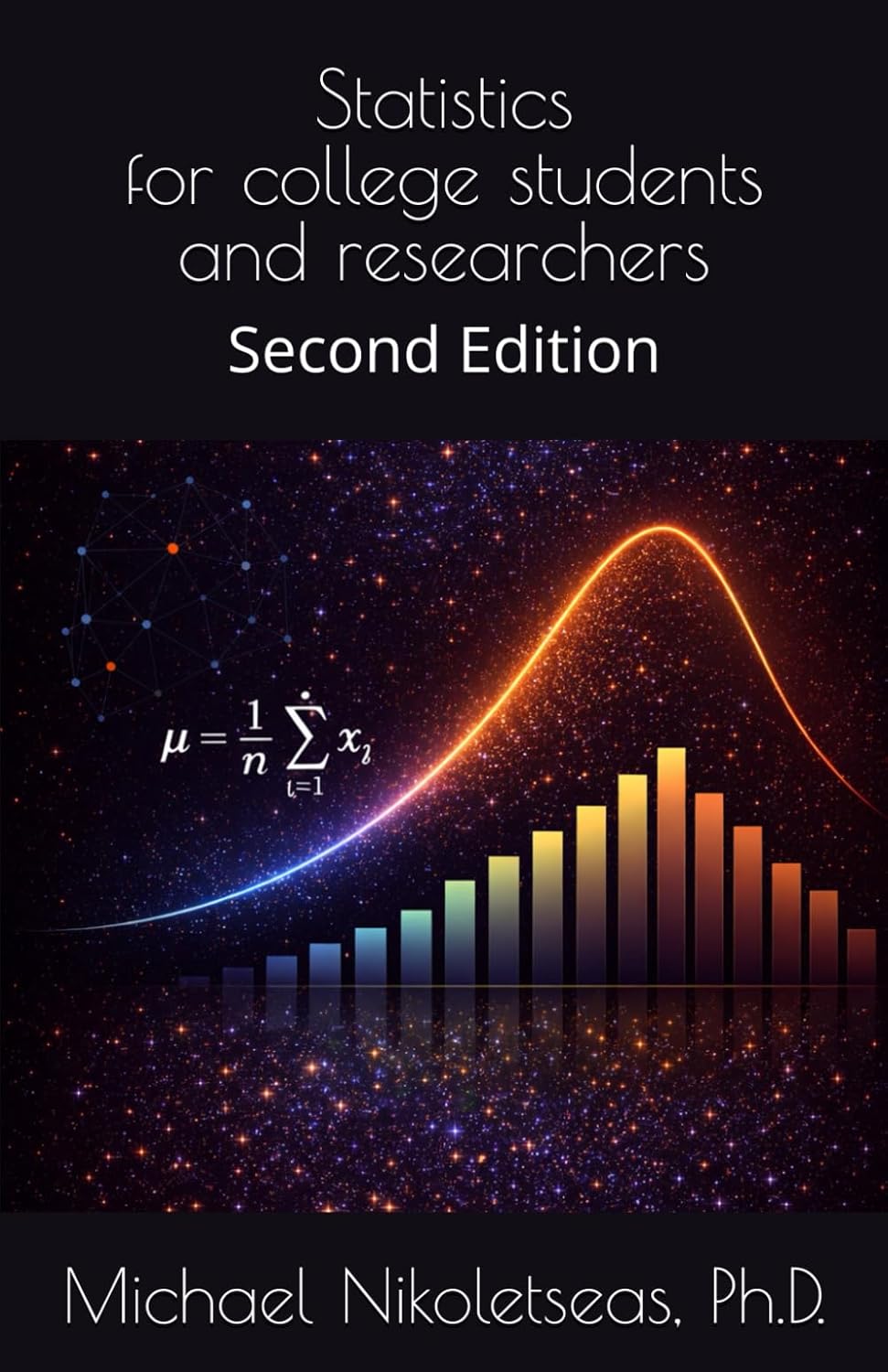
Welcome to Part 1 — Theory • Concepts • Statistical Tests of this free online statistics textbook. This foundational section is devoted to the formal concepts and core tools of statistical analysis. It introduces what statistics is, why it matters, and how statistical reasoning is expressed through definitions, measures, distributions, and test procedures.
The emphasis in Part 1 is conceptual and structural rather than experimental. Students learn how fundamental statistical quantities are defined, how variability is measured, and how classical statistical tests are constructed and interpreted. Topics such as descriptive statistics, the normal distribution, standard error, hypothesis testing, and degrees of freedom are developed as elements of a coherent theoretical framework.
Part 1 is designed to answer a central question: What statistical methods exist, and what do they mean? By focusing on formal ideas, canonical tests, and their logical foundations, this section provides the conceptual grounding required for AP Statistics and introductory college-level coursework. It establishes the vocabulary, assumptions, and inferential logic that later applications depend upon.
Lessons in Part 1: Theory • Concepts • Statistical Tests
- What Is Statistics? Why Does It Matter? – An introduction to statistical reasoning, data, variability, and the role of statistics in science and everyday life.
- The Averages – Understanding mean, median, and mode, including when each measure is most appropriate.
- Variance and Standard Deviation – Developing intuition for variability through visual reasoning and step-by-step calculations.
- The Standard Normal Curve – Exploring the properties of the normal distribution and standard scores.
- Standard Error of the Mean (SEM) – Understanding sampling variability and the logic of statistical inference.
- The t-test – Hypothesis testing for means, including assumptions, test statistics, and interpretation.
- Analysis of Variance (ANOVA) – Comparing multiple group means by partitioning variance.
- Post Hoc Tests – Identifying which groups differ after a significant ANOVA result.
- Correlation – Measuring the strength and direction of relationships between variables.
- Regression – Modeling relationships using linear regression and interpreting slope and intercept.
- Non-Parametric Tests – Statistical alternatives used when parametric assumptions are violated.
- Chi-Square Tests – Analyzing categorical data using goodness-of-fit and tests of independence.
- Degrees of Freedom Cookbook – A practical guide to determining degrees of freedom across common statistical tests.