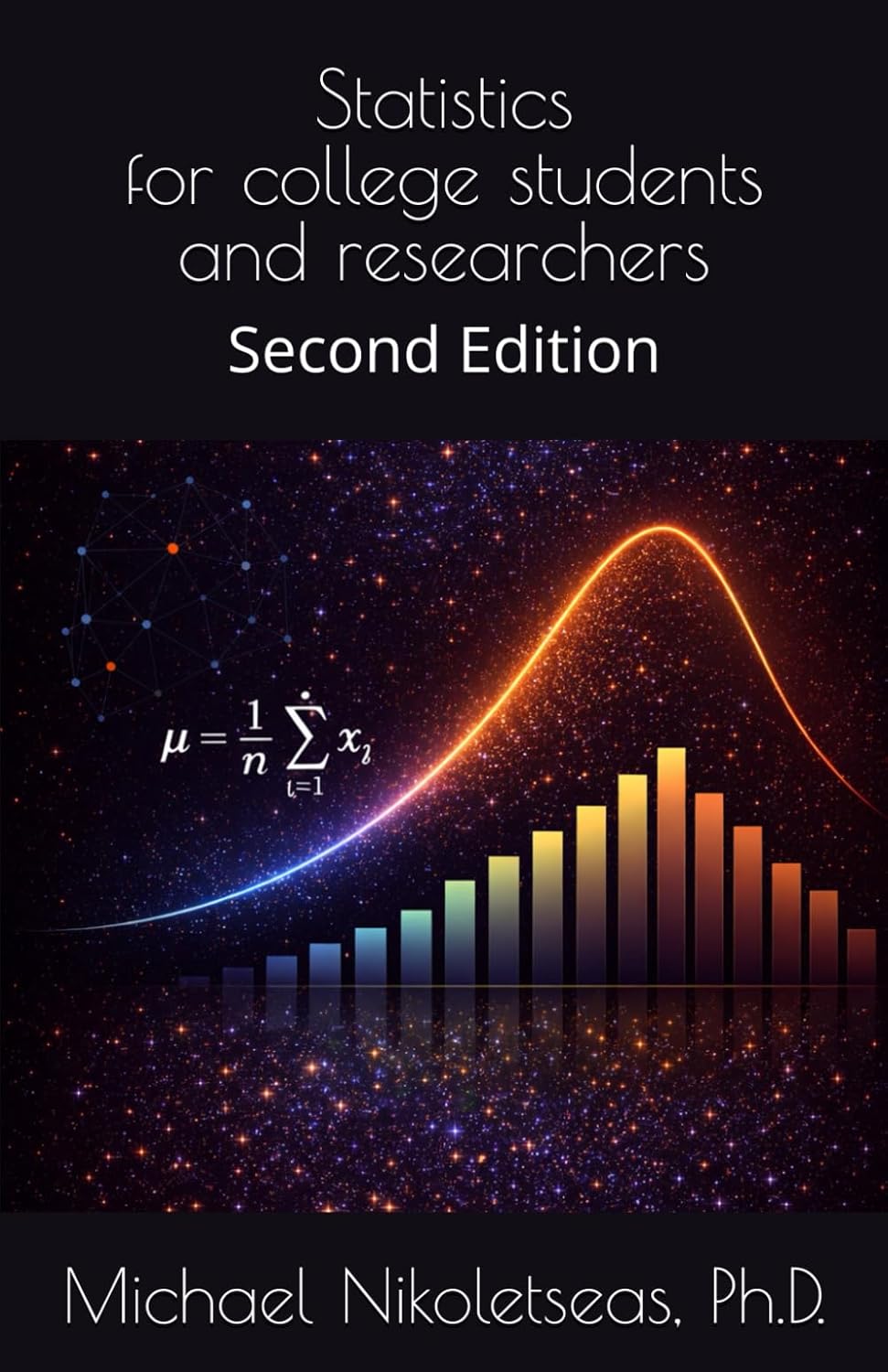
Welcome to Part 2 — Lecture & Lab of this free online statistics textbook. This section builds directly on the formal concepts introduced in Part 1 by shifting the focus from statistical definitions and test procedures to the structure of data, experimental design, and the role of variability in statistical reasoning.
Whereas Part 1 presents statistics as a system of concepts and methods, Part 2 presents statistics as a way of organizing and explaining data. The emphasis here is on understanding how statistical tests arise from patterns of variability, how distributions govern inference, and how experimental structure determines which analyses are appropriate.
Through short lectures and guided lab-style explorations, students learn to reason in terms of variance, sampling behavior, and model structure rather than isolated formulas. Classical procedures such as the t-test and analysis of variance are revisited not as new techniques, but as special cases of broader variance-based logic. This section is designed to develop intuition, reveal unifying principles, and connect statistical inference to the way data are actually generated and analyzed in practice.
Lectures in Part 2
- Scales of Measurement – Examining how levels of measurement shape the kinds of comparisons and analyses that are statistically meaningful.
- The Goddess Normal Curve – Developing an intuitive, visual understanding of the normal distribution as a governing model for variability.
- Variance and Standard Deviation – Revisiting variability as the central organizing concept underlying statistical inference.
- Uses of the Normal Distribution – Applying the normal curve to probability, standard scores, and inferential reasoning.
- The t-test – Interpreting the t-test as a comparison of variability rather than a mechanical formula.
- ANOVA: Partitioning the Variance – Understanding analysis of variance as a general framework for comparing means.
- Factorial Designs – Exploring how multiple factors and their interactions structure experimental data.
- Repeated-Measures ANOVA – Analyzing within-subject designs and the role of correlated observations.
- Mixed (Split-Plot) ANOVA – Integrating between-subjects and within-subjects factors in complex designs.