

Example 1 of 2x2 factorial experiment ANOVA
A pharmacology graduate student
working on his thesis wanted to
find whether a new chemical,
srt-X, which has been shown to
block serotonin, may be beneficial
to schizophrenic patients. He was
also interested to see if
electroshock has an effect on
these patients when combined
with srt-X.
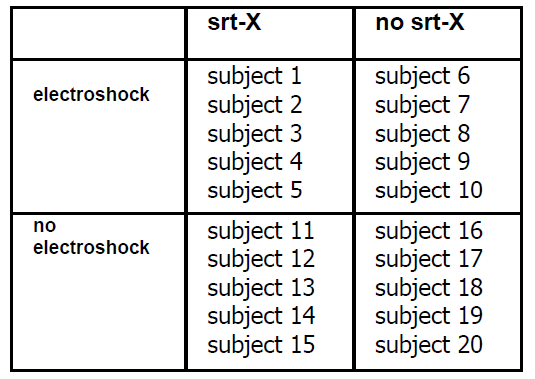
He randomly selected 20
schizophrenic patients, and
randomly assigned them to 4
groups:
electroshock - srt-X,
electroshock-no srt-X
no electroshock - srt-X,
no electroshock-no srt-X
The layout of this experiment is:
The layout in abstract form is:
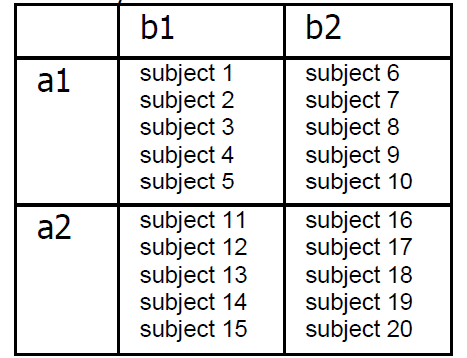
Variable A has two levels, a1 and
a2, and variable B has two levels,
b1 and b2.
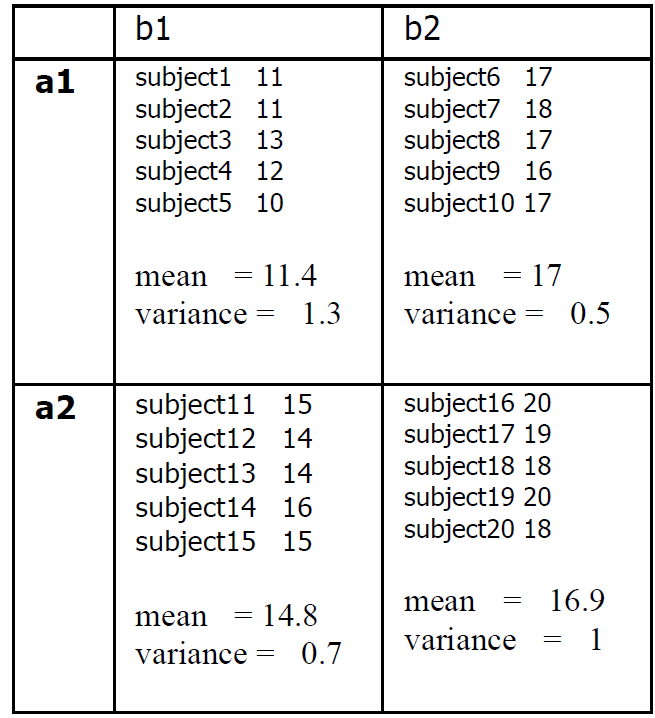
The next table shows the data he
recorded in running the
experiment. The numbers
represent scores on a psychiatric
test measuring intensity of
schizophrenic behavior. The
higher the number the worse the
condition of the patient.
THE SEROTONIN BLOCKER
PLUS SHOCK EXPERIMENT
ANOVA SUMMARY TABLE OF
THE SEROTONIN BLOCKER
PLUS SHOCK EXPERIMENT
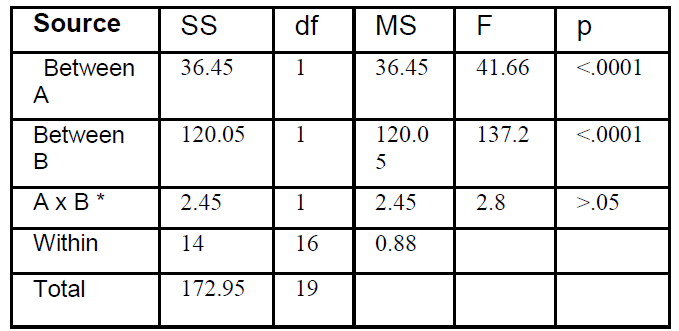
* Interaction
I will first discuss the table in terms
of the calculations we did.
First and most important, the
degrees of freedom.
If you tell me the degrees of
freedom in any ANOVA
experiment, but without the use of
formulas (I do also mean resorting
to memory for the recollection of
formulas - ban formulas!), I know
you know what you are talking
about. Calculation of the F is easy,
high school arithmetic.
If you
Why df for Between A is 1?
Because in order to calculate
variance Between we line up the
means, consider them scores, and
calculate the variance using the
one and only formula for variance
(all the other formulas for variance
that you may see around are
derived from this formula.
Statisticians get their kicks by
producing equivalent formulas, of
considerable complexity and
ornamental value!). Now you and I
know that in order to calculate
variance, we must first calculate
the mean. Every time we calculate
the mean, we lose 1 degree of
freedom. Because, in the present
example we have 2 scores (never
mind that they are means), we are
left with 1 df. That is 2-1=1.
I do not understand why you say
we have 2 means for A, you ask.
Good question. A has two levels
here, a1 and a2. That is shock and
no shock. You see, when we deal
with variable A, we ignore variable
B. In other words we reduce this
part of the analysis to a one-way,
single-factor ANOVA.
Why df for Between B is 1? you
say.
For the same reasons as in the
previous paragraph, B has two
levels, b1 and b2, drug and no
drug. There are two means
(scores). In order to calculate the
variance of these two scores, we
must first compute the mean. We
therefore lose 1 df. So the df for B
is 2-1=1.
Why df for AxB interaction is 1?
This is easy. Since df for A is 1, and
df for B is also 1, the df for AxB is
1x1=1.
Why is the df for within 16?
This is simple, too. We said variance
within is variance for the first
group plus variance for the second
group, plus variance for the third
groups and so on. We have four
groups here. In order to calculate
the variance of each group we
must first calculate a mean. The
consequence of this is that we
lose 1 df for every mean we
calculate. How many scores go
into the calculation of variance for
group 1? Five scores. Therefore
df for the first group is 5-1=4. We
calculate the variance of the
remaining 3 groups in a similar
way. Since we have 4 groups
here, the df for Within is 4x4=16.
he
Note: Checksum. The sum of df
for A, B, AxB, Within, equals df
Total
SS for A, B, AxB, and Within
equals SS Total.
Remember, we said that in ANOVA
we partition variance.
Discussion of the experiment
with the schizophrenic patients.
Look at the ANOVA Table again:
ANOVA SUMMARY TABLE OF
THE SEROTONIN BLOCKER
PLUS SHOCK EXPERIMENT
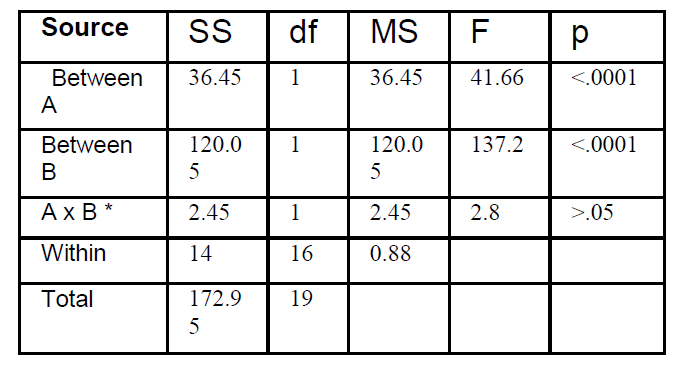
* Interaction
The p value (the probability that
the difference or effect we are
reporting may not be reliable or
significant) for A is less than 1 in
ten thousand (p<.0001|).
Variable A is electroshock in this
experiment. This means that the
two conditions, electroshock and
no electroshock (condition 1:
electroshock-drug, electroshock-no drug; condition 2: no-
electroshock-drug, no- electroshock-no drug) produced a result, a significant difference.
In other words those patients who received electroshock ended up different from those patients that did not receive electroshock.
The p value (the probability that the difference or effect we are reporting may not be reliable or significant) for B is less than 1 in ten thousand (p<.0001|).
Variable B is drug in this experiment. This means that the two conditions, drug and no drug (condition 1: drug-electroshock, drug-no electroshock, condition 2: no drug-electroshock, no drug-no electroshock) produced a result, a significant difference. In other words, those patients who received the drug were different from those patients that did not receive the drug.
The p value of AxB, the interaction
is p>.05, We read this as follows:
p greater than five per cent. This
means that if we were to say that
there was significant interaction
between electroshock and drug,
we would be running the chance
of reporting an effect that is not
reliable, not significant, meaning
that if we or someone else were to
do the same experiment again,
most likely would not find a
difference as we did
As we said earlier the concept of
interaction is a new one for us,
and we need to understand it our
way, at the gut level, as we are
used to.
We will now consider an experiment in which the interaction is significant.