Statistics is the science of learning from data. It provides the tools to decide whether what we observe is real or accidental, and whether a difference is large enough to matter.
When a scientist runs an experiment, or when a pollster surveys a group of voters, the results always vary. Statistics gives us a way to interpret that variation and to draw conclusions.
The Two Branches of Statistics
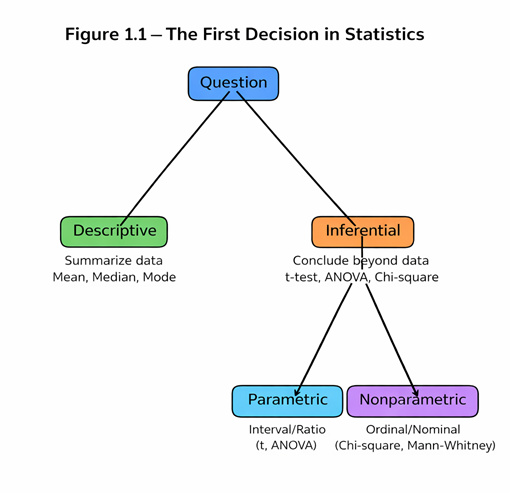
- Descriptive Statistics describe and summarize what we see.
Example: “The average score on the math test was 78.” - Inferential Statistics use a sample to make conclusions about a larger group.
Example: “Based on this sample, we estimate the average score for all students in the district.”
Definition:
- Descriptive statistics = picture of the data.
- Inferential statistics = prediction about the population.
Parametric vs. Non-parametric Statistics
There are two main families of tests:
- Parametric tests (such as the t-test or ANOVA) assume certain conditions in the data, like normal distribution and interval/ratio measurement.
- Non-parametric tests (such as Chi-square or Mann–Whitney) require fewer assumptions and are used when data are ranks (ordinal) or categories (nominal).
Simple rule of thumb:
- If data are interval or ratio (e.g., test scores, heights), use parametric tests.
- If data are ordinal or nominal (e.g., ranks, categories), use non-parametric tests.
First Formula in Statistics: The Mean
The mean is our first step toward summarizing data.
Symbolic formula:
$$\bar{X} = \frac{\sum X}{n}$$
Formula in words:
$$\text{Mean} = \frac{\text{sum of scores}}{\text{number of scores}}$$
Where:
- $$\bar{X}$$ = mean (X bar)
- $$\sum X$$ = sum of all scores
- $$n$$ = number of scores
Example: Data: 6, 8, 10
$$\bar{X} = \frac{6 + 8 + 10}{3} = \frac{24}{3} = 8$$
So the mean is 8.
Visual
Figure 1.1 — The First Decision in Statistics. A flowchart: Descriptive vs. Inferential → Parametric vs. Non-parametric, with examples inside each box.
Why This Matters
Before you can choose the right statistical test, you must know:
- What kind of data you have (descriptive vs. inferential).
- How those data are measured (nominal, ordinal, interval, ratio).
- Which family of tests applies (parametric vs. non-parametric).
This chapter sets the stage. The rest of the book builds from here, using only a small set of simple formulas to unlock the logic of statistics.
Practice self-test quiz
In the space below, please find practice problems and self-test quizzes. For full access, please signup free.