
Drama: The Cold Morning
It’s a winter morning in New York. You wake up, open your phone, and check the weather. It says 32°F.
You sigh, grab your coat, and head out. The air bites your face.
By the time you reach the subway, your phone says 31°F. You frown. Has it really changed that much? You shrug.
Then you remember your cousin in Los Angeles posted a photo this morning: 62°F and sunny.
You type quickly:
“Hey, you’re twice as warm as I am!”
Then you stop. Something feels wrong.
Can 62 really be twice as warm as 31?
It feels like it, but you know it’s not true.
Later, in class, your statistics instructor confirms it:
“Temperature in Fahrenheit is interval, not ratio**.** You can add and subtract, but you can’t multiply or divide meaningfully. There’s no true zero—no absolute absence of heat.”
You smile. The world feels slightly warmer already.
From Story to Concept: The Interval Scale
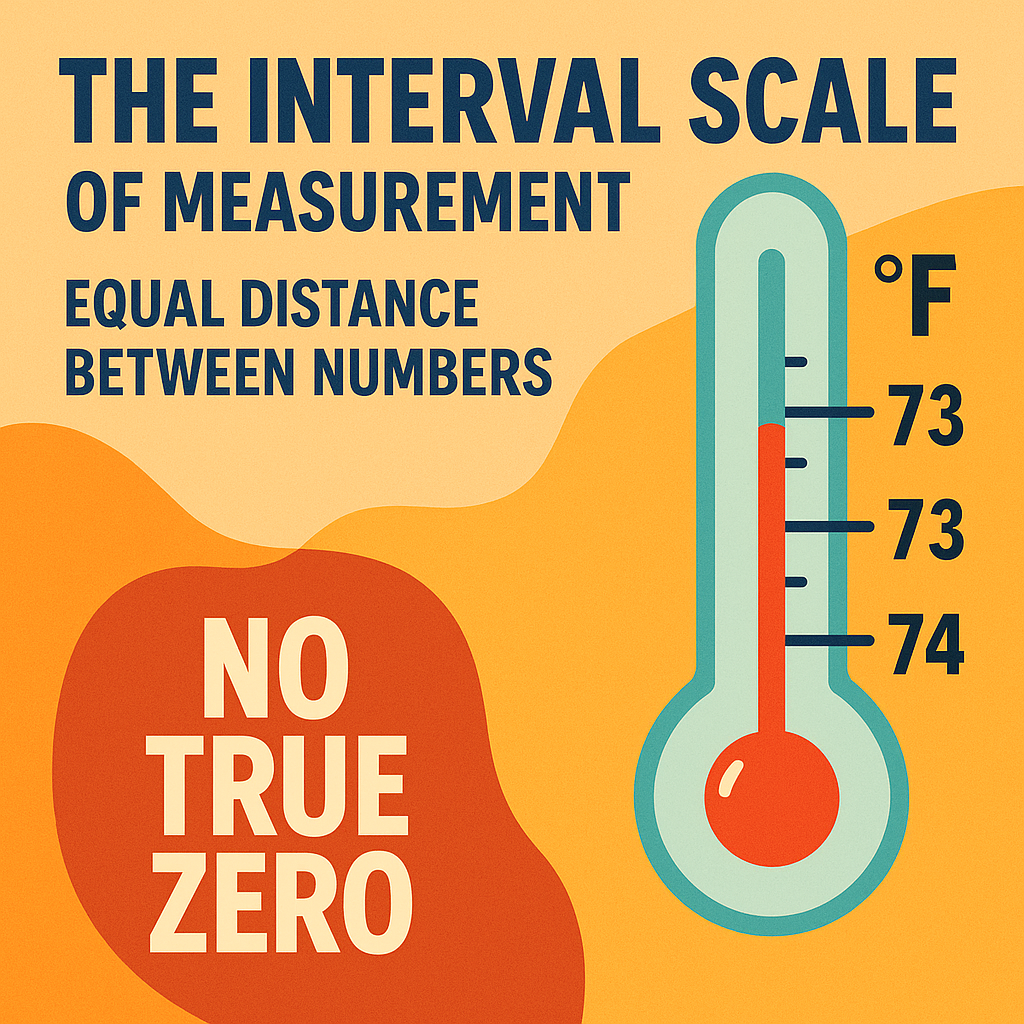
In the interval scale, the distance between numbers is equal.
Between 72 and 73 degrees Fahrenheit, the difference is the same as between 73 and 74.
You can even express subdivisions—72.4, 72.6—with equal precision.
This scale has a clear advantage over the nominal and ordinal types:
you can now perform addition and subtraction, and, in practice, even averages and standard deviations make sense.
However, one key element is missing: a true zero point.
Zero degrees Fahrenheit doesn’t mean no temperature; it simply marks an arbitrary point on the scale.
So while the interval scale lets you measure and compare distances precisely, it cannot meaningfully express ratios.
You can say it’s 10 degrees warmer today than yesterday—but not that it’s twice as warm.
The interval scale is a triumph of human thought—measurement without absolutes, order with equal steps but no foundation.
Practice self-test quiz
In the space below, please find practice problems and self-test quizzes. For full access, please signup free.