
Drama: Who’s Bigger
Twenty-first century Athens.
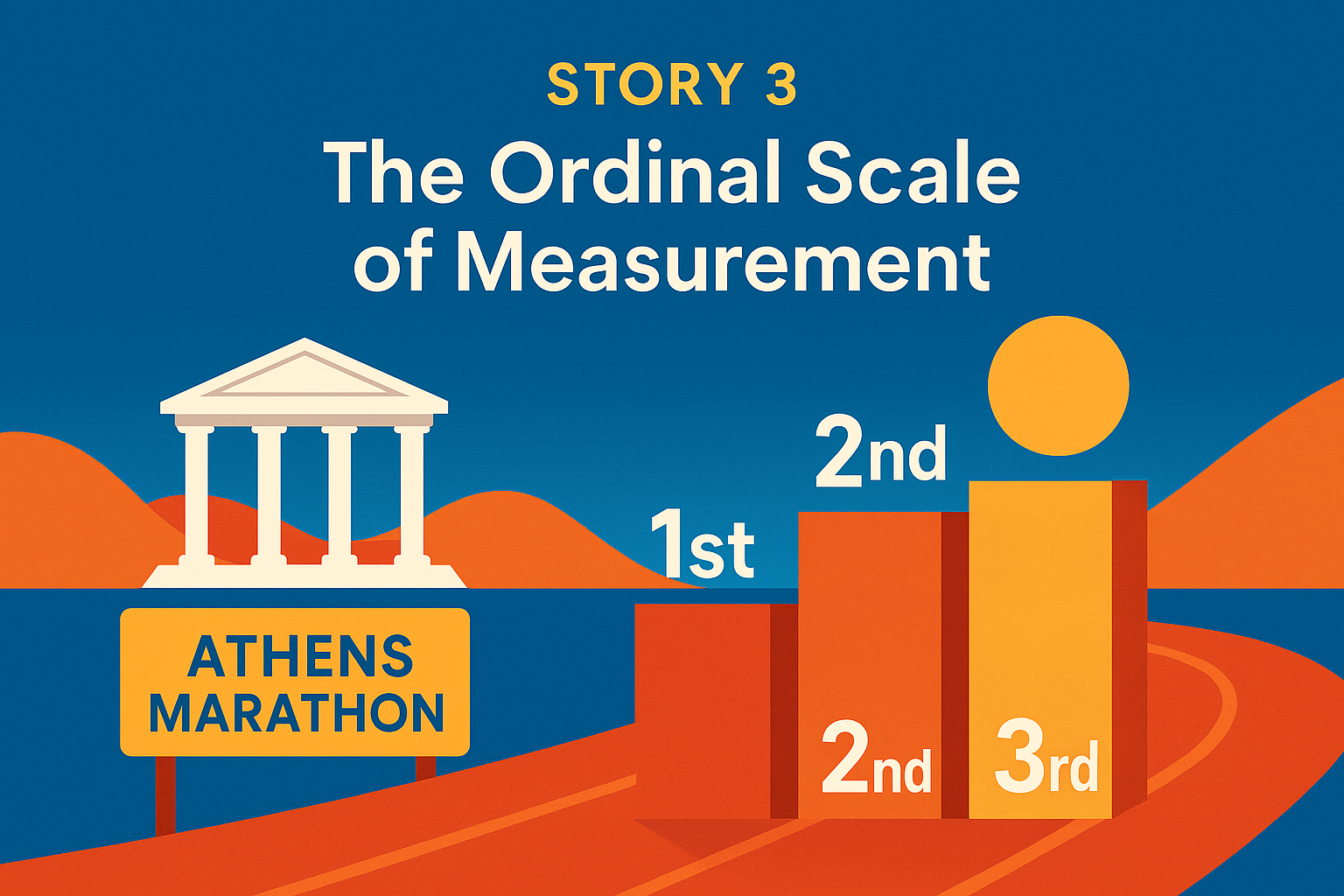
Today is the women’s Marathon.
Before you leave home, you catch a glimpse of the start line on television. The runners are ready in Marathon, the historic starting point. The finish line, as always, is the grand stadium in downtown Athens—the same place where the ancient games once ended.
You return home at dinner time. The family is gathered around the television, watching the news. Three winners stand proudly on the podium as the national anthems play.
“Great athletes!” you say.
Your family bursts into laughter.
“What’s so funny?” you ask. “Did I say something wrong? That was a great race—especially in this city’s smog!”
They laugh even harder. Finally, your father explains.
“The first runner truly was great—she broke the world record. But the second also broke the world record, only in a negative sense. She took so long to finish that no one in recorded history has ever taken that long. The smog made all the runners faint!”
From Story to Concept: The Ordinal Scale
This type of measurement has an advantage over the nominal scale: it tells you which element is greater or lesser.
It introduces order.
You can now say who finished first, second, and third.
But you still don’t know by how much they differ.
The ordinal scale gives you ranking, not magnitude.
It answers which is greater, but not how much greater.
You cannot add, subtract, multiply, or divide ordinal numbers. You cannot calculate means or standard deviations. You cannot run sophisticated statistical analyses.
The ordinal scale is, in its essence, primitive—but revolutionary. It marks humanity’s first attempt to compare, to arrange, to impose order on experience.
It is the bridge between naming and measuring.
Practice self-test quiz
In the space below, please find practice problems and self-test quizzes. For full access, please signup free.