
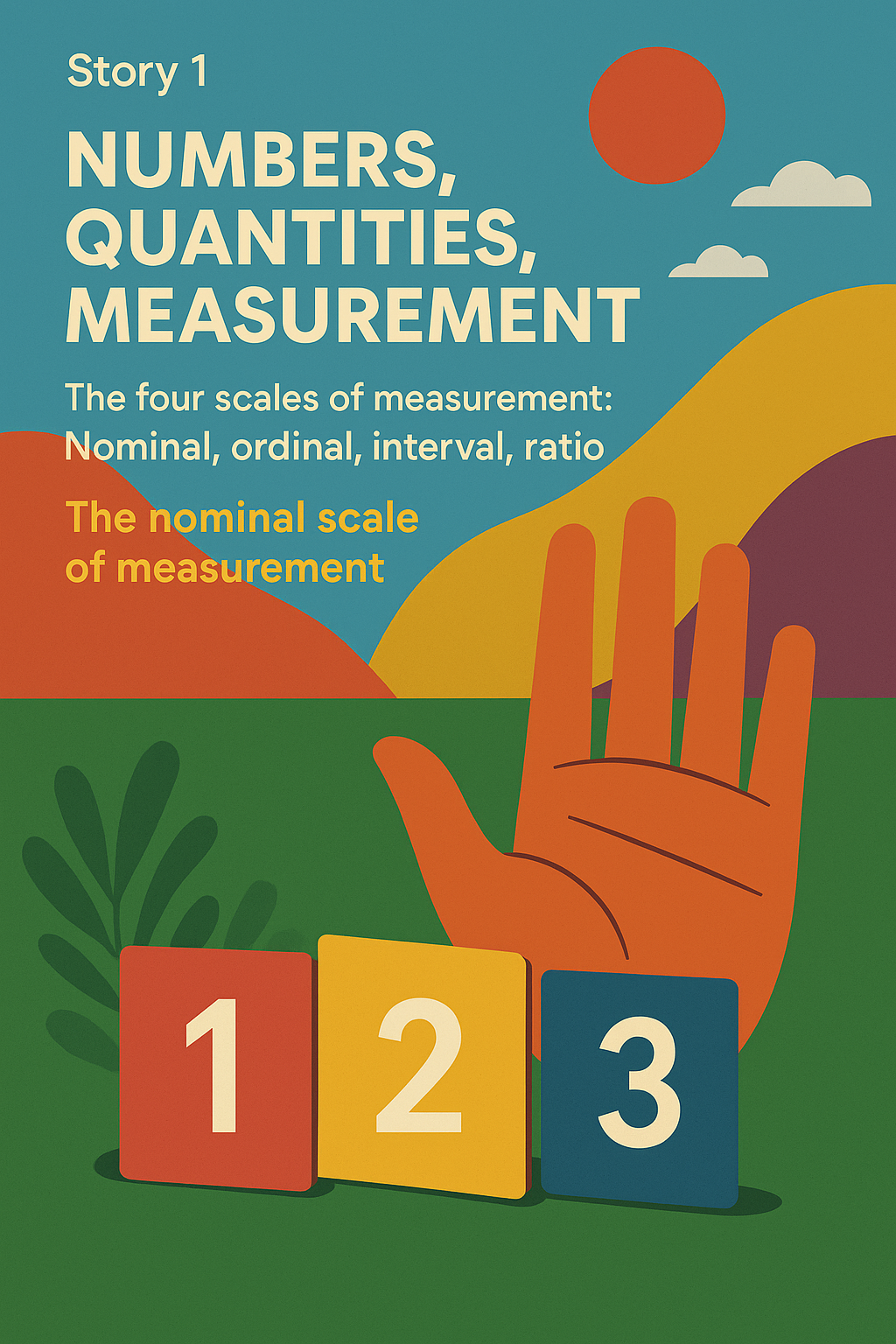
The Four Scales of Measurement
Nominal, ordinal, interval, ratio.
The first story belongs to the nominal scale—the simplest, and the oldest.
Drama: My Kids, My Fingers
A family of early Homo sapiens sits around a fire in a cave in Africa, devouring the evening meal of a goat-like animal. The children dance and chase each other; the women laugh and talk. The man stares into the dark mouth of the cave.
Now he raises his hands before his eyes. With the index finger of his right hand, he touches each finger of his left—one by one—his gaze fixed on his children. One child, one finger. He repeats the ritual with his other hand.
The next morning, he is crouched in the brush, waiting for game to pass. Again, he looks down at his hands. His eyes move from finger to finger—and he smiles. He knows how many children he has.
No words, no symbols. Only the raw sense of how many. The first pulse of number—the intuition of quantity—is born.
Thousands of years later, the names of each finger will no longer name a child but will stand for frequency, count, occurrence. They will become symbols: words like one, two, three.
And much later still, the words themselves will take form as written marks:
1, 2, 3.
Primitive arithmetic, yes—but also the first spark of the human mind’s most powerful invention: measurement.
From Story to Concept: The Nominal Scale
The man in the cave did not yet know numbers.
What he had discovered was naming.
He had no word for “one,” “two,” or “three.” But he knew this child and that child.
He separated—distinguished—each entity in his world. His perception of difference was the first act of measurement.
The nominal scale is born from that primitive gesture: the act of naming things to make them distinct.
It is the simplest form of measurement—no order, no magnitude, no arithmetic.
When we assign labels such as male and female, red and blue, apple and pear, we are using the nominal scale. These names carry identity but not quantity.
They answer the question what, not how many or how much.
In the story, each finger represented a child—not a number, but a name, a mark of uniqueness. The father’s counting was not numerical; it was symbolic, categorical. He was labeling, not adding.
Later in history, this act of naming evolved into words that expressed magnitude—one, two, three.
But before there were numbers, there were names.
And before there was mathematics, there was distinction—the mind’s first measurement of the world.
Practice self-test quiz
In the space below, please find practice problems and self-test quizzes. For full access, please signup free.