Statistics 2nd ed

independent-groups

Lesson 11 — Non-parametric Tests
mann whitney
wilcoxon test
kruskal wallis test
friedman test

Most tests so far (t-tests, ANOVA, regression) are parametric.
They assume:

  • Interval/ratio data
  • Approximately normal distribution
  • Homogeneity of variance

But what if these assumptions are not met?
Or if data are ranks or categories?

Then we use non-parametric tests.
They make fewer assumptions and are based on ranks, not raw scores.


Mann–Whitney U Test

When to Use:

  • Compare two independent groups, ordinal or non-normal data.
  • Non-parametric alternative to independent t-test.

Formula:
$$U = n_1 n_2 + \frac{n_1(n_1 + 1)}{2} - R_1$$

Where $$R_1$$ = sum of ranks for group 1.

Example:
Two groups (n = 5 each) ranked by performance. Compute rank sums, plug into U formula.


Wilcoxon Signed-Rank Test

When to Use:

  • Compare the same group measured twice.
  • Ordinal or non-normal data.
  • Non-parametric alternative to paired t-test.

Procedure:

  1. Compute differences (After – Before).
  2. Rank absolute differences.
  3. Add signs.
  4. Test statistic = smaller signed sum.

Example:
5 students tested before/after training → positive ranks dominate → training helps.


Kruskal–Wallis Test

When to Use:

  • Compare 3+ independent groups.
  • Ordinal or non-normal data.
  • Non-parametric alternative to one-way ANOVA.

Formula:
$$H = \frac{12}{N(N+1)} \sum \frac{R_j^2}{n_j} - 3(N+1)$$

Where:

  • $$R_j$$ = sum of ranks in group j
  • $$n_j$$ = group size
  • $$N$$ = total number of cases

Example:
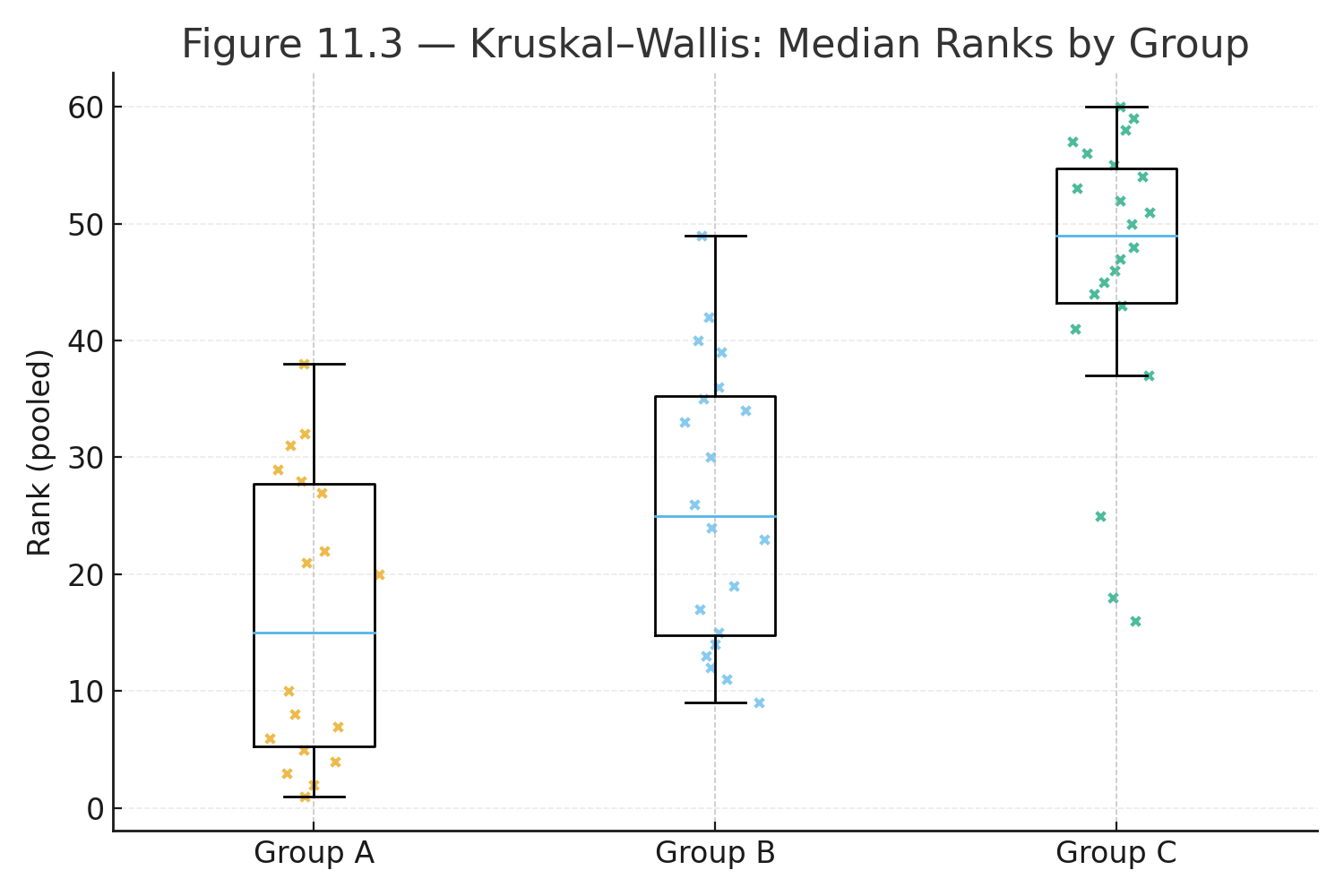
Three therapy groups (n = 6 each). Rank improvement scores → compare H to χ² distribution.


Friedman Test

When to Use:

  • Compare 3+ related groups (repeated measures).
  • Ordinal or non-normal data.
  • Non-parametric alternative to repeated-measures ANOVA.

Formula:
$$Q = \frac{12}{nk(k+1)} \sum R_j^2 - 3n(k+1)$$

Where:

  • $$R_j$$ = rank sum for each condition
  • $$n$$ = number of subjects
  • $$k$$ = number of conditions

Example:
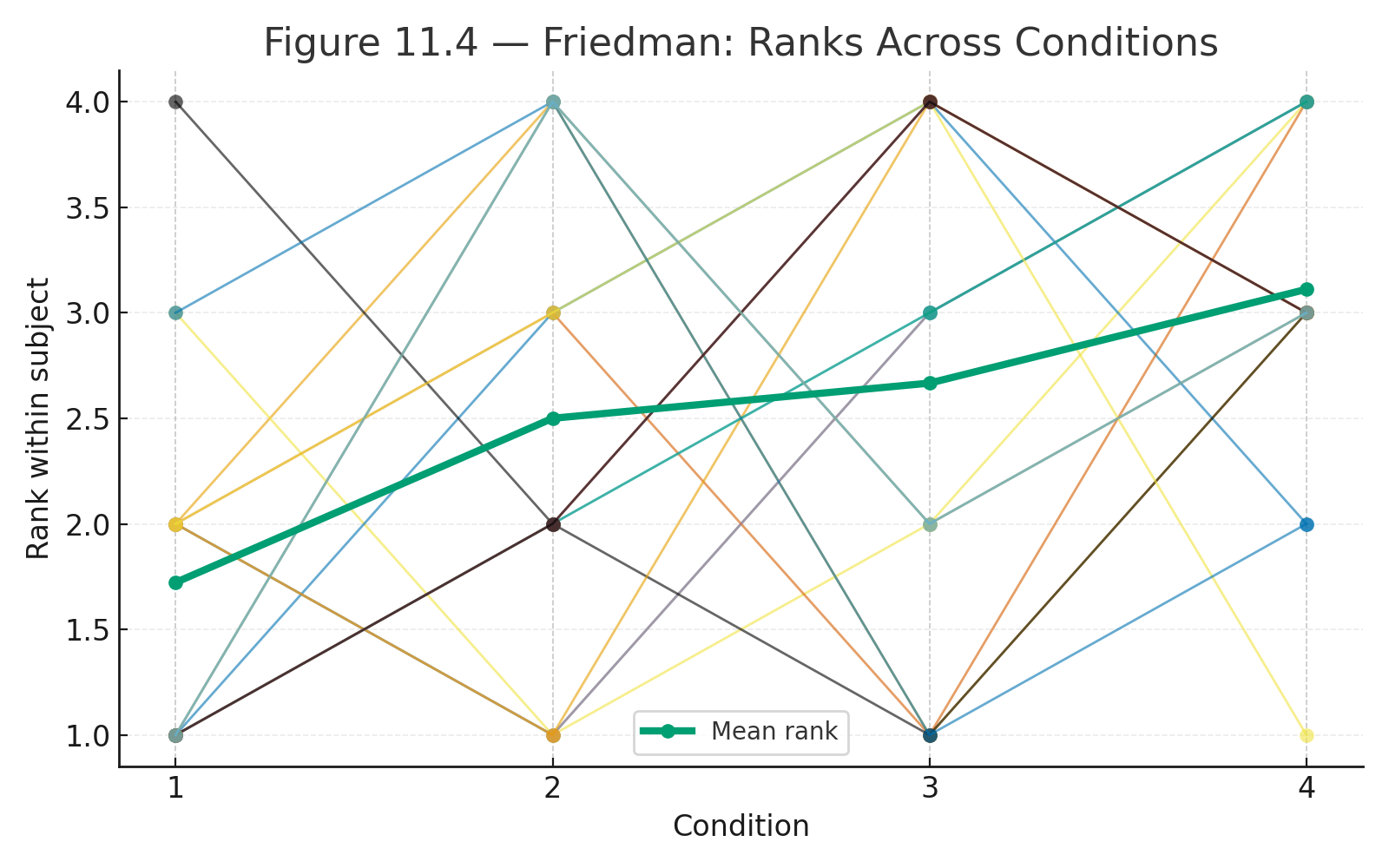
10 participants ranked across 3 learning tasks. Compare Q to χ² distribution.


Definition

  • Non-parametric tests: statistical tests based on ranks, not raw scores
  • Used when parametric assumptions fail or data are ordinal

Visuals

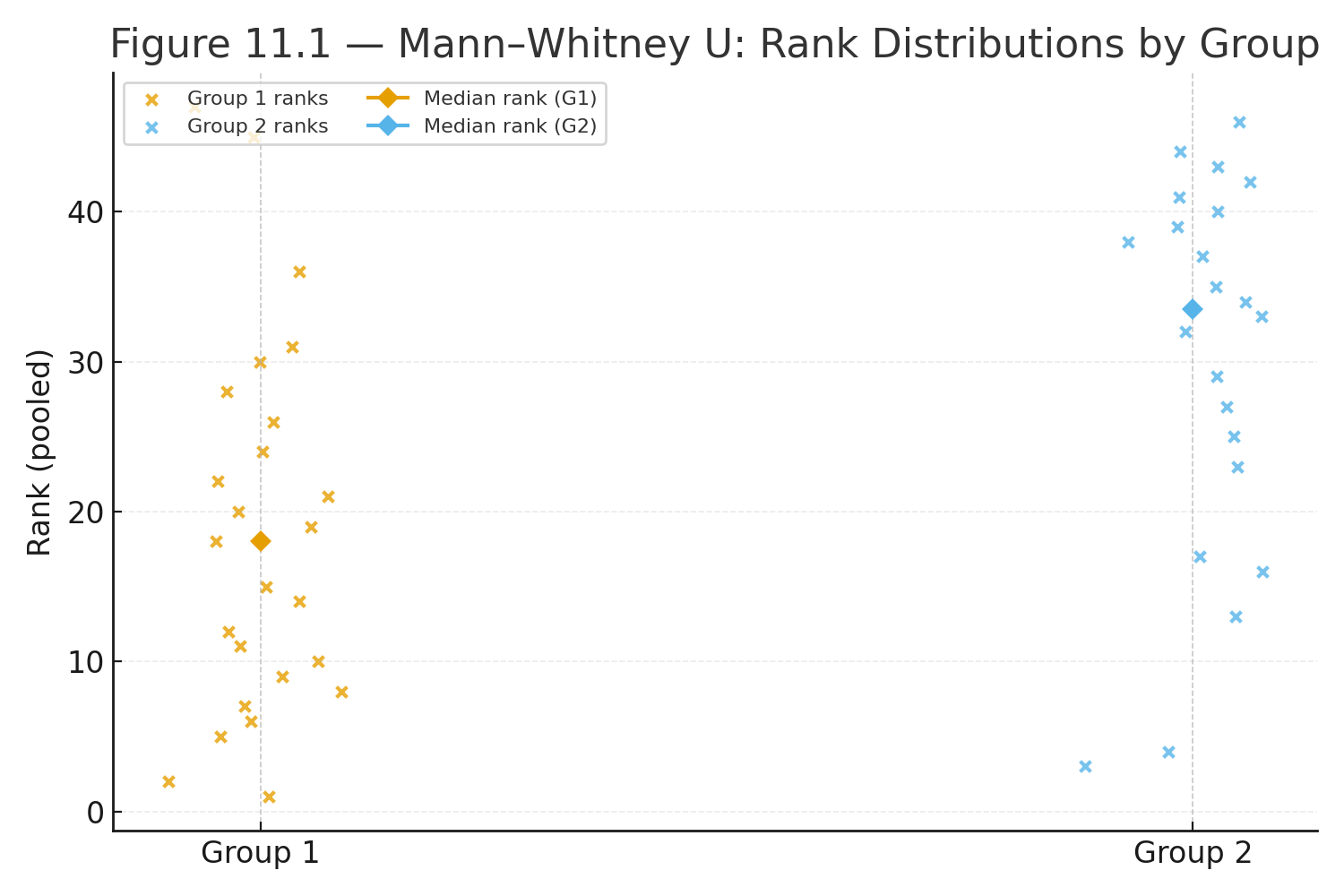
Figure 11.1 — Mann–Whitney U test: two groups compared by rank distributions.

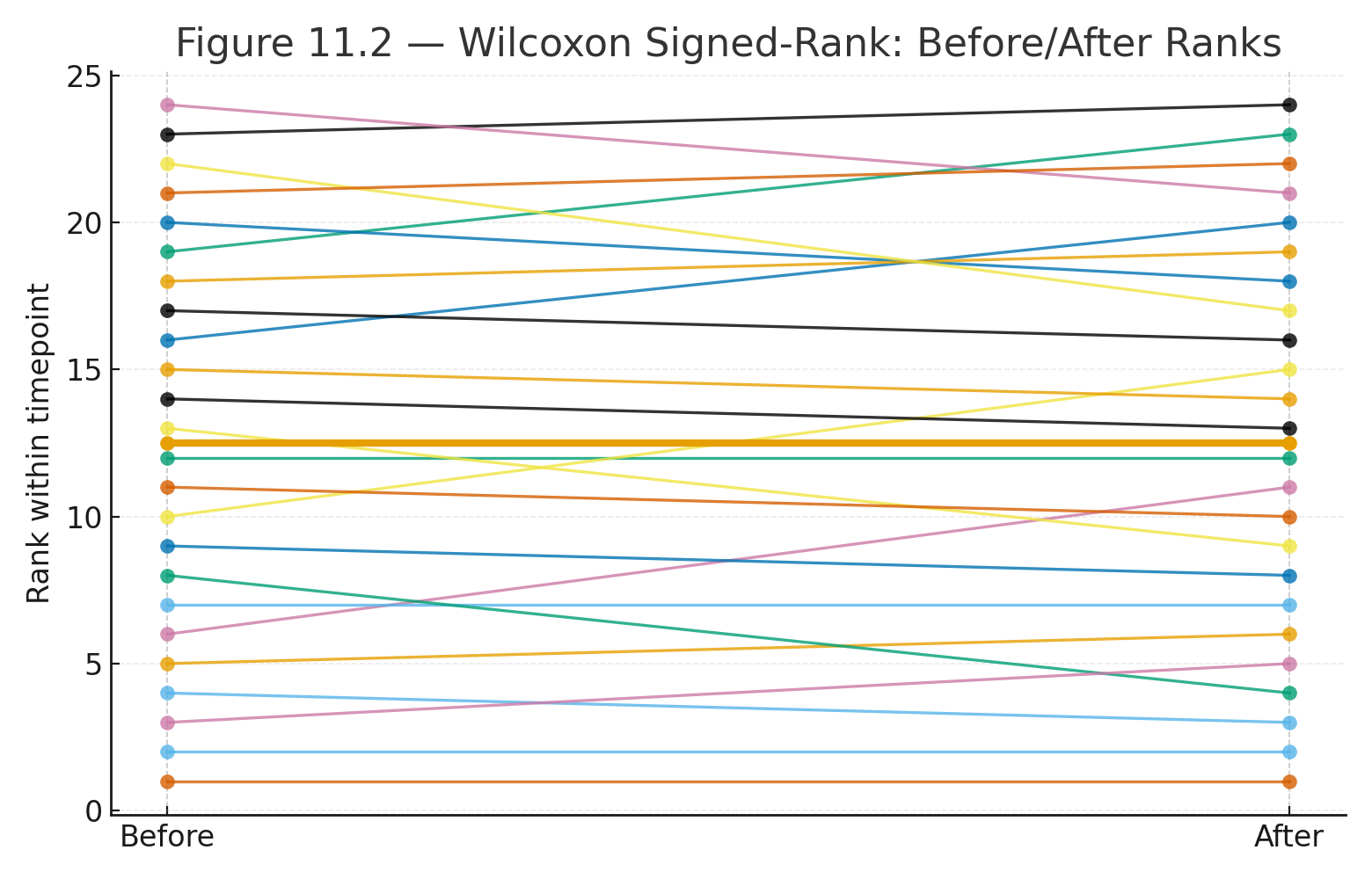
Figure 11.2 — Wilcoxon signed-rank: before/after ranks with arrows.

Figure 11.3 — Kruskal–Wallis layout: three groups compared by median ranks.

Figure 11.4 — Friedman layout: subjects compared across repeated conditions.


Why This Matters

Non-parametric tests give us flexibility.
They extend statistical reasoning to real-world data that are messy, skewed, or categorical.
They are essential tools for psychology, education, and biology.

Practice self-test quiz

In the space below, please find practice problems and self-test quizzes. For full access, please signup free.

Identify the Design


Case 1

Scenario: A teacher compares test scores of students in two different classrooms (Class A vs. Class B).
Question: Are the two groups significantly different in mean score?
Answer: Independent-samples t-test.


Case 2

Scenario: A researcher tests the same group of students before and after tutoring.
Question: Did their scores improve after the program?
Answer: Paired-samples t-test (dependent t-test).


Case 3

Scenario: Three groups of students use different study methods: flashcards, highlighting, and practice tests.
Question: Do the study methods lead to different mean scores?
Answer: One-way ANOVA.


Case 4

Scenario: A psychologist measures anxiety scores in patients given three different drugs.
Question: Do the drugs produce different mean anxiety scores?
Answer: One-way ANOVA.


Case 5

Scenario: A study compares two groups of athletes: runners vs. swimmers, on reaction time.
Question: Are the two sports groups different in mean reaction time?
Answer: Independent-samples t-test.


Case 6

Scenario: Students are tested at three times: beginning, middle, and end of the semester.
Question: Did their scores change over time?
Answer: Repeated-measures ANOVA.


Case 7

Scenario: Two teaching methods (Lecture, Online) are tested across two times of day (Morning, Afternoon).
Question: What are the effects of method, time, and their interaction?
Answer: Two-way (factorial) ANOVA.


Case 8

Scenario: A company compares productivity of three work shifts (Day, Evening, Night) across two departments (Sales, Service).
Question: Are there main effects of shift and department, and is there an interaction?
Answer: Two-way (factorial) ANOVA.


Case 9

Scenario: Students are randomly assigned to a control or experimental group, and both groups are measured three times (Weeks 1, 2, 3).
Question: Is there an effect of group, time, and interaction?
Answer: Mixed (split-plot) ANOVA.


Case 10

Scenario: A survey asks students to choose their favorite subject: Math, Science, or English.
Question: Is the distribution of responses different from chance?
Answer: Chi-square goodness-of-fit test.


Case 11

Scenario: A researcher studies whether gender (Male, Female) is related to preference for sports (Soccer, Basketball, Tennis).
Question: Is there an association between gender and sport preference?
Answer: Chi-square test of independence.


Case 12

Scenario: Students are ranked by teacher ratings: 1st, 2nd, 3rd, etc. Two different teaching methods are compared on these ranks.
Question: Do the groups differ in median ranks?
Answer: Mann–Whitney U test (non-parametric).


Case 13

Scenario: The same students are ranked before and after a training program.
Question: Did the ranks change after training?
Answer: Wilcoxon signed-rank test (non-parametric).

Practice self-test quiz

In the space below, please find practice problems and self-test quizzes. For full access, please signup free.