Story 5 — My Zero Is Not Zero
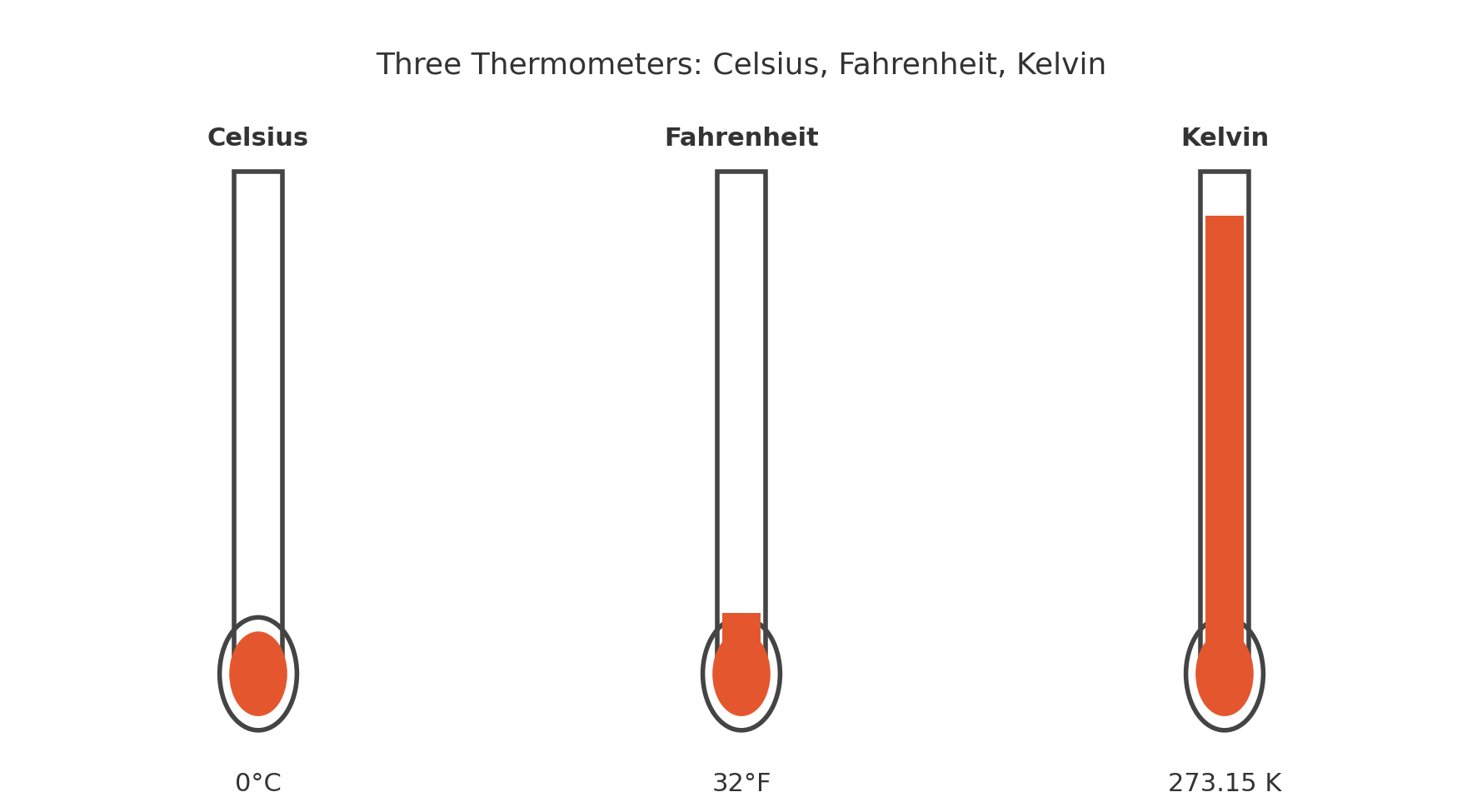
C, F, K thermometers juxstaposed

Drama: The Frozen Lab

Midnight in a physics laboratory.
The digital clock glows blue against the stainless steel counters. A researcher leans over a glass chamber filled with swirling vapor. The temperature sensors hum quietly.

She adjusts a dial—then another. The vapor slows, the molecular motion within it decreasing. The digital display falls:
5 Kelvin… 3 Kelvin… 1 Kelvin…

Finally, the numbers stabilize.
0 Kelvin.

She looks up and whispers, “Nothing moves.”

For the first time, zero means nothing at all. No motion. No energy. Not “cold,” not “less heat”—but the absence of temperature itself.

In this moment, measurement meets reality. The number zero no longer stands as a symbol or label—it marks the true origin of what is measured.


From Story to Concept: The Ratio Scale

In advanced sciences such as physics, measurement itself becomes a science.
When physicists speak of zero, they do not mean “a small number.” They mean the absence of what is measured.

Zero degrees on the Kelvin scale corresponds to the total absence of molecular motion, because temperature, in physical terms, is molecular motion.
At 0 K, nothing moves.

The ratio scale of measurement resembles the interval scale—equal distances between numbers—but goes further.
Here, zero is not arbitrary. It represents the true zero point in the phenomenon being measured.

With this foundation, we can now perform every mathematical operation:

  • Addition and subtraction (differences between quantities)
  • Multiplication and division (ratios, proportions, rates)

In ratio measurement, numbers are not merely symbolic; they are structural reflections of reality.
They allow science to speak in the language of law and proportion.

The ratio scale is the pinnacle of measurement:
zero becomes origin, and quantity becomes truth.

Practice self-test quiz

In the space below, please find practice problems and self-test quizzes. For full access, please signup free.
Story 4 — The Interval Scale of Measurement

The Interval Scale of Measurement

Drama: The Cold Morning

It’s a winter morning in New York. You wake up, open your phone, and check the weather. It says 32°F.
You sigh, grab your coat, and head out. The air bites your face.

By the time you reach the subway, your phone says 31°F. You frown. Has it really changed that much? You shrug.
Then you remember your cousin in Los Angeles posted a photo this morning: 62°F and sunny.

You type quickly:

“Hey, you’re twice as warm as I am!”

Then you stop. Something feels wrong.
Can 62 really be twice as warm as 31?
It feels like it, but you know it’s not true.

Later, in class, your statistics instructor confirms it:

“Temperature in Fahrenheit is interval, not ratio**.** You can add and subtract, but you can’t multiply or divide meaningfully. There’s no true zero—no absolute absence of heat.”

You smile. The world feels slightly warmer already.


From Story to Concept: The Interval Scale

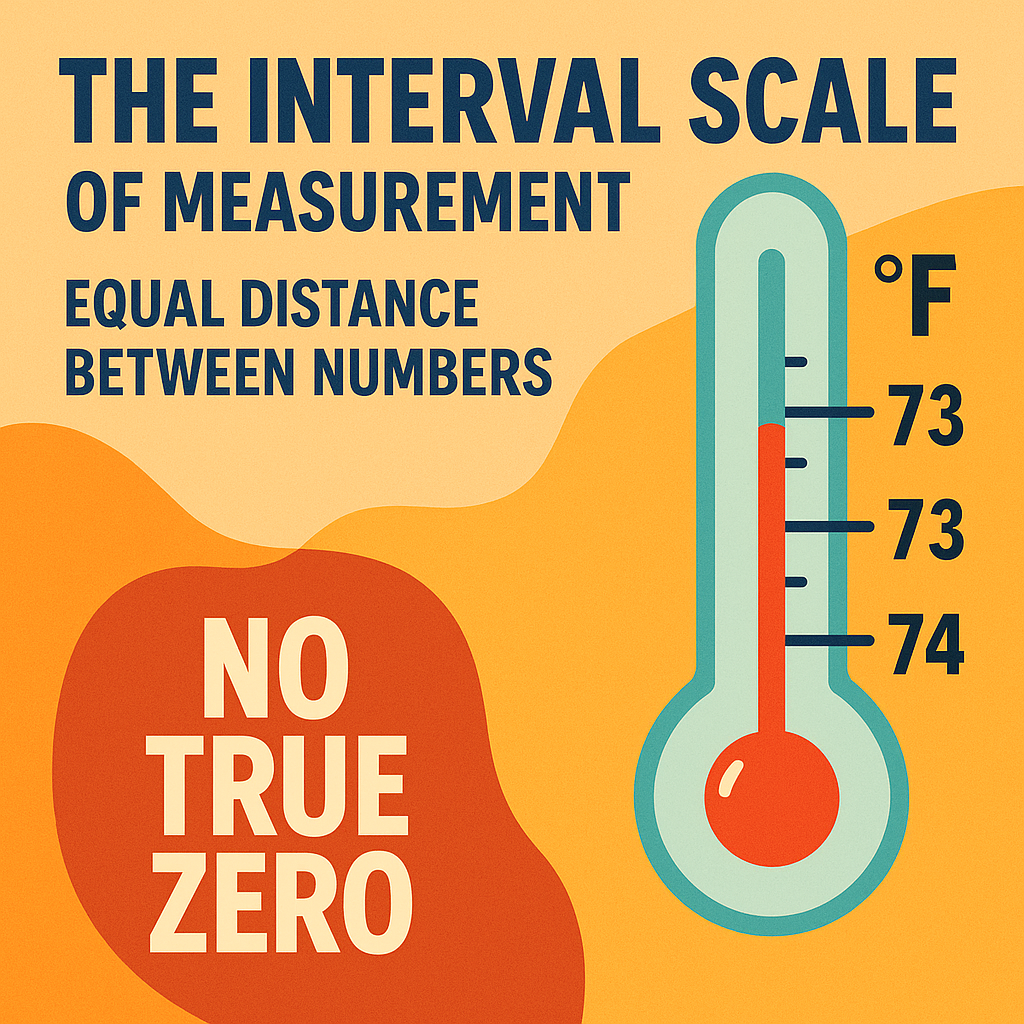
In the interval scale, the distance between numbers is equal.
Between 72 and 73 degrees Fahrenheit, the difference is the same as between 73 and 74.
You can even express subdivisions—72.4, 72.6—with equal precision.

This scale has a clear advantage over the nominal and ordinal types:
you can now perform addition and subtraction, and, in practice, even averages and standard deviations make sense.

However, one key element is missing: a true zero point.
Zero degrees Fahrenheit doesn’t mean no temperature; it simply marks an arbitrary point on the scale.

So while the interval scale lets you measure and compare distances precisely, it cannot meaningfully express ratios.
You can say it’s 10 degrees warmer today than yesterday—but not that it’s twice as warm.

The interval scale is a triumph of human thought—measurement without absolutes, order with equal steps but no foundation.


Practice self-test quiz

In the space below, please find practice problems and self-test quizzes. For full access, please signup free.

Story 3 — The Ordinal Scale of Measurement

The Ordinal Scale of Measurement99

Drama: Who’s Bigger

Twenty-first century Athens.
Today is the women’s Marathon.

Before you leave home, you catch a glimpse of the start line on television. The runners are ready in Marathon, the historic starting point. The finish line, as always, is the grand stadium in downtown Athens—the same place where the ancient games once ended.

You return home at dinner time. The family is gathered around the television, watching the news. Three winners stand proudly on the podium as the national anthems play.

“Great athletes!” you say.

Your family bursts into laughter.

“What’s so funny?” you ask. “Did I say something wrong? That was a great race—especially in this city’s smog!”

They laugh even harder. Finally, your father explains.

“The first runner truly was great—she broke the world record. But the second also broke the world record, only in a negative sense. She took so long to finish that no one in recorded history has ever taken that long. The smog made all the runners faint!”


From Story to Concept: The Ordinal Scale

This type of measurement has an advantage over the nominal scale: it tells you which element is greater or lesser.
It introduces order.

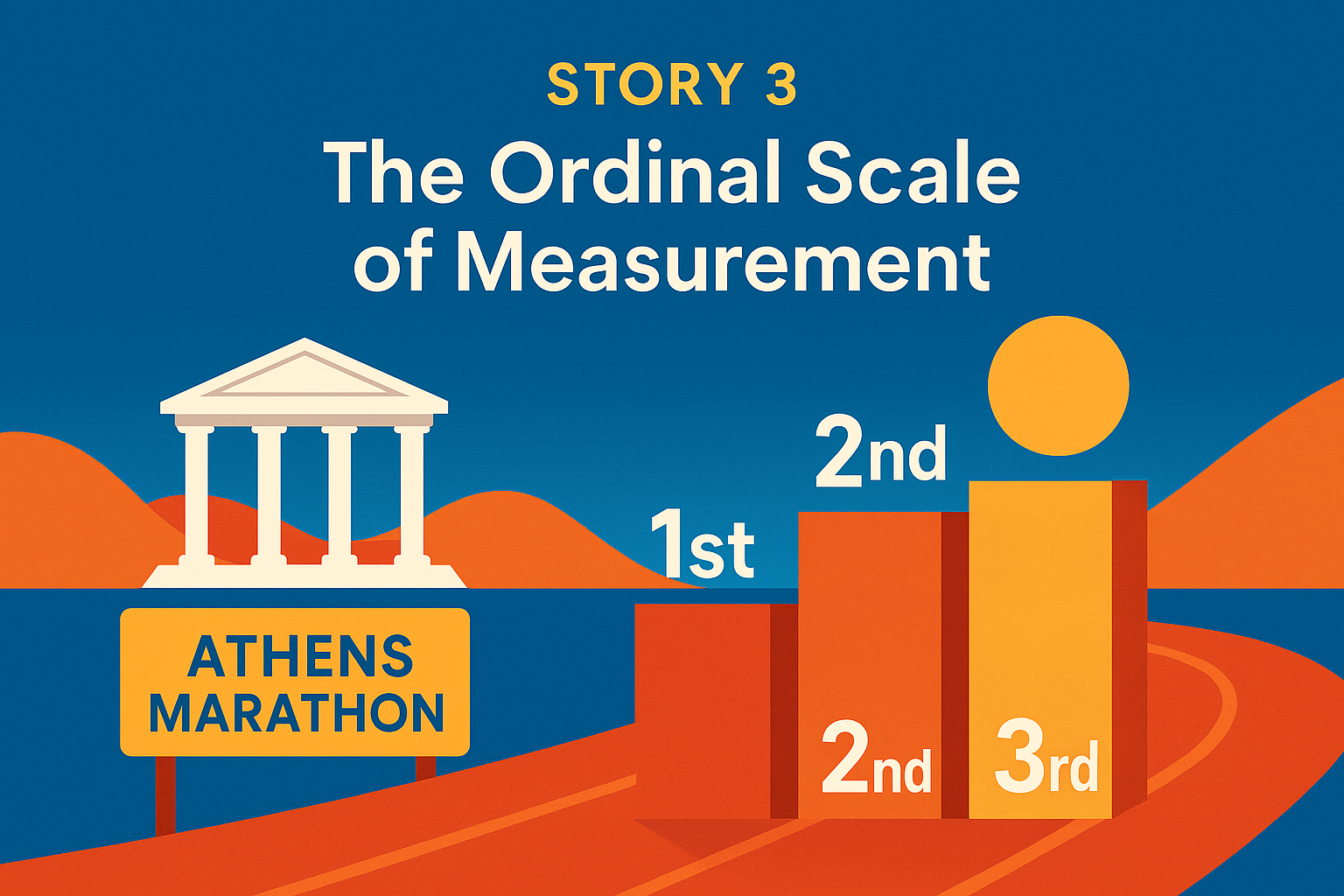
You can now say who finished first, second, and third.
But you still don’t know by how much they differ.

The ordinal scale gives you ranking, not magnitude.
It answers which is greater, but not how much greater.

You cannot add, subtract, multiply, or divide ordinal numbers. You cannot calculate means or standard deviations. You cannot run sophisticated statistical analyses.

The ordinal scale is, in its essence, primitive—but revolutionary. It marks humanity’s first attempt to compare, to arrange, to impose order on experience.

It is the bridge between naming and measuring.

Practice self-test quiz

In the space below, please find practice problems and self-test quizzes. For full access, please signup free.

Story 2 — No-Number Numbers

Nominal numbers

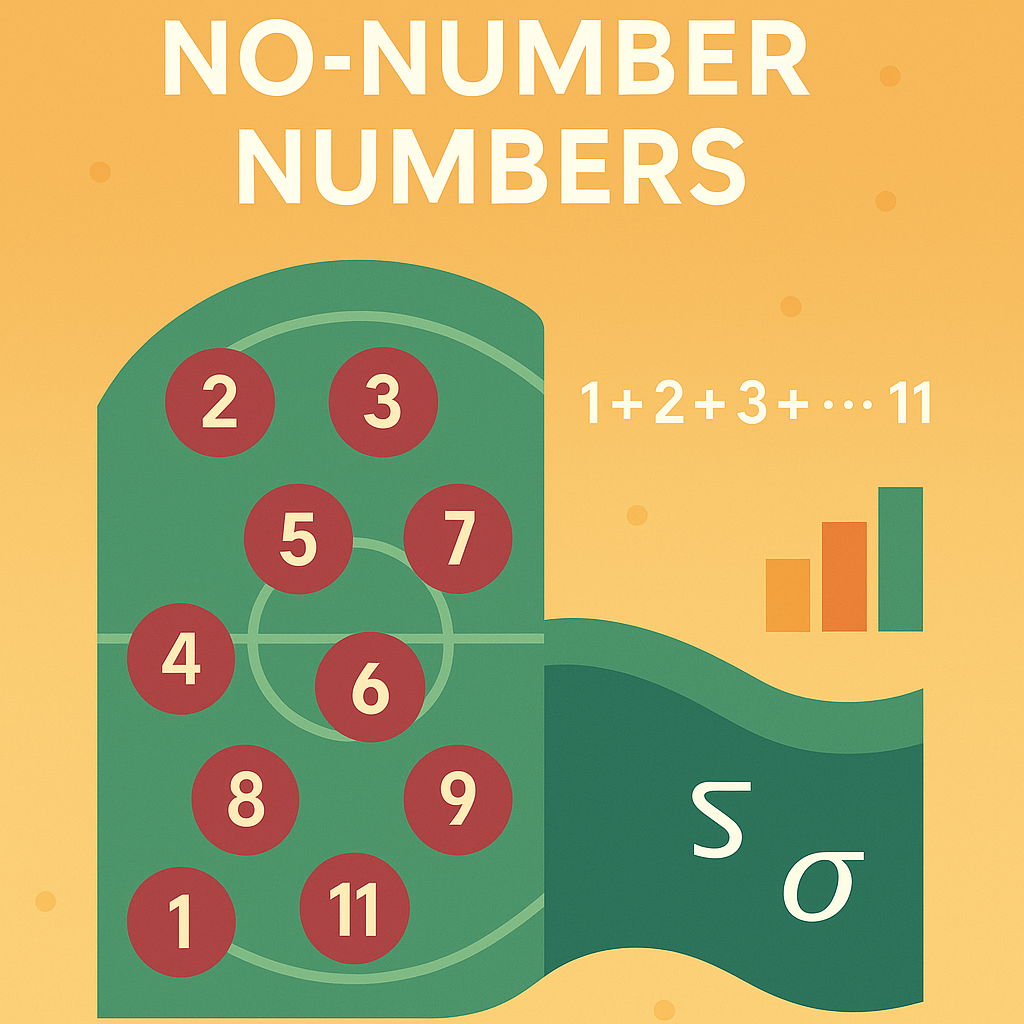
It’s a Saturday afternoon on a soccer field in New York.
You’re sitting in the stands with your friends, pretending to enjoy the game. The truth is, you’re not much of a soccer fan. You open your laptop and drift into your own world.

Your friends are shouting and jumping with excitement. You, on the other hand, are studying the players.
You notice the numbers on their shirts.

“Hey,” you say, “who’s the guy with the number 11? He must be the best on the team. Poor number 3—he’s probably one of the worst.”

Your friends give you a look that says, please stop talking.

Unbothered, you go further:
“Guys, if you add up all the numbers on their shirts—1 + 2 + 3 + 4 + 5 + 6 + 7 + 8 + 9 + 10 + 11—it’s 66!”

You grin, waiting for applause.

Nothing.

So you take it up a notch.
You open your laptop, punch in the numbers, and announce proudly,
“I just calculated the standard deviation of the team’s jersey numbers!”

You never finish your sentence.
Your friends grab you, laughing, and shove you gently into the aisle.


From Story to Concept: The Ordinal Scale

The story of the soccer field is about numbers that aren’t really numbers.
The digits on the players’ shirts don’t measure anything. They only distinguish. Number 11 isn’t better than number 3, and adding 8 and 9 doesn’t produce a meaningful 17.

These are nominal numbers—they serve as labels, not quantities.
But we’re about to move one step further, to the next great human leap: the moment when order enters the world of measurement.

Practice self-test quiz

In the space below, please find practice problems and self-test quizzes. For full access, please signup free.


Story 1 — Numbers, Quantities, Measurement

Nominal scale of measurement

The Four Scales of Measurement

Nominal, ordinal, interval, ratio.
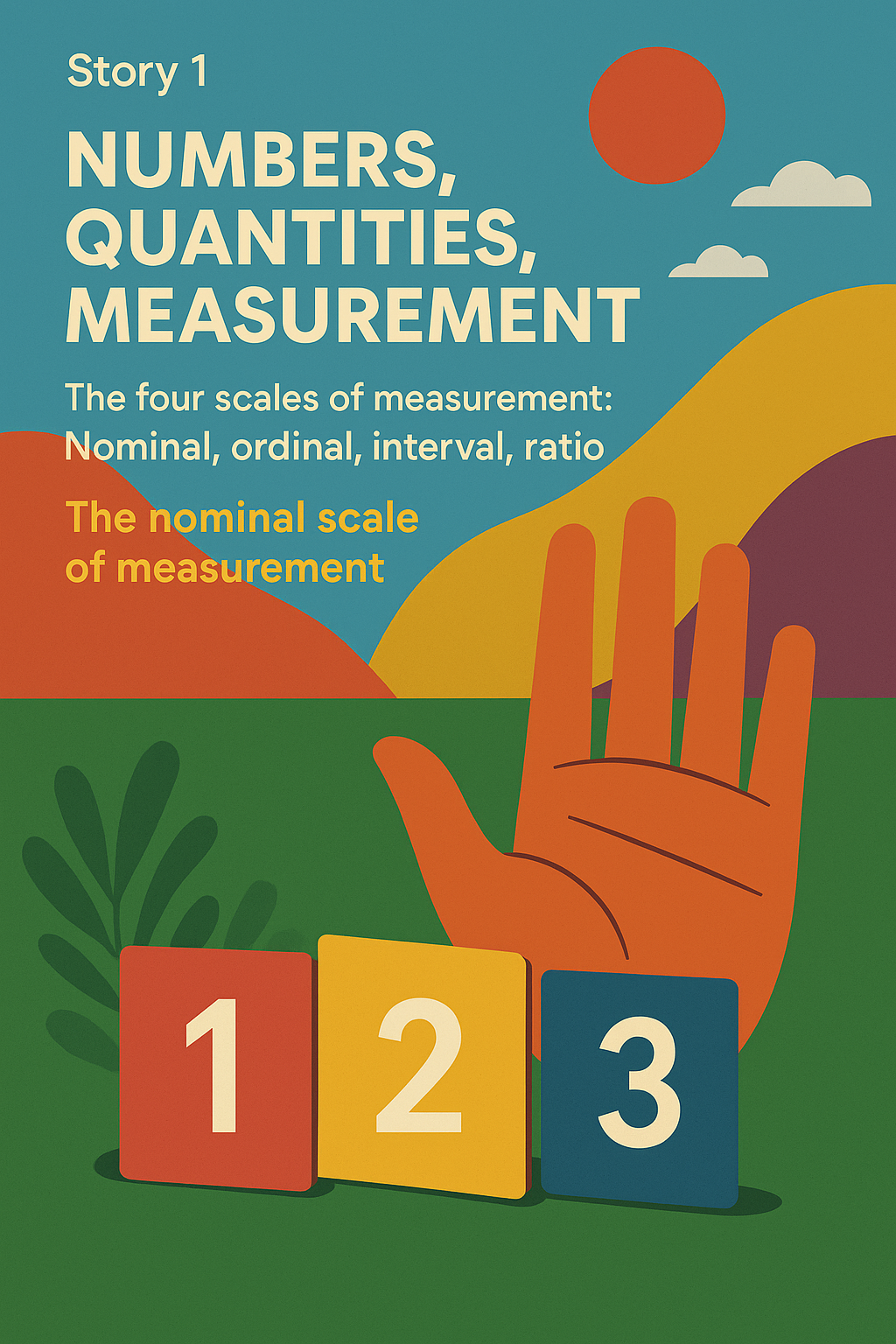
The first story belongs to the nominal scale—the simplest, and the oldest.


Drama: My Kids, My Fingers

A family of early Homo sapiens sits around a fire in a cave in Africa, devouring the evening meal of a goat-like animal. The children dance and chase each other; the women laugh and talk. The man stares into the dark mouth of the cave.

Now he raises his hands before his eyes. With the index finger of his right hand, he touches each finger of his left—one by one—his gaze fixed on his children. One child, one finger. He repeats the ritual with his other hand.

The next morning, he is crouched in the brush, waiting for game to pass. Again, he looks down at his hands. His eyes move from finger to finger—and he smiles. He knows how many children he has.

No words, no symbols. Only the raw sense of how many. The first pulse of number—the intuition of quantity—is born.

Thousands of years later, the names of each finger will no longer name a child but will stand for frequency, count, occurrence. They will become symbols: words like one, two, three.

And much later still, the words themselves will take form as written marks:
1, 2, 3.

Primitive arithmetic, yes—but also the first spark of the human mind’s most powerful invention: measurement.


From Story to Concept: The Nominal Scale

The man in the cave did not yet know numbers.
What he had discovered was naming.

He had no word for “one,” “two,” or “three.” But he knew this child and that child.
He separated—distinguished—each entity in his world. His perception of difference was the first act of measurement.

The nominal scale is born from that primitive gesture: the act of naming things to make them distinct.
It is the simplest form of measurement—no order, no magnitude, no arithmetic.

When we assign labels such as male and female, red and blue, apple and pear, we are using the nominal scale. These names carry identity but not quantity.
They answer the question what, not how many or how much.

In the story, each finger represented a child—not a number, but a name, a mark of uniqueness. The father’s counting was not numerical; it was symbolic, categorical. He was labeling, not adding.

Later in history, this act of naming evolved into words that expressed magnitude—one, two, three.
But before there were numbers, there were names.
And before there was mathematics, there was distinction—the mind’s first measurement of the world.

Practice self-test quiz

In the space below, please find practice problems and self-test quizzes. For full access, please signup free.
Part 8 --- The Storyteller Statistician

The storyteller statistiian

Part 7: The Storyteller Statistician

Think statistics means scary formulas and endless algebra? Think again.

In this part you only need everyday arithmetic: addition, subtraction, multiplication, and division. Most formulas are written in plain words rather than symbols — and you really only need to master one core idea.

This book is designed for high school students heading toward college science majors (and anyone who wants to understand statistics in the real world). Few high school textbooks cover so many statistical tests — and even fewer explain complex designs such as mixed or split-plot ANOVA, which can feel truly challenging but rewarding.

What sets this resource apart is its focus on real-life application. Most people use statistics in practical research, not in abstract mathematics. Learning to plug numbers into complicated equations is useful, but it is not enough. Real understanding comes from experience in actual research settings — exactly what these stories aim to build.

Stories in Part 7

Complete list of stories

  • Story 1 — Numbers, Quantities, Measurement How we turn observations into numbers we can trust.
  • Story 2 — No-Number Numbers When "numbers" are really categories or ranks.
  • Story 3 — The Ordinal Scale of Measurement Ranking things without assuming equal intervals.
  • Story 4 — The Interval Scale of Measurement Equal differences that still lack a true zero.
  • Story 5 — My Zero Is Not Zero Why zero can be arbitrary — and what that means for data.
  • Story 6 — The Goddess Normal Curve Why the bell curve appears everywhere — and how to use it wisely.
  • Story 7 — Variance and Standard Deviation Measuring how spread out your data really is.
  • Story 8 — The Uses of the Normal Distribution Everyday applications beyond the basics.
  • Story 9 — Normal Distribution: Use #1 — Describing and Organizing Data Using the curve to summarize and compare groups.
  • Story 10 — Normal Distribution: Use #2 — Making Statements of Probability and Betting Turning the curve into probabilities for decisions and risks.
  • Story 11 — Normal Distribution: Use #3 — Reliability of a Single Mean Confidence intervals for one group's average.
  • Story 12 — Normal Distribution: Use #4 — Reliability of the Difference Between Two Means Comparing groups with statistical confidence.
  • Story 13 — The t-test The go-to test when samples are small or variance unknown.
  • Story 14 — An Example of the t-test A step-by-step real-world application.
  • Story 15 — Analysis of Variance: One-Way ANOVA Comparing means across more than two groups.
  • Story 16 — Analysis of Variance: Factorial Designs Testing multiple factors and their interactions at once.
  • Story 16A — Example of a 2×2 Factorial Experiment A concrete look at two factors interacting.
  • Story 16B — Example 2 of a 2×2 Factorial Experiment Another practical illustration of interactions.
  • Story 17 — Example of a 2×3 Factorial Experiment Expanding to more levels for richer insights.
  • Story 18 — Repeated-Measures ANOVA Analyzing the same subjects over time or conditions.
  • Story 19 — Complex, Mixed, Split-Plot Designs (ANOVA) Handling advanced, real-world experimental structures.

These stories take you from basic measurement to advanced ANOVA designs — all told through real-world examples and simple reasoning. Start wherever you like, or follow the sequence in the book navigation. Which story surprises you most? Share your thoughts in the comments below!

Appendix 8 — Glossary of Key Terms

Mean (average)
Sum of all scores divided by number of scores.
Example: (6 + 8 + 10) / 3 = 8.

Median
Middle score when data are ordered.
Example: For [5, 7, 8], median = 7.

Mode
Most frequent score.
Example: For [2, 3, 3, 5], mode = 3.

Variance (s²)
Average squared deviation from the mean.

Standard Deviation (s)
Square root of variance. Spread of scores around the mean.

Standard Error of the Mean (SEM)
How much sample means vary.
Formula: $$SEM = \frac{s}{\sqrt{n}}$$

t-test
Compares two means.

ANOVA (F-test)
Compares three or more means.

Post Hoc Test
Used after ANOVA to find which groups differ.

Correlation (r)
Strength and direction of a linear relationship. Range: –1 to +1.

Regression
Equation that predicts Y from X.
Example: $$\hat{Y} = a + bX$$

Chi-square (χ²)
Test for categorical data (counts).

Degrees of Freedom (df)
Independent pieces of information in a test.

p-value
Probability of getting the observed result (or more extreme) if the null hypothesis is true.


📱 QR: Interactive glossary (search symbols, formulas, definitions)

Practice self-test quiz

In the space below, please find practice problems and self-test quizzes. For full access, please signup free.
Appendix 7 — Study Tips for Statistics

Learning statistics is not about memorizing formulas — it’s about thinking with data.
Here are some strategies to make it easier.


1. Read Formulas in Two Ways

  • Symbolic: $$\bar{X} = \frac{\Sigma X}{n}$$
  • Words: “Mean = sum of scores / number of scores”

2. Practice by Hand First

  • Work out a mean or variance with a small dataset.
  • Then check with calculator/Excel.
  • This builds intuition and confidence.

3. Draw Pictures

  • Normal curve with shaded area
  • Bar charts for group means
  • Scatterplots for correlation
    Visuals make ideas stick.

4. Watch Out for Common Mistakes

  • Mixing up SD and SEM
  • Forgetting to subtract 1 for df
  • Using a one-tailed test when two-tailed is needed

5. Use Short Sessions

  • 10–15 minutes of practice each day beats one long cram.
  • Try one formula or test per session.

6. Check Your Understanding

  • Can you explain in words what the test does?
  • Example: “t-test compares two means. ANOVA compares three or more.”

📱 QR: Online flashcards + short quiz (practice key terms & formulas)


Practice self-test quiz

In the space below, please find practice problems and self-test quizzes. For full access, please signup free.

Appendix 6 — Data Sets for Practice

spreadsheet dataset

```html

Appendix 6 — Data Sets for Practice

Working with real numbers is the best way to learn statistics. This appendix provides small “mini datasets” you can analyze by hand (or with a calculator), plus larger files for practice with spreadsheets.


Dataset Provenance (Read This First)

  • Pedagogical = small, simplified numbers chosen to make learning and checking easier.
  • Simulated = computer-generated numbers designed to resemble real data (not collected from real people).
  • Empirical = collected from real observations (only used if explicitly stated).

Note: Unless a dataset is explicitly labeled Empirical, you should treat it as Pedagogical or Simulated practice data.


Mini Datasets (In-Page)

1) Quiz Scores

Provenance: Pedagogical
n: 10
Scale: Ratio (points)
Data: 6, 7, 8, 9, 10, 7, 8, 6, 9, 10

  • Suggested Lessons:
    • Lesson 2 — The Averages: mean, median, mode
    • Lesson 3 — Variance & Standard Deviation: variance, SD, z-scores
    • Lesson 4 — The Standard Normal Curve: interpret z-scores (as a bridge)
  • Check values (optional): Mean = 8.0; SD ≈ 1.41

2) Reaction Times (ms)

Provenance: Pedagogical (human-like values)
n: 8
Scale: Ratio (milliseconds)
Units: ms
Data: 220, 250, 270, 230, 260, 280, 240, 300

  • Suggested Lessons:
    • Lesson 3 — Variance & Standard Deviation: spread, outliers, SD
    • Lesson 6 — The t-test: use as a template dataset (e.g., compare two conditions by splitting into two groups)
    • Lesson 7 — ANOVA: extend to 3+ groups by creating conditions
  • Instructor tip: reaction time data often show mild skew in real life. If you want skew, see the larger practice files below.

3) Stress Reduction Scores (Three Groups)

Provenance: Pedagogical (grouped scores)
Scale: Interval/Ratio (score units; treat as interval for ANOVA practice)
Groups:

  • Meditation (n = 3): 65, 70, 72
  • Exercise (n = 3): 68, 71, 75
  • Music (n = 3): 75, 78, 82
  • Suggested Lessons:
    • Lesson 7 — ANOVA: one-way ANOVA (three independent groups)
    • Lesson 8 — Post Hoc Tests: follow-up comparisons after ANOVA (conceptual)
    • Lesson 13 — Degrees of Freedom Cookbook: df for one-way ANOVA
  • Important note: The sample sizes are intentionally small for learning mechanics. In real studies, groups are usually larger.

Larger Practice Datasets (Download Files)

These datasets are designed for spreadsheet work, graphing, and full problem sets.

  • Exam Scores (n = 100)
    Provenance: Simulated
    Suggested Lessons: Lesson 4 (normal curve), Lesson 5 (SEM), Lesson 6 (t-test foundations)
  • Survey Data (preferences by gender/age)
    Provenance: Simulated (categorical practice)
    Suggested Lessons: Lesson 12 (chi-square), Lesson 1 (why statistics matters in decisions)
  • Simulated Medical Trial (treatment vs. control, repeated measures)
    Provenance: Simulated (instructional “trial-style” dataset; not clinical research)
    Suggested Lessons: Lesson 6 (t-test concepts), Lesson 7 (variance partitioning concepts), and for advanced learners: repeated-measures ideas (optional)

Downloads: CSV and Excel files are provided via the QR code(s) on this page (and/or direct links, if enabled on your device).

Reproducibility note (simulated files): If you revise these datasets in future editions, consider generating them with a fixed random seed so instructors and students can reproduce results across versions.


Trusted External Sources (Optional)

If you want additional datasets beyond the practice files above, the following repositories are widely used for learning and benchmarking:

  • NIST Statistical Reference Datasets (SRD)
    High-quality benchmark datasets for practice and verification (excellent for checking calculations and software).
  • UCI Machine Learning Repository
    Larger, more complex datasets. Recommended only for advanced students or enrichment projects.

Visual Reference

Figure F.1 — Example spreadsheet view of a dataset (columns such as ID, Score, Group). Use this as a template for organizing your own data before running calculations.


Self-Test Quiz Access

Practice problems and self-test quizzes may appear below. If full access is restricted, please sign up (free) to unlock the quiz section.

```

Appendix 5 — Technology Tips (On Your Phone & Laptop)

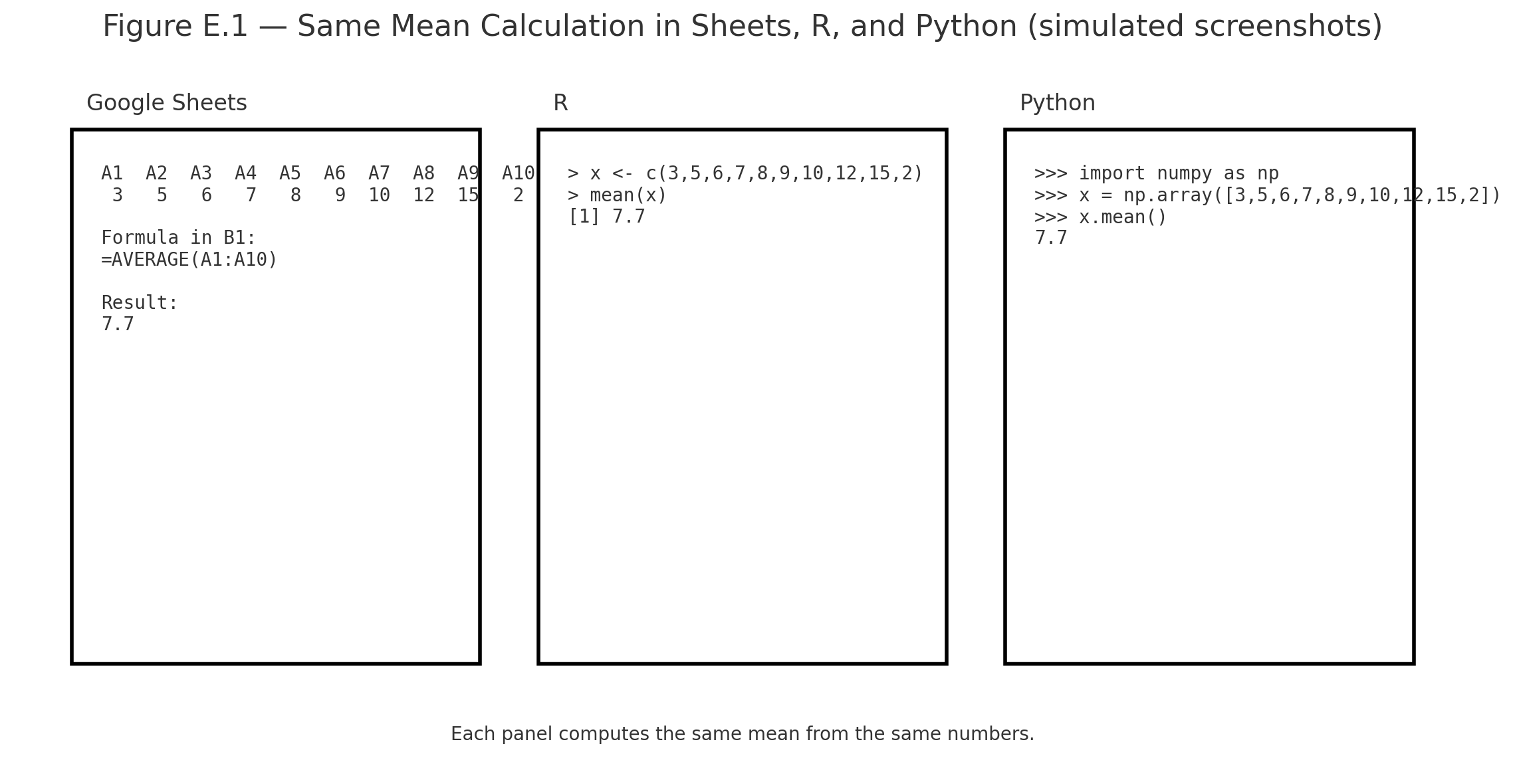
mean across tools

Statistics can be done with calculators, spreadsheets, or software. Here’s a quick guide.


Excel / Google Sheets

TaskFormulaExample
Mean=AVERAGE(A1:A10)Mean of scores in A1–A10
Standard Deviation=STDEV.S(A1:A10)Spread of scores
t-test=T.TEST(A1:A10,B1:B10,2,2)Compare two groups

R (RStudio or RStudio Cloud)

TaskCommandExample
Meanmean(x)mean(c(6,8,10)) = 8
SDsd(x)sd(c(6,8,10)) = 2
t-testt.test(x,y)Compare two groups

Python (NumPy / SciPy / Pandas)

TaskCommandExample
Meannp.mean(x)np.mean([6,8,10]) = 8
SDnp.std(x, ddof=1)np.std([6,8,10],ddof=1) = 2
t-teststats.ttest_ind(x,y)Compare two groups

iPhone Calculator

  • Rotate sideways → scientific mode
  • Use √ for square root
  • Parentheses matter: type numerator, then divide by denominator
  • Fine for small problems, but not for full datasets

Summary

  • For quick homework: iPhone calculator
  • For assignments: Excel / Google Sheets
  • For coding: Python (Colab) or R (RStudio Cloud)

📱 QR: Open sample data in Google Sheets (ready to practice mean, SD, t-test)


Visuals

Figure E.1 — Screenshots of the same mean calculation in Sheets, R, and Python side by side.

Practice self-test quiz

In the space below, please find practice problems and self-test quizzes. For full access, please signup free.