Identify the Design


Case 1

Scenario: A teacher compares test scores of students in two different classrooms (Class A vs. Class B).
Question: Are the two groups significantly different in mean score?
Answer: Independent-samples t-test.


Case 2

Scenario: A researcher tests the same group of students before and after tutoring.
Question: Did their scores improve after the program?
Answer: Paired-samples t-test (dependent t-test).


Case 3

Scenario: Three groups of students use different study methods: flashcards, highlighting, and practice tests.
Question: Do the study methods lead to different mean scores?
Answer: One-way ANOVA.


Case 4

Scenario: A psychologist measures anxiety scores in patients given three different drugs.
Question: Do the drugs produce different mean anxiety scores?
Answer: One-way ANOVA.


Case 5

Scenario: A study compares two groups of athletes: runners vs. swimmers, on reaction time.
Question: Are the two sports groups different in mean reaction time?
Answer: Independent-samples t-test.


Case 6

Scenario: Students are tested at three times: beginning, middle, and end of the semester.
Question: Did their scores change over time?
Answer: Repeated-measures ANOVA.


Case 7

Scenario: Two teaching methods (Lecture, Online) are tested across two times of day (Morning, Afternoon).
Question: What are the effects of method, time, and their interaction?
Answer: Two-way (factorial) ANOVA.


Case 8

Scenario: A company compares productivity of three work shifts (Day, Evening, Night) across two departments (Sales, Service).
Question: Are there main effects of shift and department, and is there an interaction?
Answer: Two-way (factorial) ANOVA.


Case 9

Scenario: Students are randomly assigned to a control or experimental group, and both groups are measured three times (Weeks 1, 2, 3).
Question: Is there an effect of group, time, and interaction?
Answer: Mixed (split-plot) ANOVA.


Case 10

Scenario: A survey asks students to choose their favorite subject: Math, Science, or English.
Question: Is the distribution of responses different from chance?
Answer: Chi-square goodness-of-fit test.


Case 11

Scenario: A researcher studies whether gender (Male, Female) is related to preference for sports (Soccer, Basketball, Tennis).
Question: Is there an association between gender and sport preference?
Answer: Chi-square test of independence.


Case 12

Scenario: Students are ranked by teacher ratings: 1st, 2nd, 3rd, etc. Two different teaching methods are compared on these ranks.
Question: Do the groups differ in median ranks?
Answer: Mann–Whitney U test (non-parametric).


Case 13

Scenario: The same students are ranked before and after a training program.
Question: Did the ranks change after training?
Answer: Wilcoxon signed-rank test (non-parametric).

Practice self-test quiz

In the space below, please find practice problems and self-test quizzes. For full access, please signup free.

Part 3 — Statistical Design

Welcome to Part 3 — Statistical Design of this free online high school statistics textbook. This practical section focuses on one of the most important skills in statistics: choosing the right statistical test for a given research question or scenario. Through decision-oriented lessons, real-world examples, and guided exercises, high school students learn how to evaluate study designs, identify appropriate descriptive and inferential methods, and avoid common pitfalls in statistical planning—essential preparation for AP Statistics, college-level courses, and real data analysis.

Part 3 bridges theory from earlier sections to applications, emphasizing experimental design, hypothesis formulation, variable types, sample size considerations, and test selection. Ideal for learners seeking to master statistical test selection, research design, and study planning in an intuitive, step-by-step format with free resources and interactive decision tools.

Lessons in Part 3: Statistical Design

  1. Formulating Research Questions and Hypotheses – Crafting clear statistical questions and null/alternative hypotheses with practical examples.
  2. Identifying Variables and Scales – Determining independent/dependent variables, scales of measurement, and their impact on test choice.
  3. Choosing Between Descriptive and Inferential Statistics – When to summarize data vs. draw conclusions about populations.
  4. Selecting the Right Test for One or Two Samples – Decision guide for t-tests, z-tests, and non-parametric alternatives.
  5. Tests for Multiple Groups and Relationships – Flowcharts and criteria for ANOVA, correlation, regression, and chi-square tests.
  6. Experimental vs. Observational Designs – Randomization, control groups, confounding variables, and ethical considerations.
  7. Sample Size and Power Basics – Understanding why sample size matters and simple rules for adequate power.
  8. Common Design Pitfalls and How to Avoid Them – Real-world cases highlighting errors in planning and interpretation.

>

Lecture 9 — Mixed (Split-Plot) ANOVA

mixed anova summary table
mixed ANOVA split plot interaction
mixed anova summary table

A mixed design combines a between-subjects factor (different groups of participants) with a within-subjects factor (the same participants measured repeatedly).
It is also called a split-plot design.

This design is common in psychology, education, and medicine.
Example: groups of patients (between factor) measured at different time points (within factor).


Structure of the Design

  • Between-subjects factor: separate groups of participants (e.g., Drug vs. Placebo).
  • Within-subjects factor: repeated measures on each participant (e.g., Week 1, Week 2, Week 3).
  • Interaction: tests whether the effect of the within factor depends on the between factor.

Degrees of Freedom

For a design with:

  • $$a$$ levels of the between-subjects factor
  • $$b$$ levels of the within-subjects factor
  • $$n$$ subjects in total
  • Between: $$df_{\text{between}} = a - 1$$
  • Subjects (within groups): $$df_{\text{subjects}} = N - a$$
  • Within: $$df_{\text{within}} = b - 1$$
  • Interaction: $$df_{A \times B} = (a-1)(b-1)$$
  • Error terms depend on design partitioning.

Example

Two groups of students (Drug, Placebo) are tested across three weeks.

GroupWeek 1Week 2Week 3
Drug708090
Placebo707274
  • Between factor (Group): Drug vs. Placebo
  • Within factor (Time): Weeks 1–3
  • Interaction: Drug improves over time, Placebo stays flat

Symbolic Formula

$$F = \frac{MS_{\text{effect}}}{MS_{\text{error}}}$$

Where $$\text{effect}$$ may be between, within, or interaction, depending on the hypothesis.


Definition

  • Mixed (split-plot) ANOVA: combines a between factor (different groups) and a within factor (repeated measures).
  • Use: tests real-world designs where groups are compared across time or conditions.

Visuals

Figure L9.1 — Mixed ANOVA Layout. Two groups (Drug, Placebo) × three repeated measures (Weeks 1–3).

Figure L9.2 — Mixed ANOVA Interaction Plot. Drug group line rises sharply; Placebo line flat.

Figure L9.3 — ANOVA Summary Table for mixed design.


Why This Matters

Mixed designs are realistic and powerful.
They reflect how experiments are often run: groups compared across time.
This design unites the logic of between- and within-subjects testing.

Practice self-test quiz

In the space below, please find practice problems and self-test quizzes. For full access, please signup free.

Lecture 8 — Repeated-Measures ANOVA

repeated measures profile
repeated measures anova summary

In a repeated-measures design, the same participants are tested under multiple conditions.
This reduces error, because each person serves as their own control.
It is more powerful than a one-way ANOVA with independent groups.


Structure of the Design

  • Rows (subjects): variation due to individual differences
  • Columns (conditions): variation due to treatments
  • Error: leftover variability after accounting for rows and columns

Degrees of Freedom

  • $$df_{\text{rows}} = n - 1$$
  • $$df_{\text{columns}} = k - 1$$
  • $$df_{\text{error}} = (n - 1)(k - 1)$$

Where:

  • $$n$$ = number of subjects
  • $$k$$ = number of conditions

Example

Five students are tested under three conditions:

SubjectCond 1Cond 2Cond 3
S1707580
S2687479
S3727783
S4697378
S5717682
  • Means increase steadily across conditions.
  • ANOVA will partition the variance into Rows, Columns (treatments), and Error.

Symbolic Formula

$$F = \frac{MS_{\text{columns}}}{MS_{\text{error}}}$$

Formula in words:
$$F = \frac{\text{mean square for conditions}}{\text{mean square for error}}$$


Definition

  • Repeated-measures ANOVA: compares means of the same group measured under different conditions.
  • Advantage: controls for subject differences, increases statistical power.

Visuals

Figure L8.1 — Repeated-Measures Profile Plot. Each subject shown as a line across conditions.

Figure L8.2 — ANOVA Summary Table for repeated measures. Rows | Columns | Error.


Why This Matters

Repeated-measures designs are common in psychology, neuroscience, and medicine.
They allow researchers to detect changes over time or across treatments with fewer subjects and greater sensitivity.

Practice self-test quiz

In the space below, please find practice problems and self-test quizzes. For full access, please signup free.

Lecture 7 — Factorial Designs (Two-way ANOVA)

2x2 factorial layout
2x2 interaction
2x2 anova summary table

A factorial design includes two or more factors studied at once.
This allows us to test not only the effect of each factor separately, but also whether the factors interact.


Example: 2 × 2 Design

  • Factor A: Teaching method (Lecture, Online)
  • Factor B: Time of day (Morning, Afternoon)

This design has 4 groups (2 levels of A × 2 levels of B).

We can test:

  1. The main effect of Factor A (method).
  2. The main effect of Factor B (time).
  3. The interaction between method and time.

The ANOVA Partition

For a 2 × 2 design:

  • Main effect A: $$df_A = a - 1$$
  • Main effect B: $$df_B = b - 1$$
  • Interaction A × B: $$df_{A \times B} = (a - 1)(b - 1)$$
  • Error (within): $$df_{\text{within}} = N - ab$$

Where $$a$$ = levels of Factor A, $$b$$ = levels of Factor B, $$N$$ = total number of observations.


Interaction

An interaction occurs when the effect of one factor depends on the level of the other factor.

  • If lines in a plot are parallel, there is no interaction.
  • If lines cross or diverge, there is an interaction.

Example

Suppose means are:

  • Lecture: Morning = 70, Afternoon = 90
  • Online: Morning = 80, Afternoon = 80

Here:

  • Main effect of method: Online > Lecture overall
  • Main effect of time: Afternoon > Morning overall
  • Interaction: Lecture scores rise with time, Online scores stay flat → non-parallel lines.

Visuals

Figure L7.1 — Factorial Layout (2 × 2). A 2 × 2 grid: Method × Time.

Figure L7.2 — Interaction Plot. Lecture line slopes upward, Online line flat. Caption: “Lines not parallel = interaction.”

Figure L7.3 — ANOVA Summary Table for 2 × 2 design. Source | SS | df | MS | F | p.


Why This Matters

Factorial designs let us test more than one factor at a time.
They are efficient and powerful, and the concept of interaction is central in science.
Two-way ANOVA is the foundation for more complex designs, including repeated measures and mixed ANOVA.

Practice self-test quiz

In the space below, please find practice problems and self-test quizzes. For full access, please signup free.

Lecture 6 — ANOVA (Partitioning the Variance)

variance partitioning
two normal curves different means
anova summary table

The t-test compares two means. But what if we have three or more groups?
We could run multiple t-tests, but that inflates the chance of error.

The solution is the Analysis of Variance (ANOVA).
ANOVA partitions the variability into two parts: between groups and within groups.


Partitioning the Variance

Total variability = variability between groups + variability within groups.

  • Between groups: differences due to the factor (treatment).
  • Within groups: differences due to chance or individual variation.

Symbolic formula:
$$F = \frac{MS_{\text{between}}}{MS_{\text{within}}}$$

Formula in words:
$$F = \frac{\text{mean square between groups}}{\text{mean square within groups}}$$

Where:

  • $$MS_{\text{between}} = \tfrac{SS_{\text{between}}}{df_{\text{between}}}$$
  • $$MS_{\text{within}} = \tfrac{SS_{\text{within}}}{df_{\text{within}}}$$

Degrees of Freedom

  • $$df_{\text{between}} = k - 1$$
  • $$df_{\text{within}} = N - k$$
  • $$df_{\text{total}} = N - 1$$

Where $$k$$ = number of groups, $$N$$ = total number of observations.


Example (One-way ANOVA)

Three groups of students use different study techniques:

  • Group A: mean = 70
  • Group B: mean = 75
  • Group C: mean = 85

Suppose calculations give:

  • $$SS_{\text{between}} = 300, , df_{\text{between}} = 2 \Rightarrow MS_{\text{between}} = 150$$
  • $$SS_{\text{within}} = 200, , df_{\text{within}} = 12 \Rightarrow MS_{\text{within}} = 16.7$$

Then:

$$F = \frac{150}{16.7} = 9.0$$

This F value is compared to the F table at df = (2, 12).


Definition

  • ANOVA: compares means across three or more groups.
  • F ratio: signal-to-noise ratio (treatment effect vs. error).

Visual Placeholders

Figure L6.1 — Partitioning Variance. Total variability divided into Between vs. Within.

Figure L6.2 — One-way ANOVA Layout. Bar graph with three groups (A, B, C).

Figure L6.3 — ANOVA Summary Table. Source | SS | df | MS | F | p.


Why This Matters

ANOVA generalizes the t-test to multiple groups.
It is one of the most widely used tools in psychology, education, and medicine.
Understanding the F ratio is key: a large F means treatment differences are greater than chance variation. 

Practice self-test quiz

In the space below, please find practice problems and self-test quizzes. For full access, please signup free.

Lecture 5 — The t-test

t-test independence
paired treatments
t-pairded
t z

This lecture emphasizes conceptual understanding of the t-test, its logic, and how it fits into the broader structure of statistical reasoning.

The t-test is one of the most widely used statistical tools.
It compares two means and asks: Is the difference between them real, or could it be due to chance?

The t-test is closely related to the z-test.
When the population standard deviation is unknown and the sample size is small, we use t instead of z.


Types of t-Tests

  • One-sample t-test: compares a sample mean to a known or hypothesized population mean.
  • Independent-samples t-test: compares means from two separate groups.
  • Paired-samples t-test: compares two scores from the same group (before vs. after).

Symbolic Formulas

One-sample t-test
$$t = \frac{\bar{X} - \mu_0}{s / \sqrt{n}}$$

Independent-samples t-test
$$t = \frac{\bar{X}_1 - \bar{X}_2}{\sqrt{\tfrac{s_1^2}{n_1} + \tfrac{s_2^2}{n_2}}}$$

Paired-samples t-test
$$t = \frac{\bar{D}}{s_D / \sqrt{n}}$$


Degrees of Freedom

  • One-sample: $$df = n - 1$$
  • Independent-samples: $$df = n_1 + n_2 - 2$$
  • Paired-samples: $$df = n - 1$$

Example (Independent t-Test)

Two groups of students try different study methods:

  • Group A: \(n = 10\), mean = 80, SD = 10
  • Group B: \(n = 10\), mean = 90, SD = 10

$$t = \frac{80 - 90}{\sqrt{\tfrac{10^2}{10} + \tfrac{10^2}{10}}} = \frac{-10}{\sqrt{10 + 10}} = \frac{-10}{\sqrt{20}} = \frac{-10}{4.47} = -2.24$$

Degrees of freedom = 18.
Compare this t-value to the critical value in the t-table at \(df = 18\).


Example (Paired t-Test)

Students take a test before and after tutoring.
Differences (After − Before): 4, 6, 5, 3, 2.

Mean difference:
$$\bar{D} = \frac{4 + 6 + 5 + 3 + 2}{5} = 4$$

Standard deviation of differences:
$$s_D = 1.58$$

$$t = \frac{4}{1.58 / \sqrt{5}} = \frac{4}{0.71} = 5.63$$

Degrees of freedom = 4.
This large t-value indicates strong evidence of improvement.


Definition

  • Independent t-test: compares two separate groups.
  • Paired t-test: compares the same group measured twice.
  • Degrees of freedom (df): number of independent pieces of information.

Visuals

Figure L5.1 — Independent t-Test. Bar graph of two groups (A and B) with means and SEM error bars.

Figure L5.2 — Paired t-Test. Line plot showing before vs. after scores for each student.

Figure L5.3 — t vs. z Distribution. Overlay of the normal (z) curve and t curves with df = 5 and 20.


Why This Matters

The t-test is the workhorse of statistics.
It forms the foundation for many other methods (ANOVA, regression, mixed models).
Understanding t means understanding how we compare signal (mean difference) to noise (variability).

Practice self-test quiz

In the space below, please find practice problems and self-test quizzes. For full access, please signup free.

Lecture 4 — Uses of the Normal Distribution

two normal curves

The normal distribution is not just a shape — it is a powerful tool.
It allows us to describe data, calculate probabilities, and make decisions about means and differences.

Here are four major uses of the normal curve.


1. Describing Data

The normal curve summarizes how scores are distributed.

  • Mean = center
  • Standard deviation = spread

It provides a reference point: where most scores fall, and where extremes occur.

Figure L4.1 — Normal Curve with mean and ±1σ, ±2σ, ±3σ marked.


2. Probability of a Score

We can use the normal curve to calculate the probability of observing a score above or below a certain value.

Formula for standardization:
$$z = \frac{x - \mu}{\sigma}$$

Formula in words:
$$z = \frac{\text{score} - \text{mean}}{\text{standard deviation}}$$

The z-score tells us how many standard deviations a score is from the mean.
With the z-table, we can find the probability of that score.

Figure L4.2 — Normal curve with shaded area above z = 1.5.


3. Reliability of a Mean (SEM)

If we take many samples, the means vary. The Standard Error of the Mean (SEM) tells us how much.

Formula:
$$\mathrm{SEM} = \frac{s}{\sqrt{n}}$$

Formula in words:
$$\text{SEM} = \frac{\text{standard deviation}}{\sqrt{\text{number of scores}}}$$

Smaller SEM means the sample mean is a more reliable estimate of the population mean.

Figure L4.3 — Distribution of sample means, narrower than distribution of raw scores.


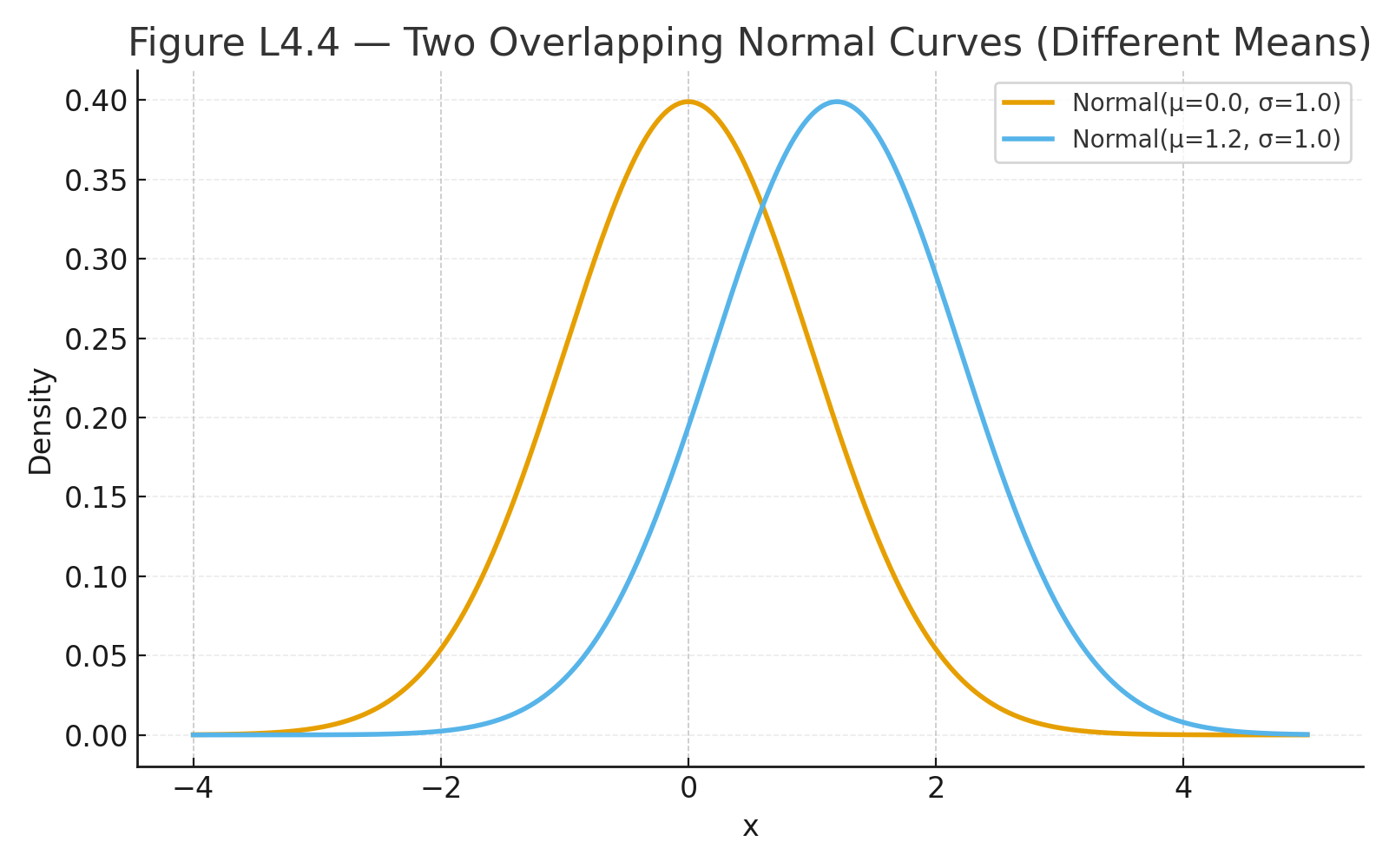
4. Reliability of a Difference

The normal distribution also underlies hypothesis testing — such as the t-test.
It allows us to compare two means and decide whether their difference is larger than expected by chance.

Figure L4.4 — Two overlapping normal curves with different means.


Why This Matters

The normal distribution is the foundation for:

  • Calculating probabilities
  • Estimating reliability of means
  • Testing hypotheses about differences

Understanding these uses prepares us for the transition from descriptive to inferential statistics.

Practice self-test quiz

In the space below, please find practice problems and self-test quizzes. For full access, please signup free.

Lecture 3 — Variance & Standard Deviation

variability

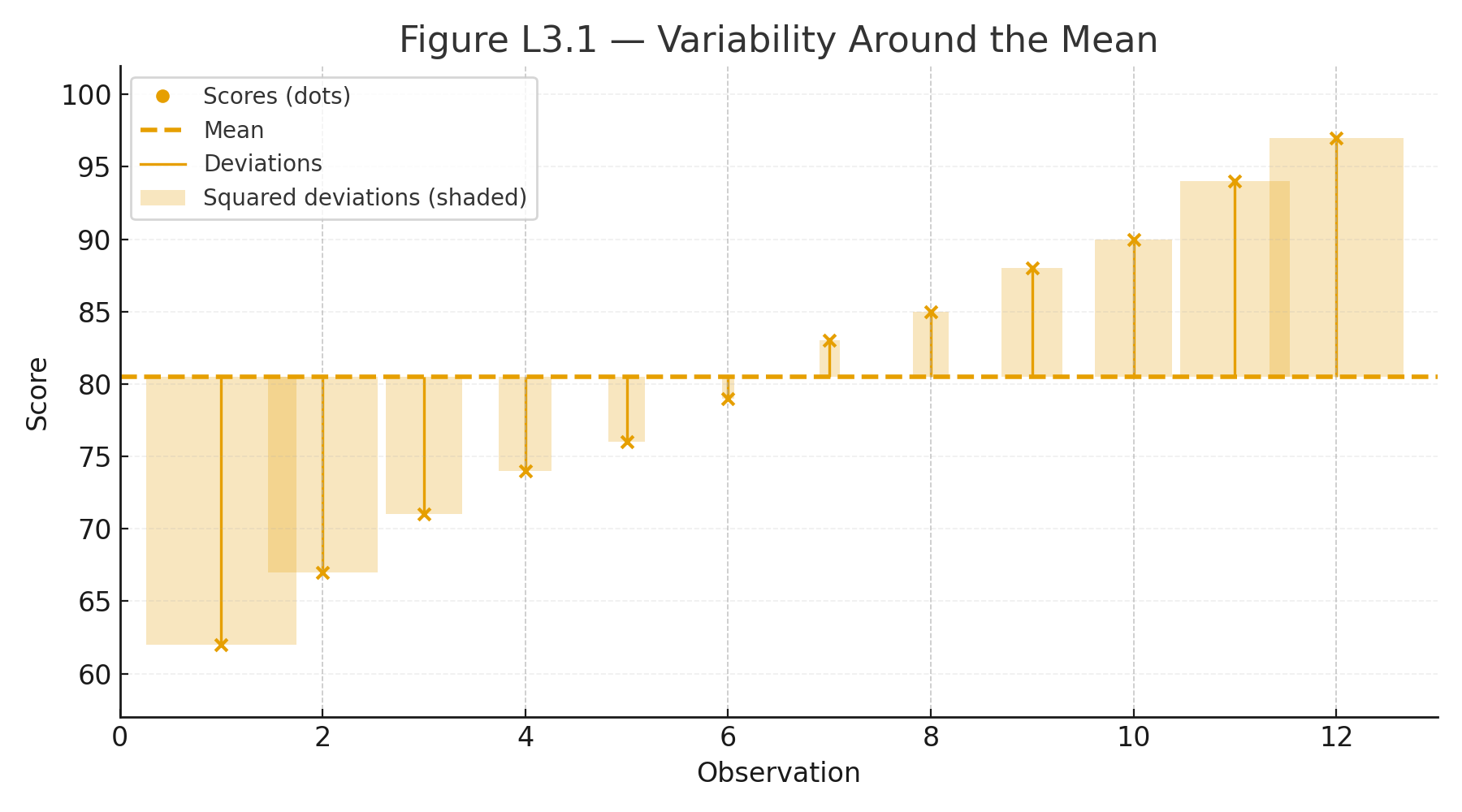
The mean tells us the “typical” score. But how tightly do scores cluster around the mean? Do they spread widely, or are they close together?

To answer, we measure variability. Two key measures are the variance and the standard deviation.


Variance

Variance is the average squared distance of scores from the mean.

Symbolic formula:
$$s^2 = \frac{\sum (X - \bar{X})^2}{n - 1}$$

Formula in words:
$$\text{Variance} = \frac{\text{sum of squared deviations from the mean}}{\text{number of scores} - 1}$$

Where:

  • $$s^2$$ = variance
  • $$X$$ = each score
  • $$\bar{X}$$ = mean
  • $$n$$ = number of scores

Standard Deviation

The standard deviation is the square root of the variance. It puts variability back into the same units as the data.

Symbolic formula:
$$s = \sqrt{\frac{\sum (X - \bar{X})^2}{n - 1}}$$

Formula in words:
$$\text{Standard deviation} = \sqrt{\frac{\text{sum of squared deviations from the mean}}{\text{number of scores} - 1}}$$


Example

Data: 6, 8, 10

  • Mean = 8
  • Deviations: –2, 0, 2
  • Squared deviations: 4, 0, 4
  • Sum = 8

Variance:
$$s^2 = \frac{8}{3-1} = 4$$

Standard deviation:
$$s = \sqrt{4} = 2$$

So, on average, scores are 2 units away from the mean.


Definition

  • Variance: average squared distance from the mean.
  • Standard Deviation: square root of variance; typical distance from the mean.

Visuals

Figure L3.1 — Variability Around the Mean. Dot plot of scores with the mean marked, vertical lines for deviations, and shaded boxes for squared deviations.


Why This Matters

Two sets of scores can have the same mean but very different spreads.
Variance and standard deviation give us the language to describe spread, and they are the building blocks for t-tests, ANOVA, and all inferential statistics.

Practice self-test quiz

In the space below, please find practice problems and self-test quizzes. For full access, please signup free.

Lecture 2 — The Goddess Normal Curve

normal curve
normal curvre 68 95
z score 1.0

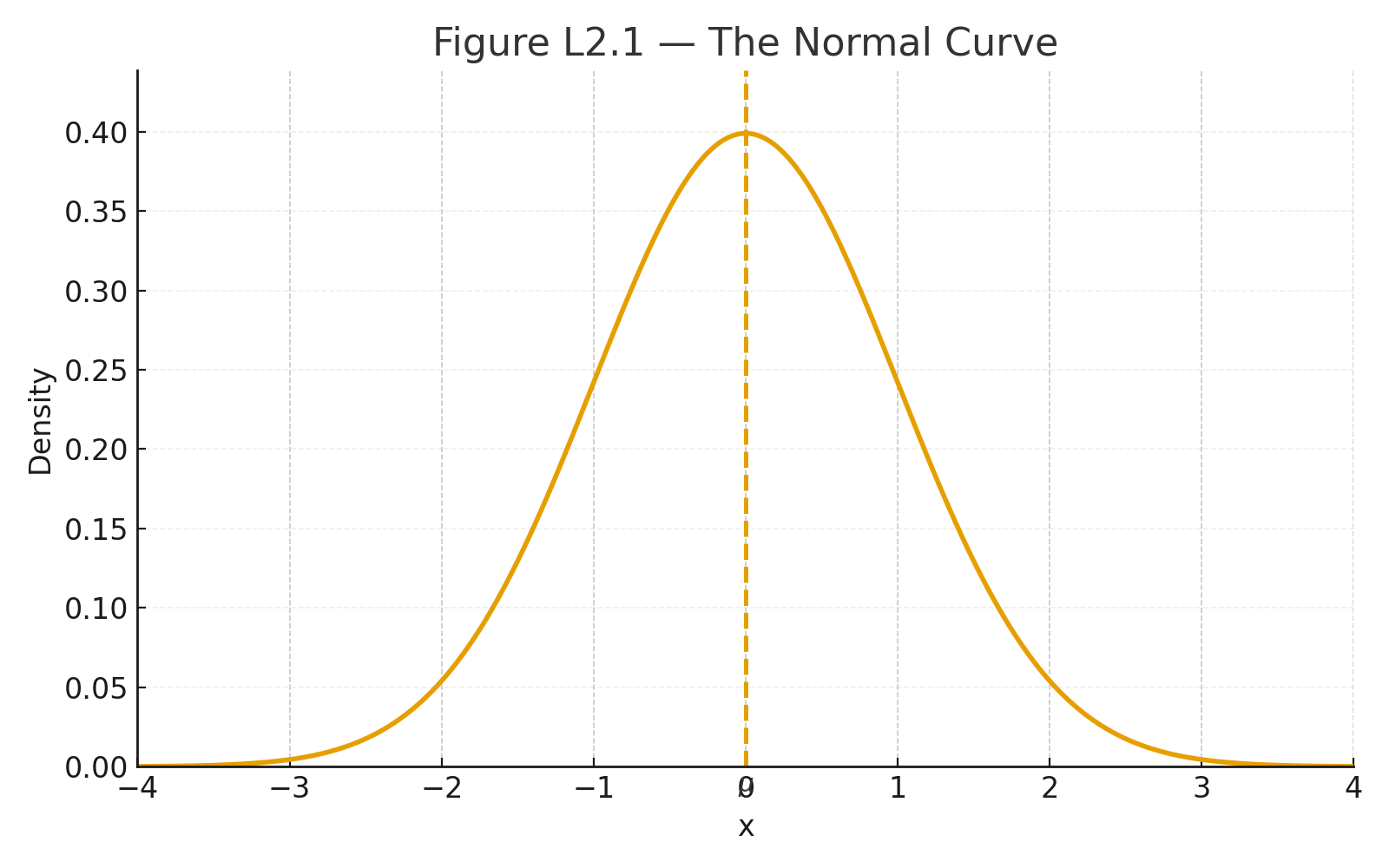
The normal curve (bell curve) is one of the most important concepts in statistics.
It is elegant, symmetrical, and central to probability and inference.
It appears whenever many small, independent factors combine: height, exam scores, measurement errors.


Properties of the Normal Curve

  1. Symmetrical around the mean
  2. One peak (unimodal)
  3. Mean = Median = Mode
  4. Total area under the curve = 1 (100%)

Formula for the Normal Distribution

Symbolic formula:
$$f(x) = \frac{1}{\sigma \sqrt{2\pi}} e^{-\frac{(x - \mu)^2}{2\sigma^2}}$$

Formula in words:
$$\text{Probability density} = \frac{1}{\text{standard deviation} \times \sqrt{2\pi}} \times e^{-\frac{(\text{score} - \text{mean})^2}{2 \times (\text{standard deviation})^2}}$$

Where:

  • $$\mu$$ = mean
  • $$\sigma$$ = standard deviation
  • $$x$$ = a score

Standardization (z-scores)

Symbolic formula:
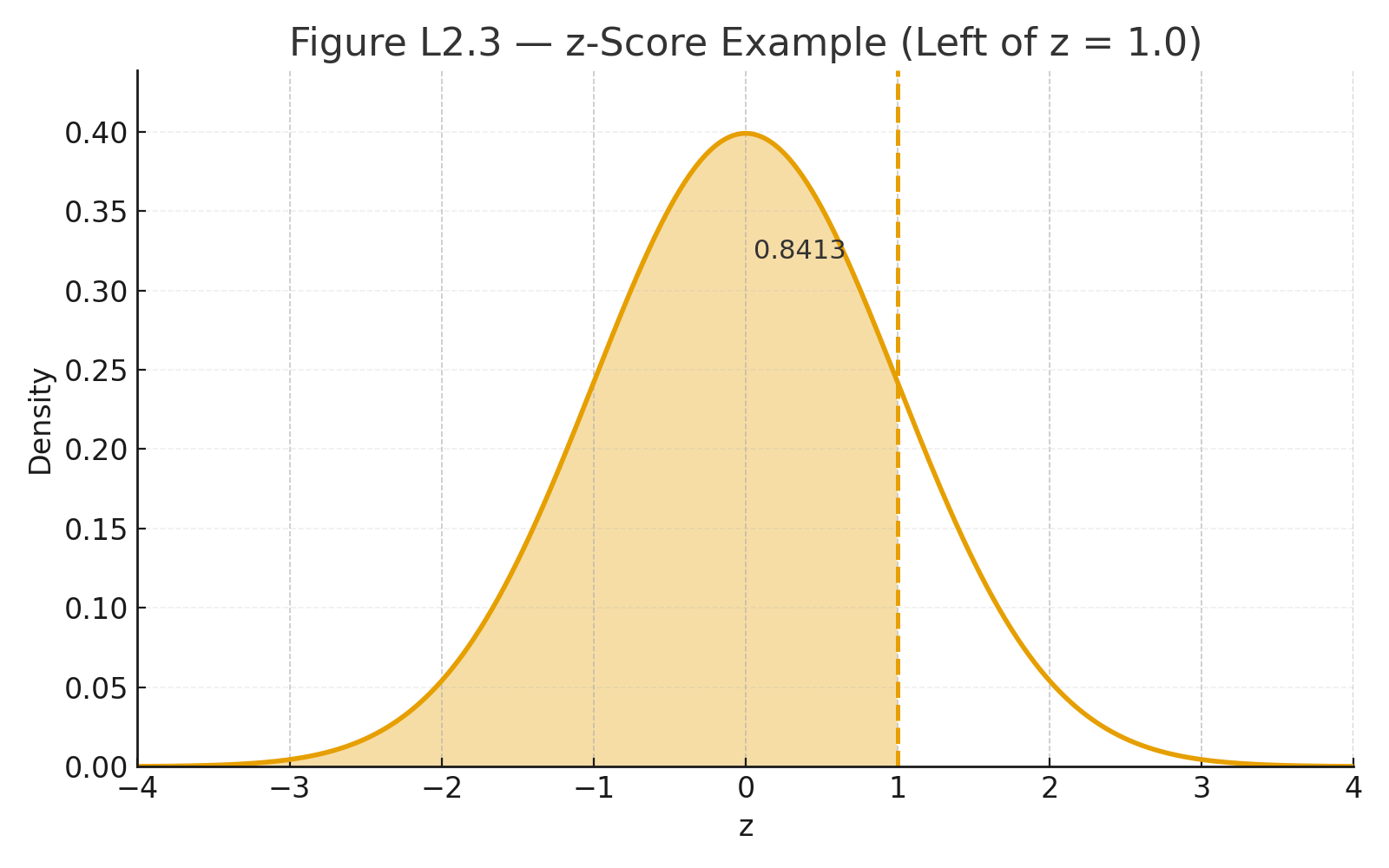
$$z = \frac{x - \mu}{\sigma}$$

Formula in words:
$$z = \frac{\text{score} - \text{mean}}{\text{standard deviation}}$$

A z-score tells us how many standard deviations a score is above or below the mean.


Key Percentages

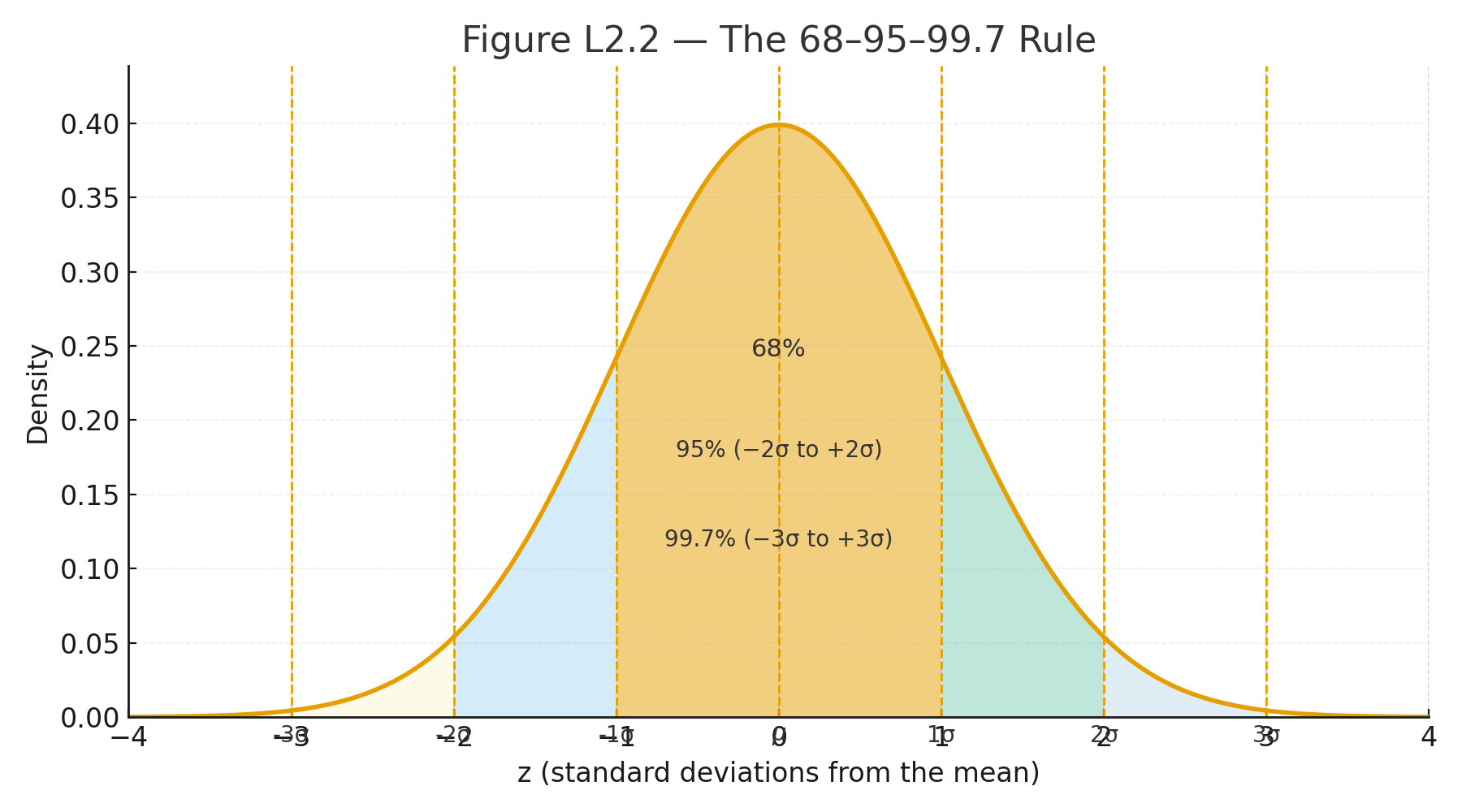
Under the normal curve:

  • About 68% of scores are within 1 standard deviation of the mean
  • About 95% are within 2 standard deviations
  • About 99.7% are within 3 standard deviations

This is called the 68–95–99.7 rule.


Drama Box — “The Goddess Normal Curve”

Imagine a temple where a perfect curve stands tall — balanced and symmetrical.

  • At the center is the mean, the balance point.
  • Half of the people (data) stand on each side.
  • As you move further away, fewer remain.
  • The Goddess teaches fairness: most scores are near the center, extreme scores are rare.

This image helps students remember the normal curve not as a dry formula, but as a principle of balance and probability.


Visuals

Figure L2.1 — The Normal Curve. Bell-shaped curve centered at the mean (μ).

Figure L2.2 — The 68–95–99.7 Rule. Normal curve with shaded regions ±1σ, ±2σ, ±3σ.

Figure L2.3 — z-score Example. Normal curve with shaded area to the left of z = 1.0, labeled 0.8413.


Why This Matters

The normal curve is the foundation of inferential statistics.

  • It allows us to calculate probabilities.
  • It underlies t-tests, ANOVAs, and confidence intervals.
  • It lets us compare scores across different tests and scales.

Practice self-test quiz

In the space below, please find practice problems and self-test quizzes. For full access, please signup free.