Lecture 1 — Scales of Measurement

scales of measurement

Before we can analyze data, we must know how it was measured.
The type of measurement determines which statistical test is appropriate.

Scientists and psychologists classify data into four scales of measurement: nominal, ordinal, interval, and ratio.


The Four Scales

  1. Nominal Scale
    • Numbers are just labels or categories.
    • Example: 1 = Male, 2 = Female.
    • No arithmetic can be done.
  2. Ordinal Scale
    • Numbers show order or rank, but not equal intervals.
    • Example: 1st place, 2nd place, 3rd place.
    • We know who is higher, but not by how much.
  3. Interval Scale
    • Numbers have equal intervals, but no true zero.
    • Example: Temperature in °C.
    • 20°C is warmer than 10°C, but not “twice as hot.”
  4. Ratio Scale
    • Numbers have equal intervals and a true zero.
    • Example: Height, weight, reaction time.
    • Ratios are meaningful: 20 kg is twice 10 kg.

Definition

  • Nominal: categories only
  • Ordinal: rank order
  • Interval: equal intervals, no true zero
  • Ratio: equal intervals, true zero

Drama Box — “My Kids, My Fingers”

A professor once explained measurement scales by holding up his hand.

  • “I have five fingers. That’s a ratio scale — it’s a real count, and zero means none.”
  • “If I say this finger is first, that’s an ordinal scale.”
  • “If I call them One, Two, Three, that’s just labels — a nominal scale.”
  • “If I measure temperature in Celsius on my skin, that’s interval — the numbers are spaced evenly, but zero doesn’t mean no heat.”

The story helps students remember: labels, ranks, intervals, ratios — the four levels of measurement.


Visuals

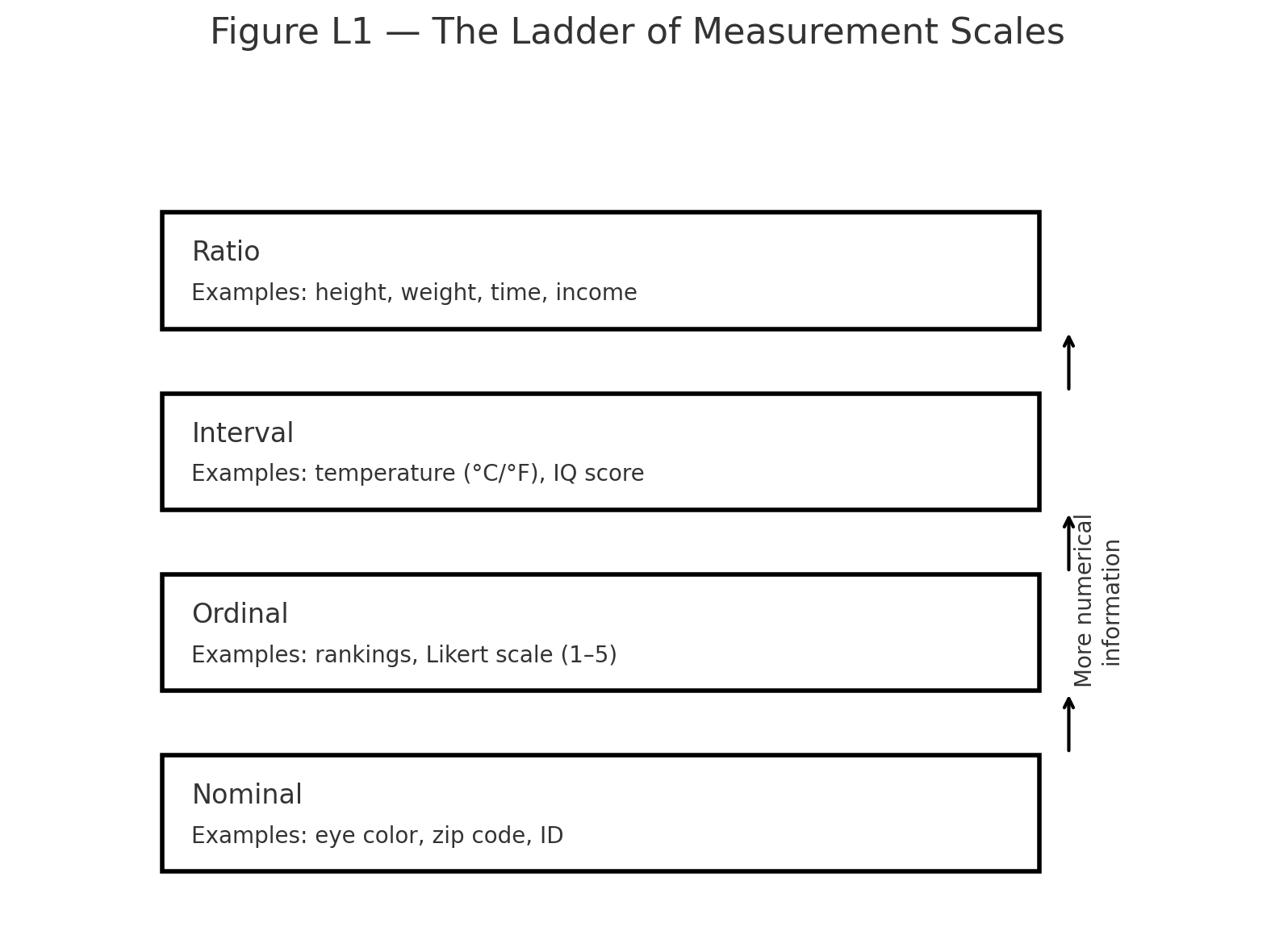
Figure L1 — The Ladder of Measurement Scales. Four rungs labeled: Nominal → Ordinal → Interval → Ratio, each with examples.


Why This Matters

  • Nominal/Ordinal data → non-parametric tests
  • Interval/Ratio data → parametric tests

This decision is the first step in statistics.
Before calculating a mean, a t-test, or an ANOVA, we must ask: How were the data measured?

Practice self-test quiz

In the space below, please find practice problems and self-test quizzes. For full access, please signup free.
Lesson 8 — Post Hoc Tests

tukey hsd
bonferroni

When ANOVA finds a significant F, we know that not all group means are equal.
But ANOVA does not tell us which groups differ.

For that, we need post hoc tests (Latin: after this).
They compare pairs of group means while controlling for the increased chance of error.


Tukey’s Honestly Significant Difference (HSD)

When to Use:

  • Equal group sizes
  • Pairwise comparisons after one-way ANOVA

Formula:
$$\text{HSD} = q \sqrt{\frac{MS_{\text{within}}}{n}}$$

In words:
$$\text{HSD} = \text{Studentized range statistic } q \times \sqrt{\frac{\text{mean square within groups}}{\text{sample size per group}}}$$

If the difference between two means ≥ HSD, they are significantly different.

Example:
3 groups, n = 10 each, $$MS_{\text{within}} = 16.7$$, critical $$q = 3.5$$.

$$\text{HSD} = 3.5 \times \sqrt{\tfrac{16.7}{10}} = 3.5 \times 1.29 = 4.52$$

So any pair of means that differ by 4.52 or more is significant.


Bonferroni Correction

When to Use:

  • Simple and conservative
  • Divide significance level by number of comparisons

Formula:
$$\alpha' = \frac{\alpha}{m}$$

In words:
$$\text{adjusted significance level} = \frac{\text{original significance level}}{\text{number of comparisons}}$$

Example: If α = 0.05 and 10 comparisons, α′ = 0.005 per test.


Scheffé Test

When to Use:

  • Unequal sample sizes
  • Most conservative post hoc test

Formula (summary):
Scheffé’s critical F = (k – 1) × F(critical, df_between, df_within).


Definition

  • Post hoc test: statistical test used after ANOVA to identify which means differ
  • Tukey HSD: balanced groups, pairwise
  • Bonferroni: adjusts α for multiple comparisons
  • Scheffé: conservative, flexible for unequal n

Visual Placeholders

Figure 8.1 — Tukey HSD example: three group means with horizontal bars showing which pairs differ.

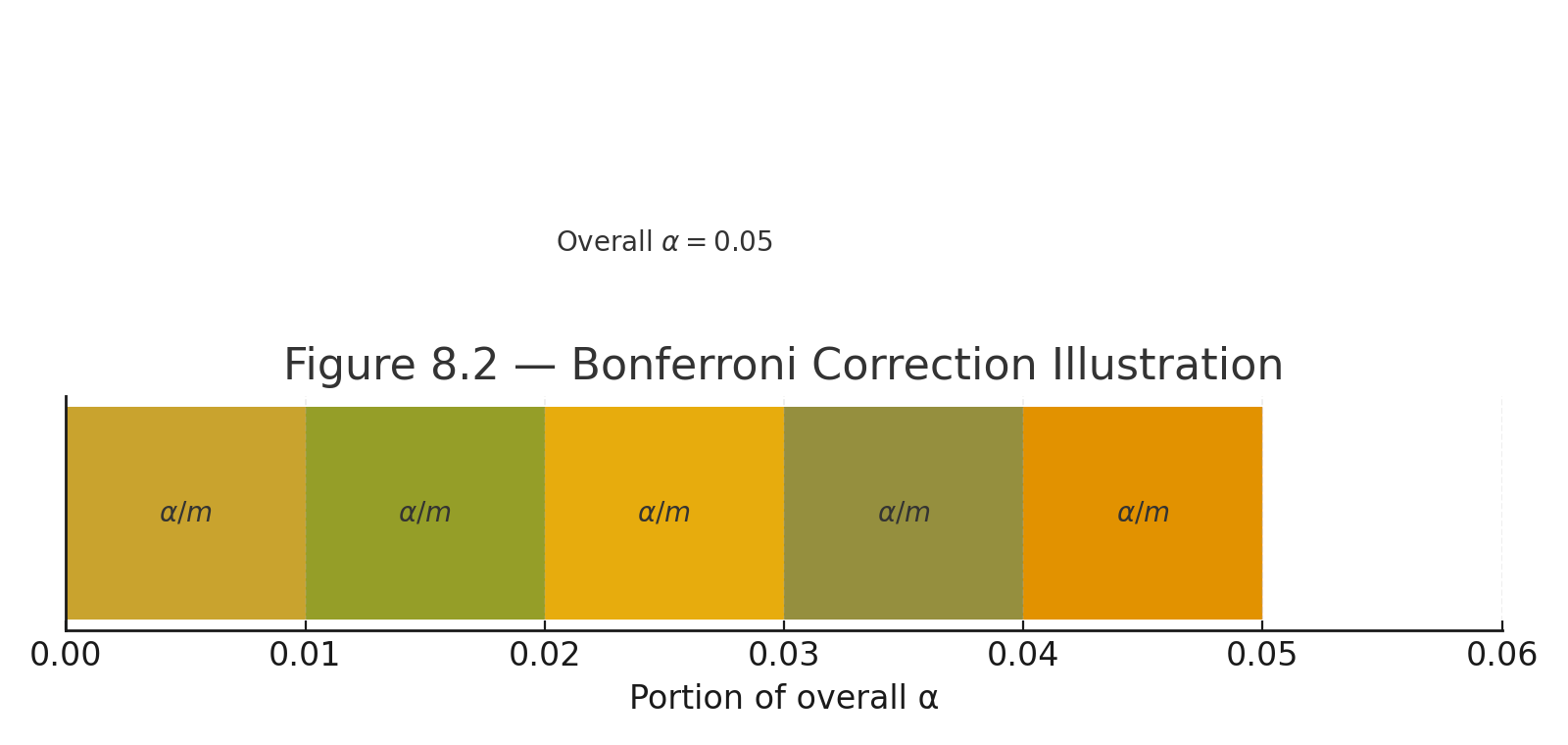
Figure 8.2 — Bonferroni correction illustration: α = 0.05 split into smaller pieces.


Why This Matters

ANOVA tells us there is a difference somewhere.
Post hoc tests tell us where.
They protect against false positives while allowing multiple group comparisons.

Practice self-test quiz

In the space below, please find practice problems and self-test quizzes. For full access, please signup free.
Lesson 7 — Analysis of Variance (ANOVA)

anova layout
partitioning variance
2x2 factorial layout
factorial interaction
repeated measures anova
mixed anova layout
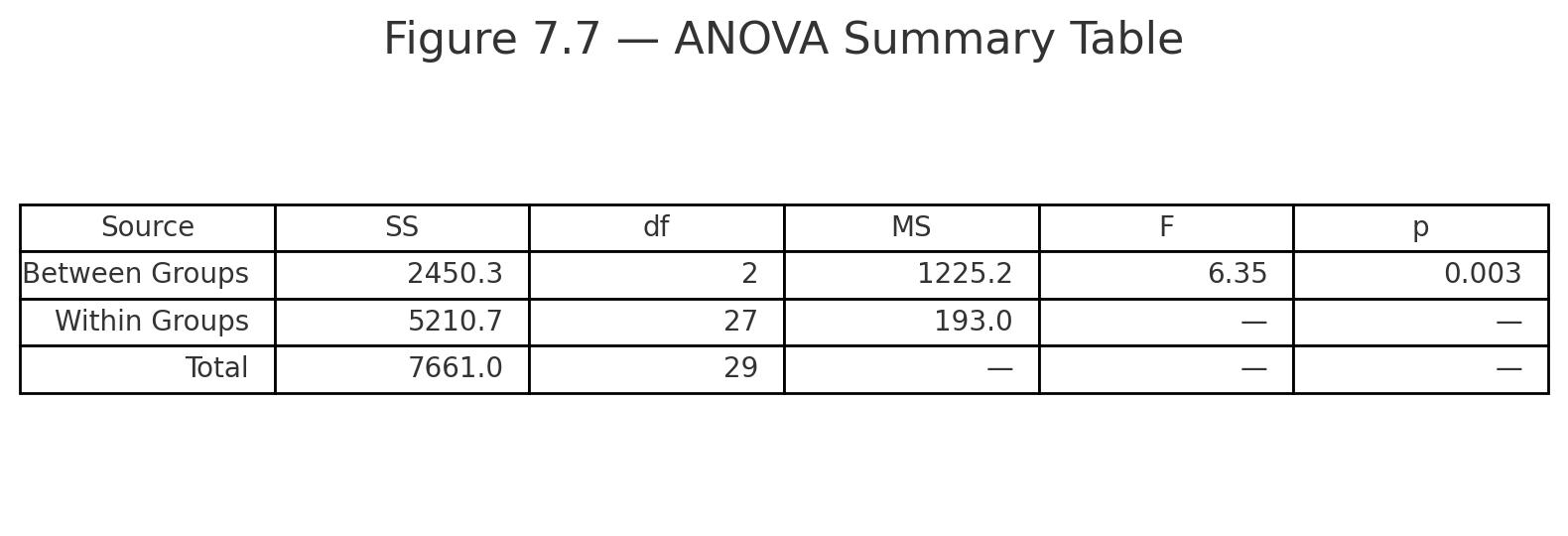
anova summary table

Lesson 7: Analysis of Variance (ANOVA)

The t-test is great for comparing two means. But what happens when you have three, four, or even more groups? Running multiple t-tests increases the chance of false positives (Type I error inflation). The solution is Analysis of Variance (ANOVA) — a powerful method that compares means across multiple groups in one test.

What ANOVA Does

ANOVA tests whether the means of several groups are significantly different from each other. It does this by partitioning (splitting) the total variability in the data into two parts:

  • Between-groups variability: Differences caused by the treatment or factor (the effect we care about).
  • Within-groups variability: Differences due to random chance or individual differences within each group (error or noise).

If between-groups variability is much larger than within-groups variability, the group means likely differ because of the treatment — not just chance.

The F Ratio — The Heart of ANOVA

The test statistic is the F ratio:

$$ F = \frac{MS_{\text{between}}}{MS_{\text{within}}} $$

In words:

$$ F = \frac{\text{Mean Square Between Groups}}{\text{Mean Square Within Groups}} $$

Where:

  • $$ MS_{\text{between}} = \frac{SS_{\text{between}}}{df_{\text{between}}} $$ (variance explained by the groups)
  • $$ MS_{\text{within}} = \frac{SS_{\text{within}}}{df_{\text{within}}} $$ (variance due to error)

A large F value suggests the between-groups differences are real, not random.

Degrees of Freedom in One-Way ANOVA

  • $$ df_{\text{between}} = k - 1 $$ (k = number of groups)
  • $$ df_{\text{within}} = N - k $$ (N = total number of observations)
  • $$ df_{\text{total}} = N - 1 $$

Example: One-Way ANOVA

Three groups of students use different study techniques:

  • Group A: mean = 70
  • Group B: mean = 75
  • Group C: mean = 85

Suppose calculations give:

  • $$ SS_{\text{between}} = 300 $$, $$ df_{\text{between}} = 2 $$ → $$ MS_{\text{between}} = 150 $$
  • $$ SS_{\text{within}} = 200 $$, $$ df_{\text{within}} = 12 $$ → $$ MS_{\text{within}} = 16.7 $$

Then:

$$ F = \frac{150}{16.7} \approx 9.0 $$

Compare F = 9.0 to the critical value from the F-table (df = 2, 12) ≈ 3.89 at p = 0.05. Since 9.0 > 3.89, the result is significant — the study techniques produce different mean scores.

Types of ANOVA

Factorial ANOVA

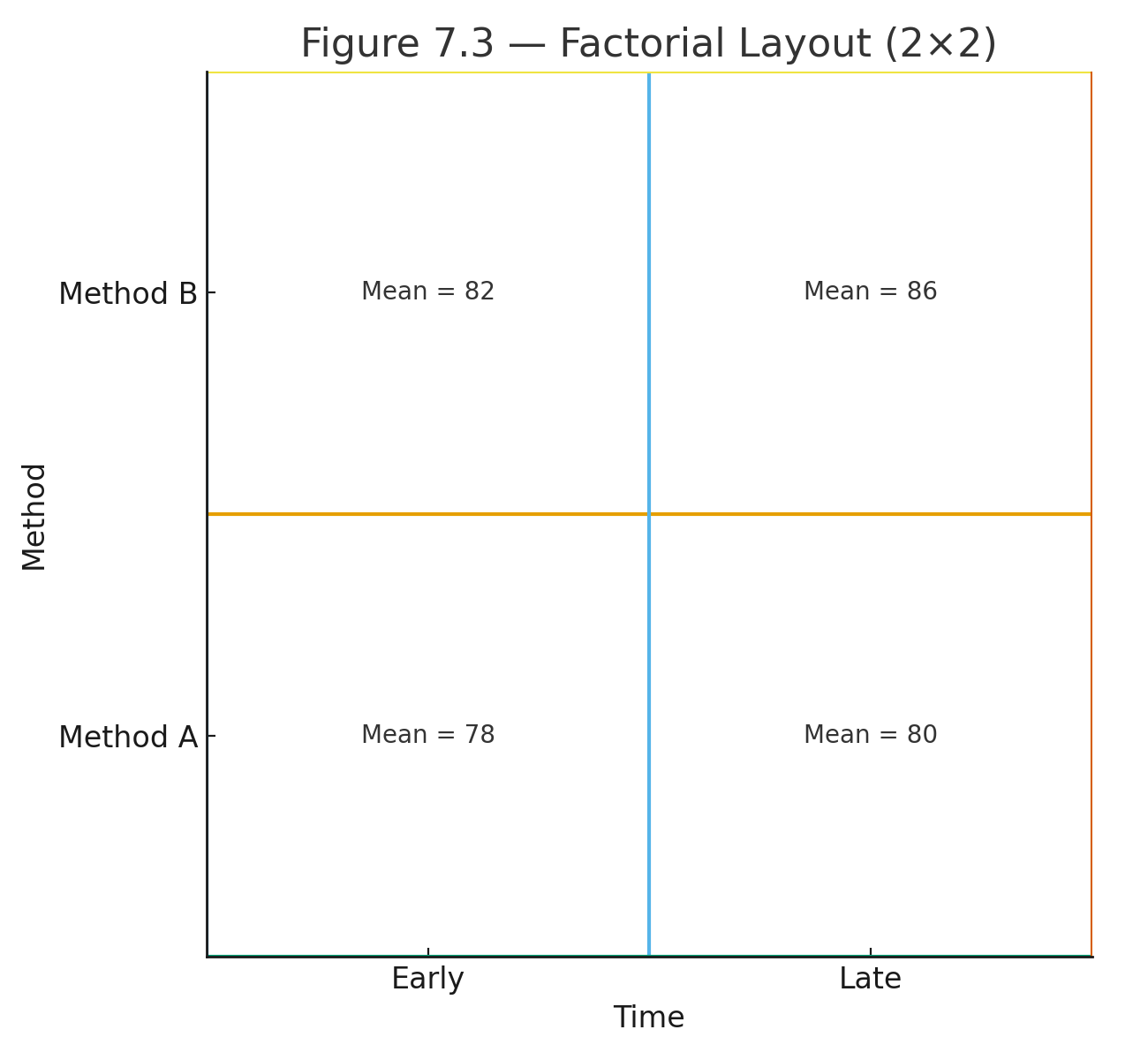
Tests two or more factors simultaneously (e.g., teaching method × time of day in a 2×2 design). It reveals:

  • Main effects of each factor
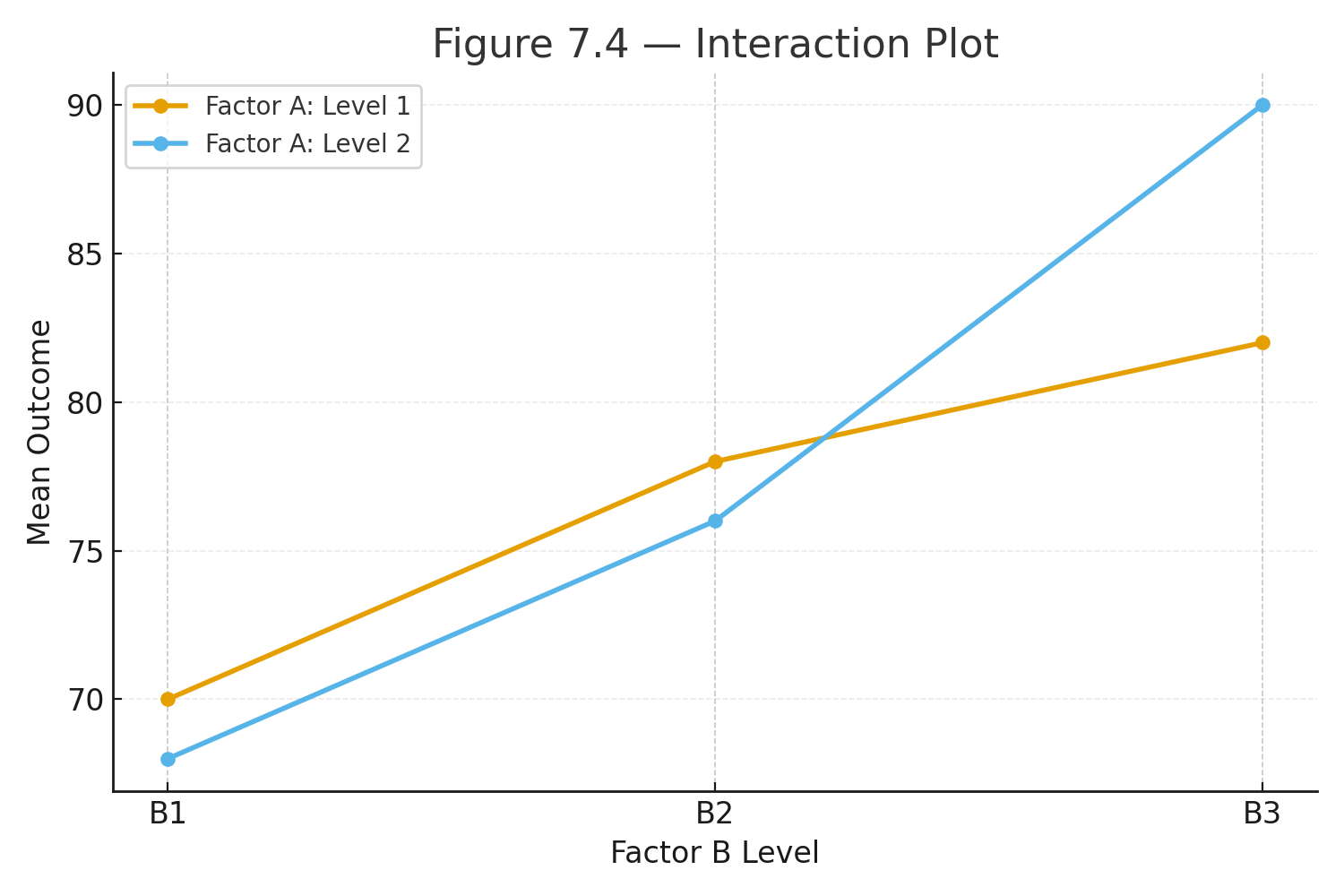
  • Interaction effects (when one factor's effect depends on the level of another)

Repeated-Measures ANOVA

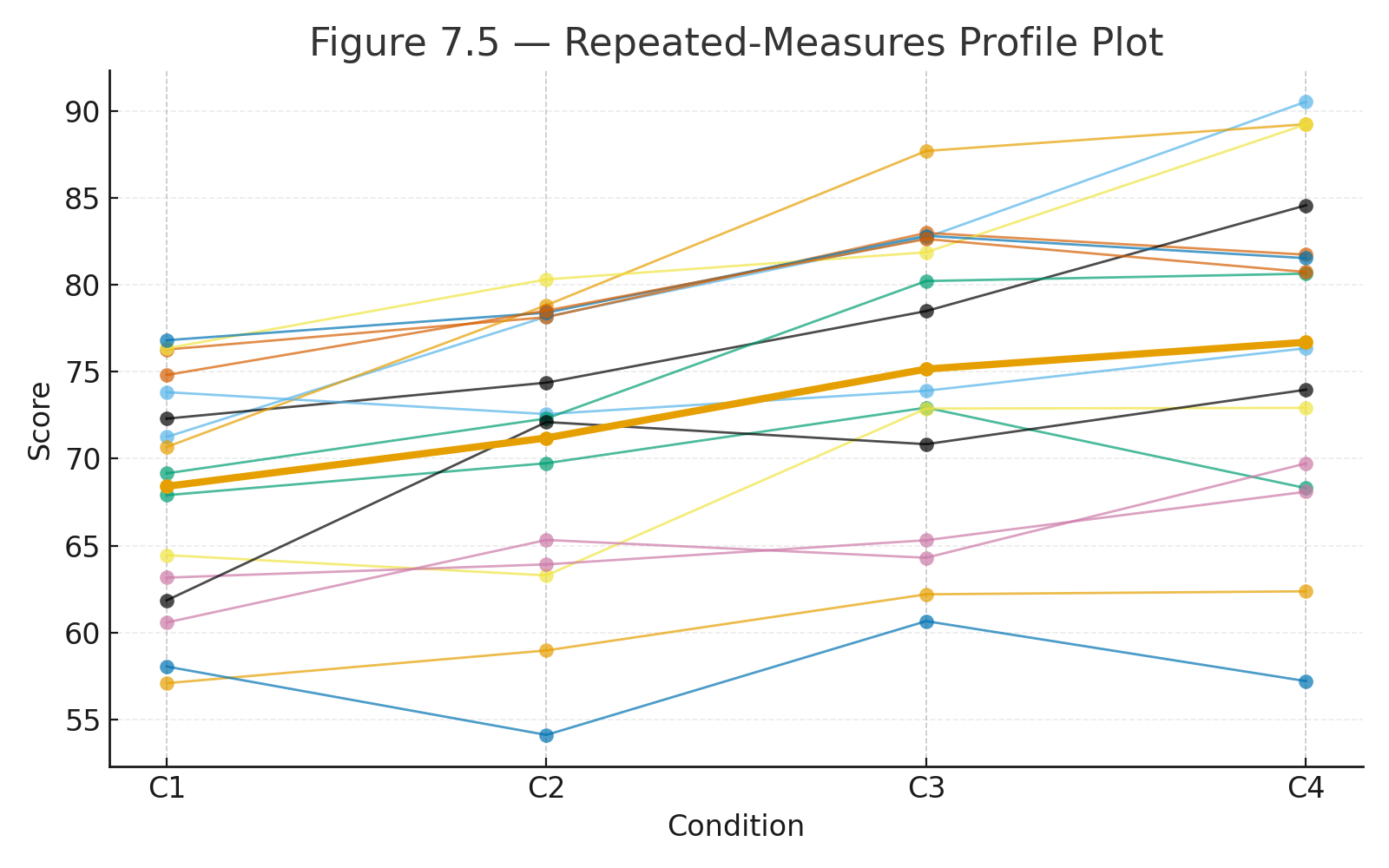
Used when the same participants are measured multiple times (e.g., test scores before, during, and after a treatment). Removes individual differences, increasing statistical power.

Mixed (Split-Plot) ANOVA

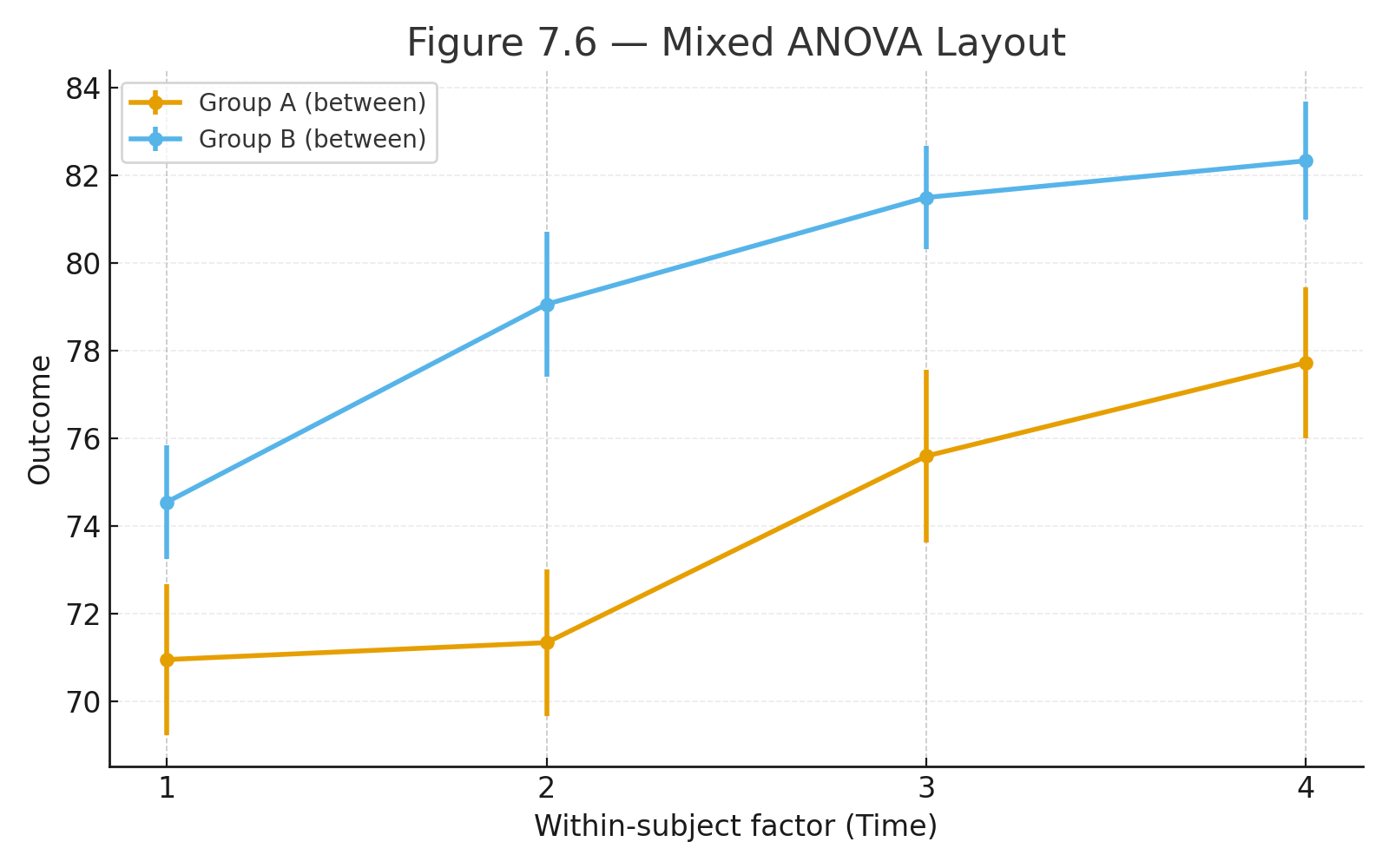
Combines between-subjects (e.g., different treatment groups) and within-subjects (e.g., repeated measures over time) factors. Common in psychology, education, and clinical research.

Quick Summary

  • ANOVA generalizes the t-test to 3+ groups.
  • F ratio compares explained variance to error variance.
  • Large F → likely real differences between groups.
  • Types: one-way, factorial, repeated-measures, mixed.

Visuals

Figure 7.1 — One-way ANOVA: Bar chart showing group means with error bars.

Figure 7.2 — Variance partitioning: Total SS split into Between SS and Within SS.

Figure 7.3 — 2×2 Factorial design grid.

Figure 7.4 — Interaction plot: Non-parallel lines indicate interaction.

Figure 7.5 — Repeated-measures profile plot.

Figure 7.6 — Mixed ANOVA structure.

Figure 7.7 — Standard ANOVA summary table (Source | SS | df | MS | F | p).

Why ANOVA Matters

ANOVA is one of the most powerful and widely used tools in science. It helps researchers determine whether differences among groups are meaningful — not just random noise — making it essential for experiments in psychology, education, biology, medicine, and more.

Practice & Self-Test

Try the interactive self-test quiz below to check your understanding of ANOVA concepts, F ratio, and interpretation. For full access and more problems, sign up free.


Lesson 6 — The t-Test: Worked Examples & Calculations

t- one sample
t- one sample curve
t- independent boxplot
t- independent means
t- independent curve
t welch
t paired profile
t- paird curve
t-residuals

Introduction. This lesson is hands-on, data-driven, and calculation-oriented. It prepares students to do t-tests with data. The t-test compares means when the population standard deviation is unknown and is estimated from the sample, so the standardized statistic follows Student’s t distribution with appropriate degrees of freedom (df). The three common variants are: (a) one-sample (compare a sample mean to a reference value \( \mu_0 \)); (b) independent-samples (compare means of two unrelated groups); and (c) paired-samples (compare repeated measures on the same units by testing the mean of the differences). All t-tests assume independent observations and approximately normal residuals; only the pooled independent-samples test assumes equal variances.


A) One-Sample t-Test

Goal. Test whether a sample mean differs from a known/reference mean \( \mu_0 \).

Design & Experiment

A company claims average battery life is \( \mu_0 = 10 \) hours. We test \( n=12 \) units.

Data

Hours (n = 12)
9.6, 10.1, 10.5, 9.9, 9.7, 10.4, 9.8, 9.6, 10.2, 9.5, 10.3, 9.8

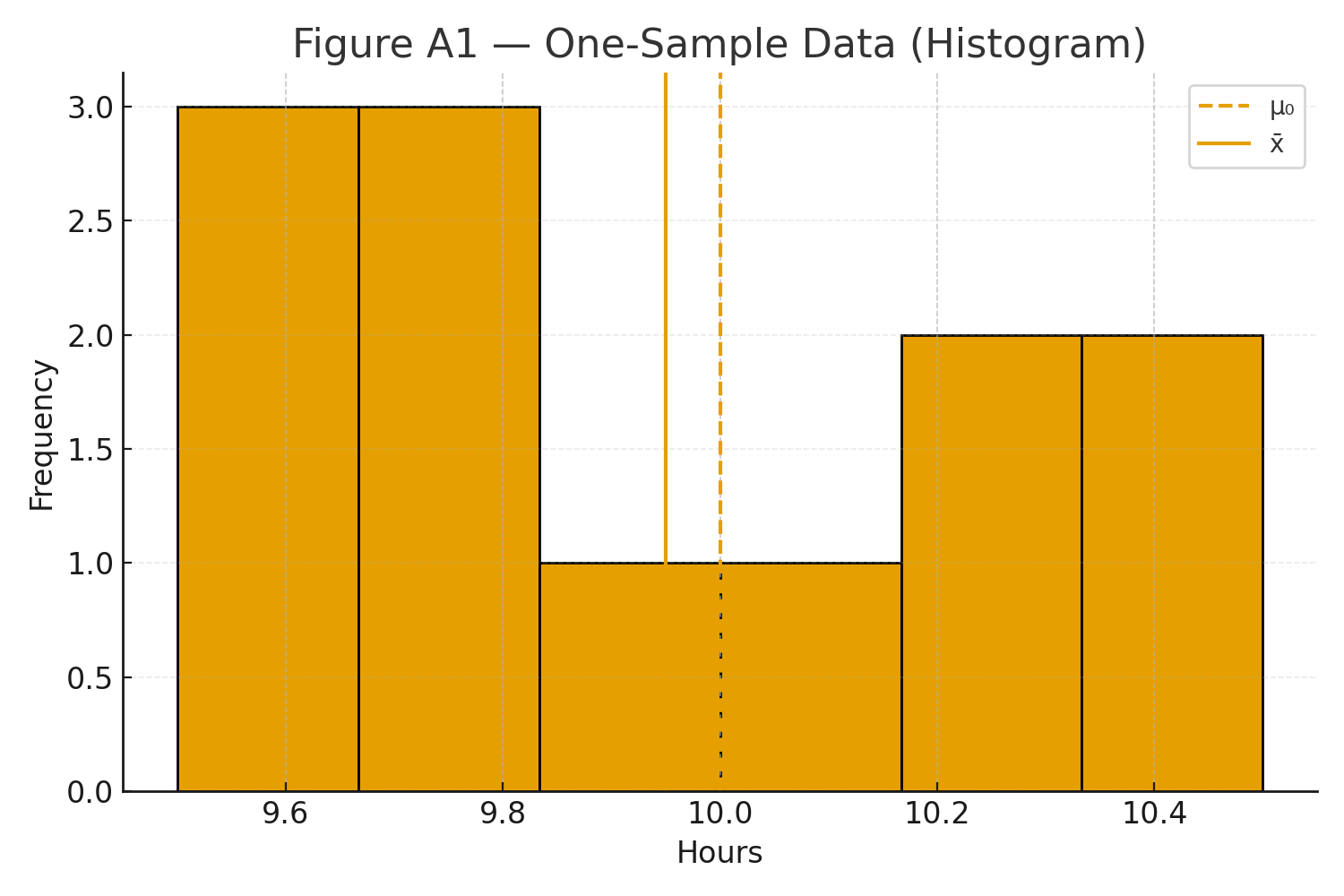
Figure A1: Histogram/QQ plot for one-sample data.

Step 1 — Sum, Mean, Variance

\(\sum x = 119.4 \Rightarrow \bar X = 9.95.\) Using \( \sum (x-\bar X)^2 = 1.086 \Rightarrow s^2 = 1.086/11 = 0.0987,\; s = 0.314.\)

Step 2 — Test Statistic & p-value

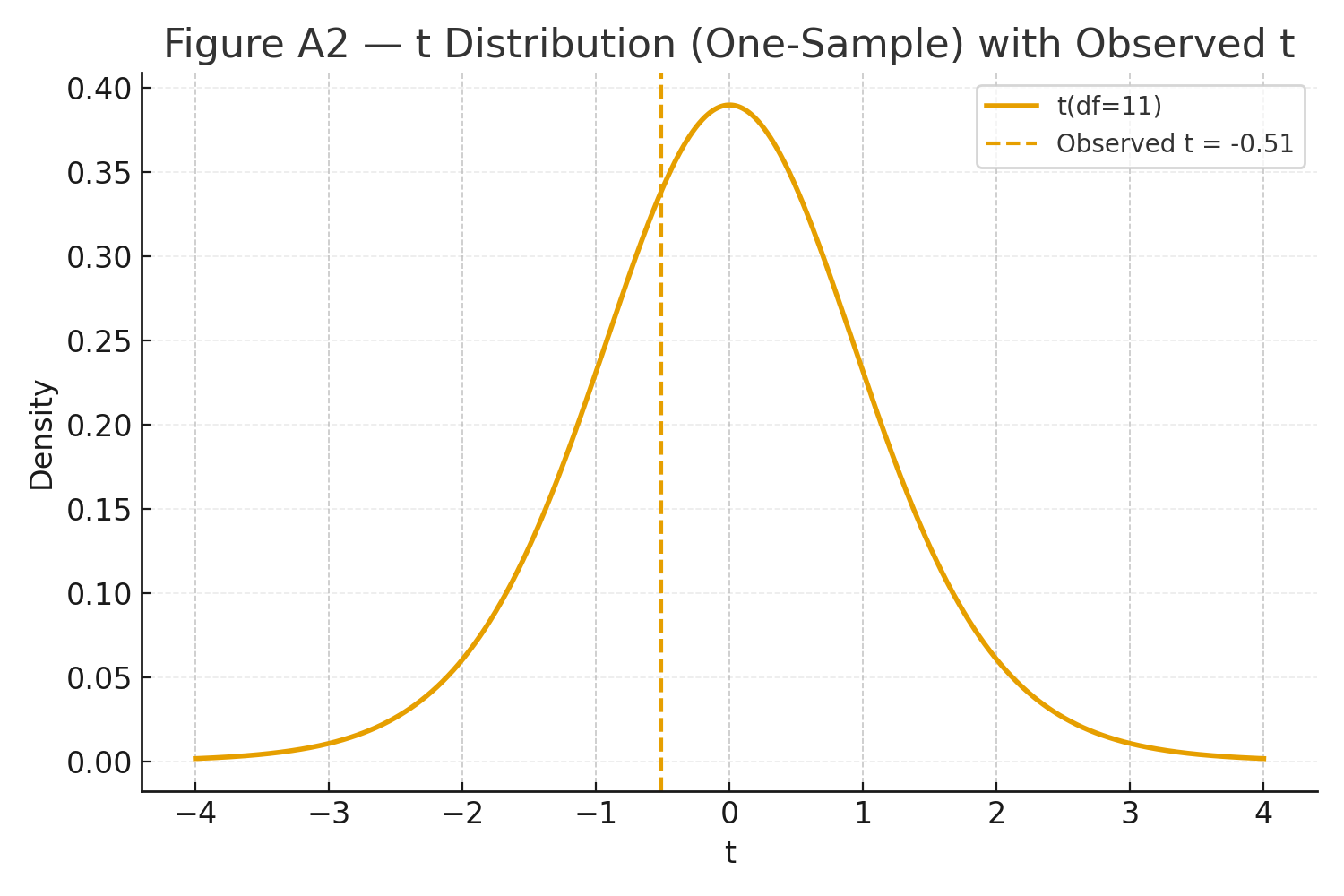
\(\displaystyle SE = \frac{s}{\sqrt{n}} = \frac{0.314}{\sqrt{12}} = 0.0906,\quad t = \frac{\bar X - \mu_0}{SE} = \frac{9.95 - 10}{0.0906} = -0.552,\quad df = n-1 = 11. \)

Two-tailed \(p \approx 0.59\) → fail to reject \(H_0\).

Figure A2: t curve (df=11) with observed \(t\) marked.

Conclusion (One-Sample)

No evidence the true mean differs from 10 hours (\(t(11)=-0.55,\; p=.59\)).


B) Independent-Samples t-Test

Goal. Test whether two teaching methods lead to different average exam scores.

Design & Experiment

Twenty students are randomly assigned to one of two methods (n = 10 per group).

  • Method A: Active discussion
  • Method B: Structured lecture

After a 2-week module, everyone takes the same 100-point exam.

Data

Method AMethod B
7278
6882
7580
7077
6979
7381
7183
7476
7678
7280

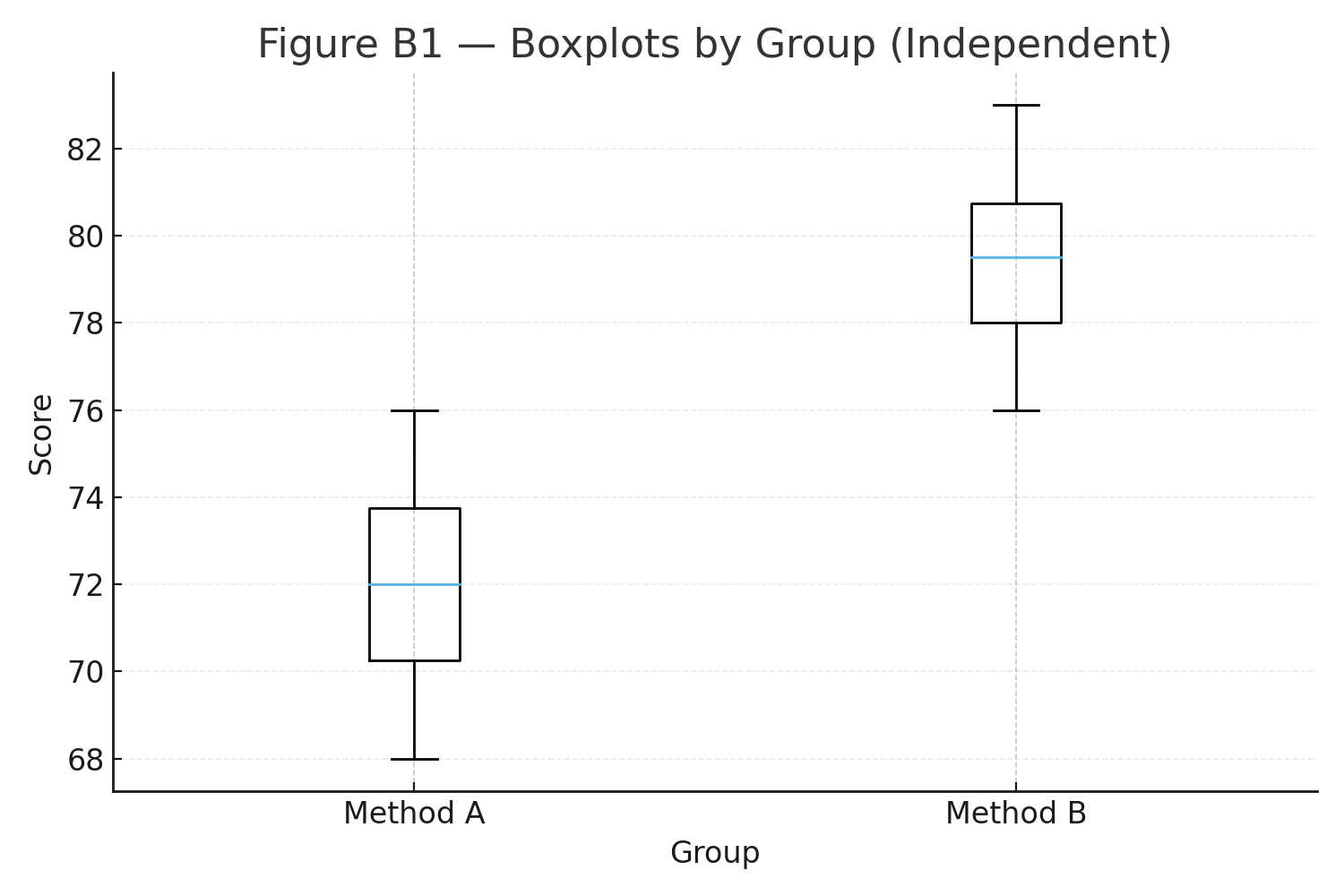
Figure B1: Boxplots of scores by group.

Step 1 — Sums & Means

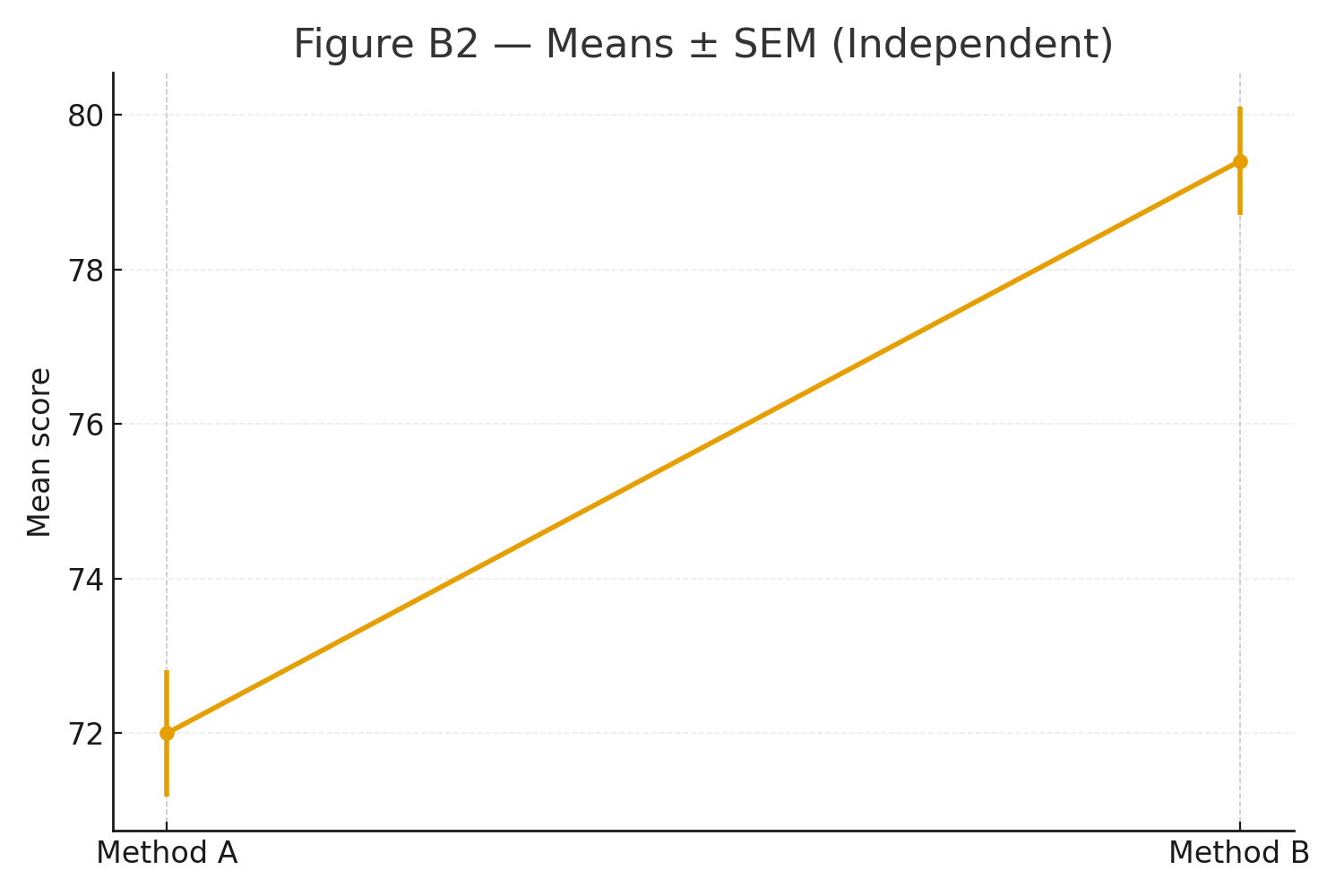
\(\displaystyle \sum A=720 \Rightarrow \bar A=72.0,\qquad \sum B=794 \Rightarrow \bar B=79.4,\qquad \bar A-\bar B=-7.4. \)

Step 2 — Within-Group Variability (sample variances)

  • \(SS_A=60.0 \Rightarrow s_A^2=60/9=6.6667.\)
  • \(SS_B=44.40 \Rightarrow s_B^2=44.40/9=4.9333.\)

Figure B2: Group means with SEM error bars.

Step 3 — Pooled Variance & Standard Error (Student’s t)

\(\displaystyle s_p^2=\frac{9(6.6667)+9(4.9333)}{18}=5.8000,\qquad SE=\sqrt{5.8\,(0.1+0.1)}=\sqrt{1.16}=1.0770. \)

Step 4 — Test Statistic, df, p

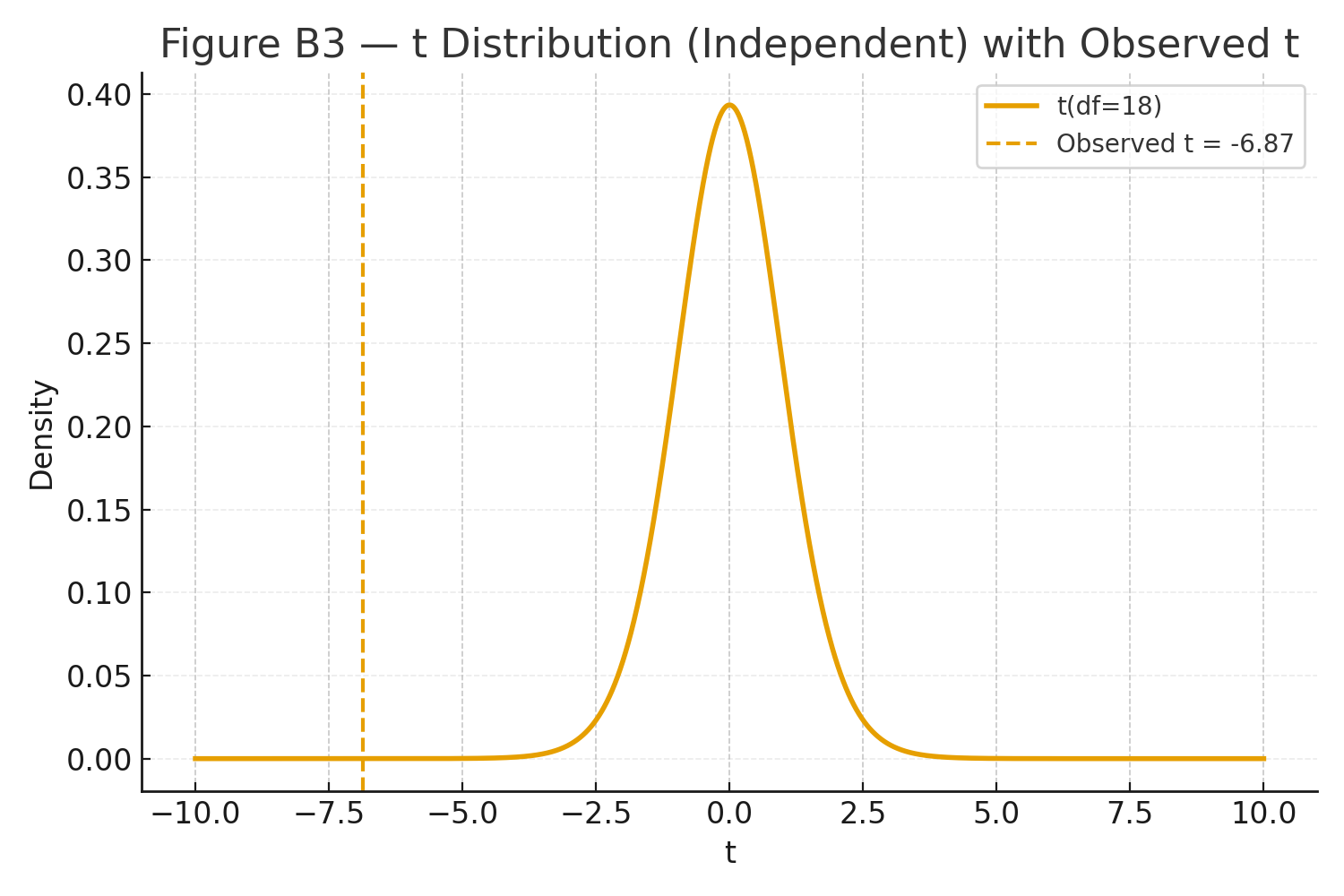
\(\displaystyle t=\frac{-7.4}{1.0770}=-6.872,\qquad df=18,\qquad p\ (\text{two-tailed}) \ll .001. \)

Figure B3: t distribution with observed \(t\) marked (two-tailed).

t-Test Summary Table (Independent)

GroupnMeanSDSE(mean)
Method A1072.002.5820.816
Method B1079.402.2220.703
\(\bar A-\bar B\)SE (pooled)tdfp (2-tailed)
-7.401.0770-6.87218< .001

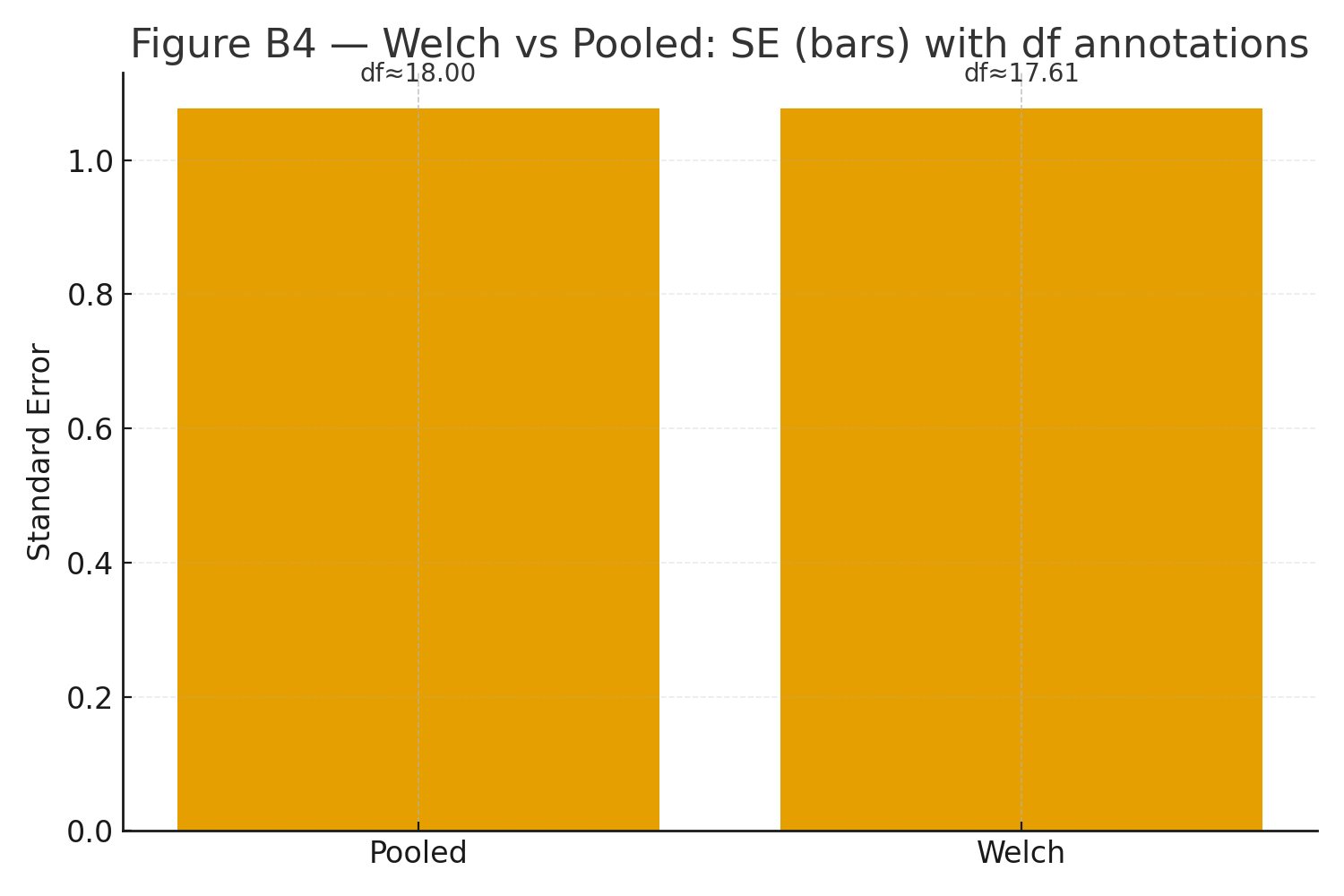
Optional Welch: \(SE_W=\sqrt{0.6667+0.4933}=1.0770,\; df_W\approx 17.61,\; t=-6.872,\; p\ll .001.\; Figure B4: Welch vs pooled comparison sketch.

Conclusion (Independent)

Method B yields higher mean scores than Method A (\(t(18)=-6.87,\; p\ll .001\)).


C) Paired-Samples (Dependent) t-Test

Goal. Test whether the mean change (After − Before) differs from zero for the same participants.

Design & Experiment

Eight students take an exam before and after a study-skills workshop.

Data

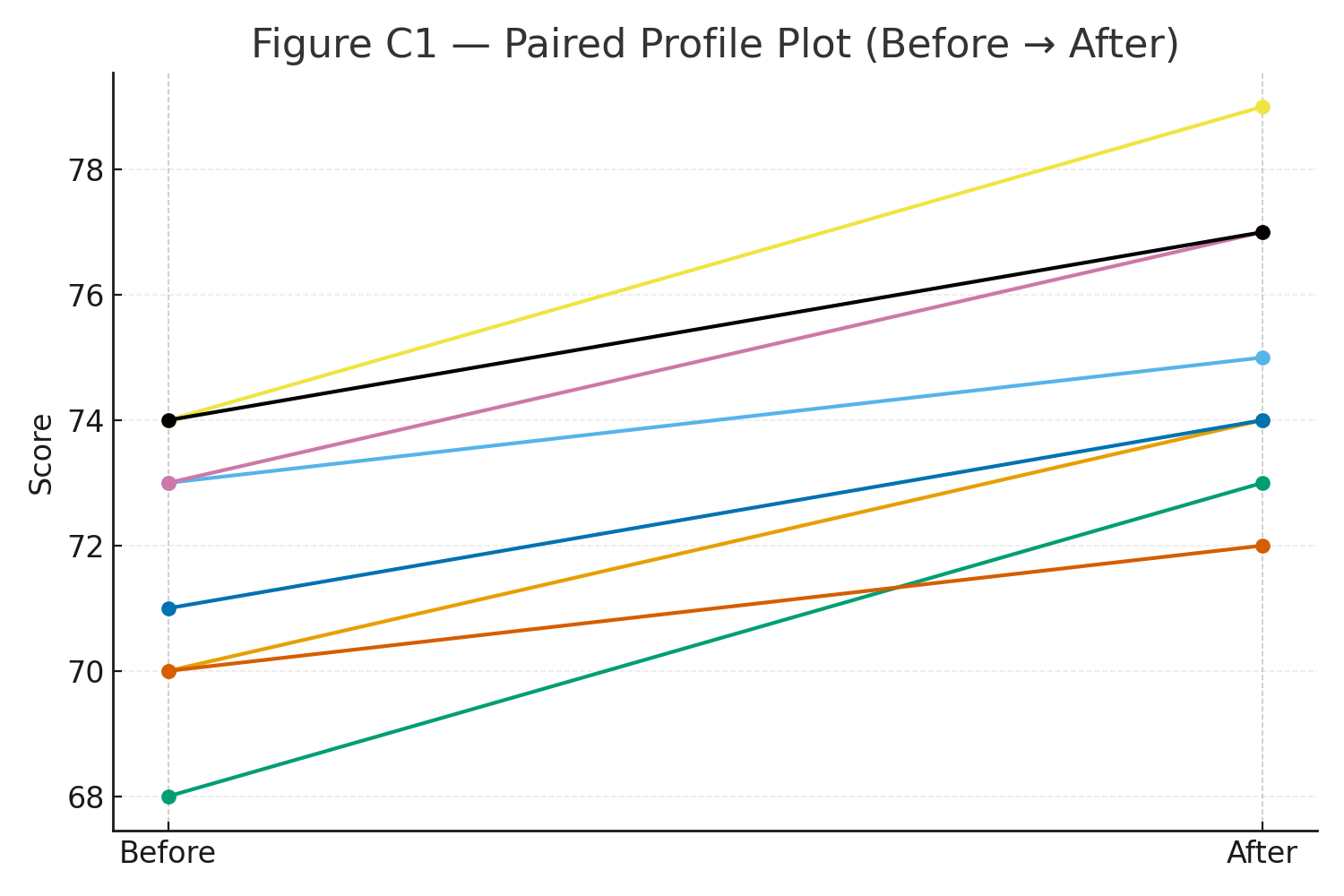
BeforeAfterDifference \(d\) (After − Before)
70744
73752
68735
74795
71743
70722
73774
74773

Figure C1: Paired profile plot (lines per subject) + histogram of differences.

Step 1 — Mean Difference & Variability

\(\sum d = 28 \Rightarrow \bar d = 3.5.\) \(\sum (d-\bar d)^2 = 10 \Rightarrow s_d^2 = 10/7 = 1.4286,\; s_d=1.196.\)

Step 2 — Test Statistic & p-value

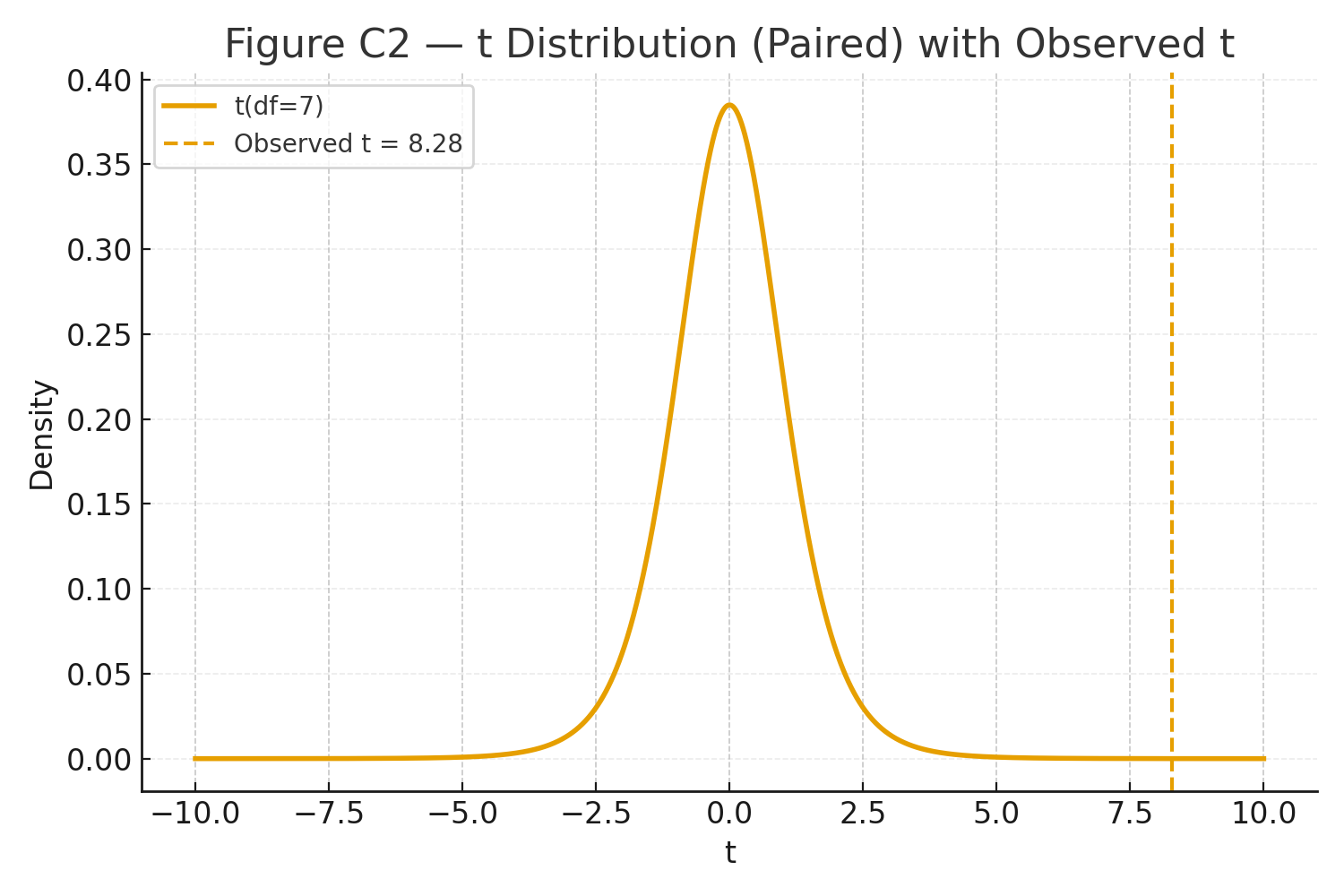
\(\displaystyle SE_{\bar d} = \frac{s_d}{\sqrt{n}}=\frac{1.196}{\sqrt{8}}=0.423,\quad t=\frac{\bar d}{SE_{\bar d}}=\frac{3.5}{0.423}=8.28,\quad df=n-1=7,\quad p\ll .001. \)

Figure C2: t curve (df=7) with observed \(t\) marked.

Conclusion (Paired)

Scores improve after the workshop (\(t(7)=8.28,\; p\ll .001\)).


Assumptions (checklist)

  • Independent observations (between units; pairing respected for the paired test).
  • Approximately normal residuals (or differences for the paired test).
  • Equal variances only for the pooled independent-samples test; if doubtful, report Welch’s t.

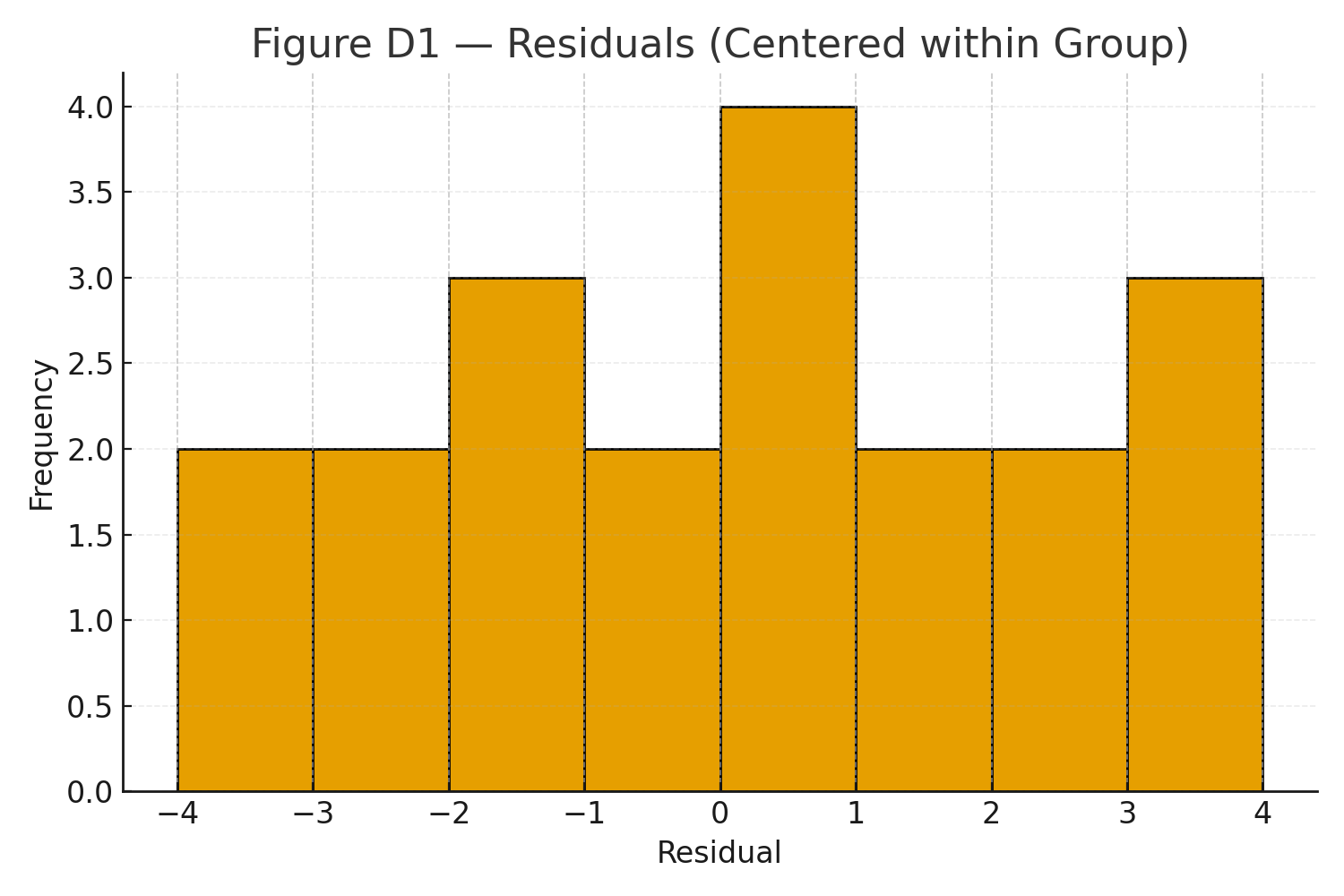
Figure D1: QQ plots and Levene/Brown–Forsythe sketch.

Practice self-test quiz

In the space below, please find practice problems and self-test quizzes. For full access, please signup free.

Lesson 5 — Standard Error of the Mean (SEM)

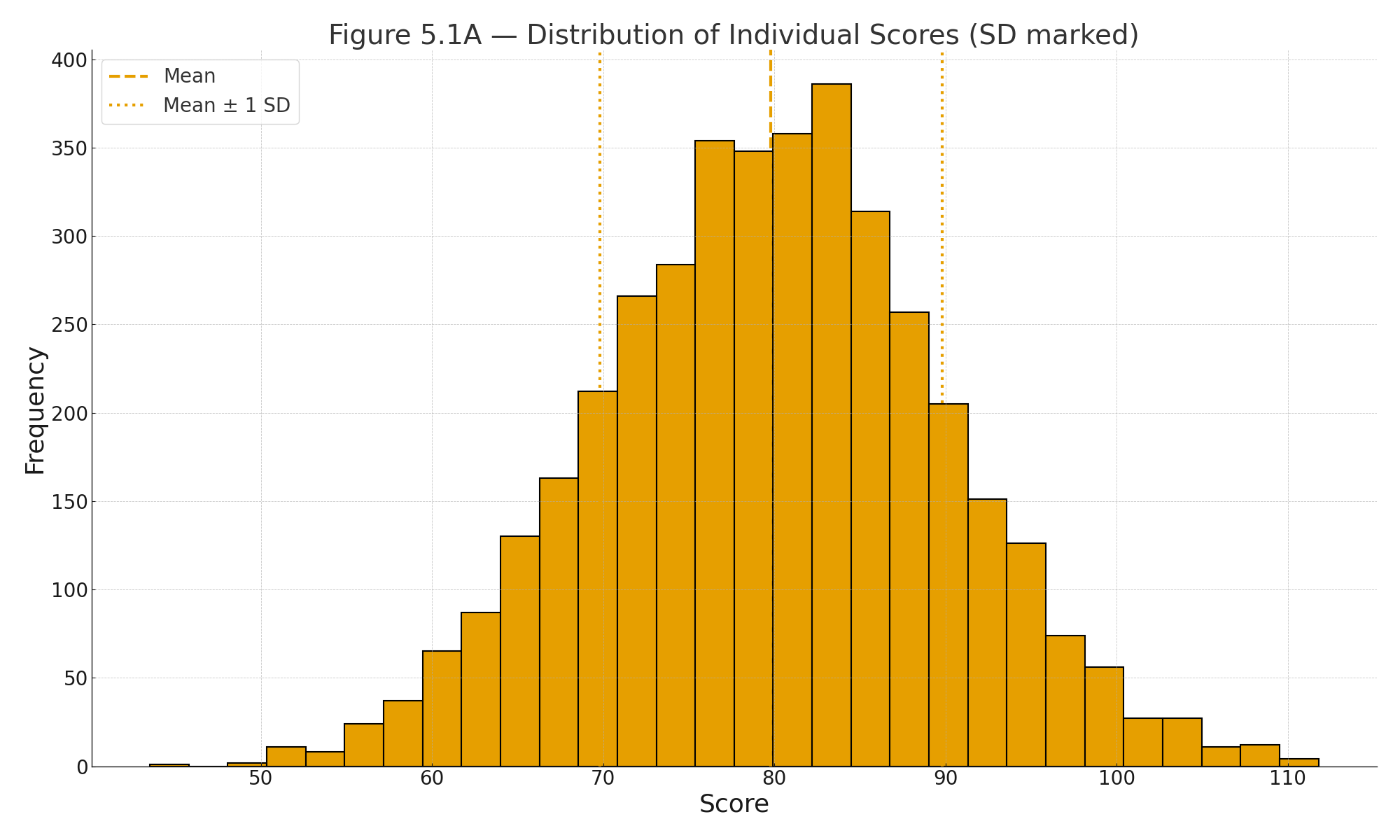
Distribution of individual scores with mean and ±1 SD marked
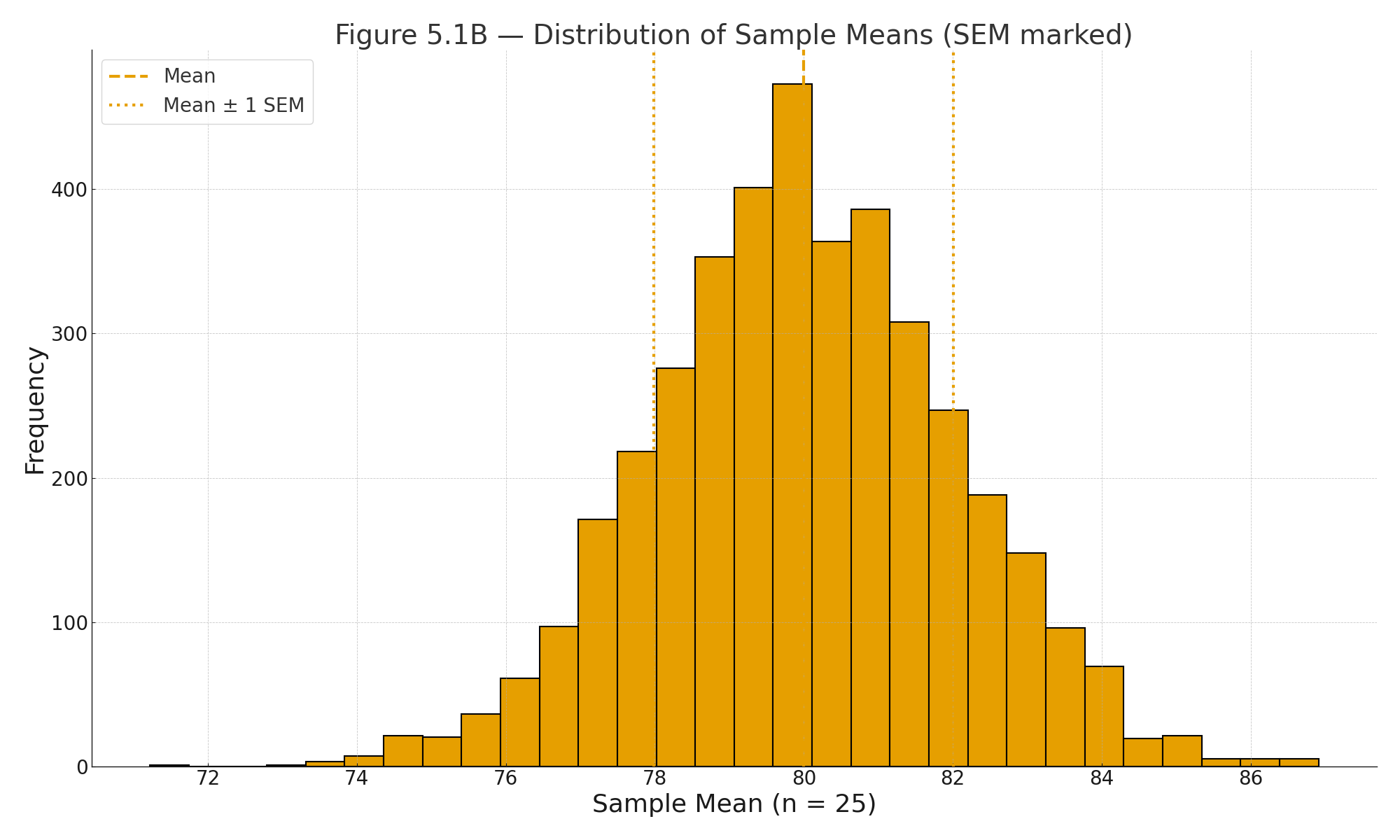
Distribution of sample means (n = 25) with mean and ±1 SEM marked; note the narrower spread
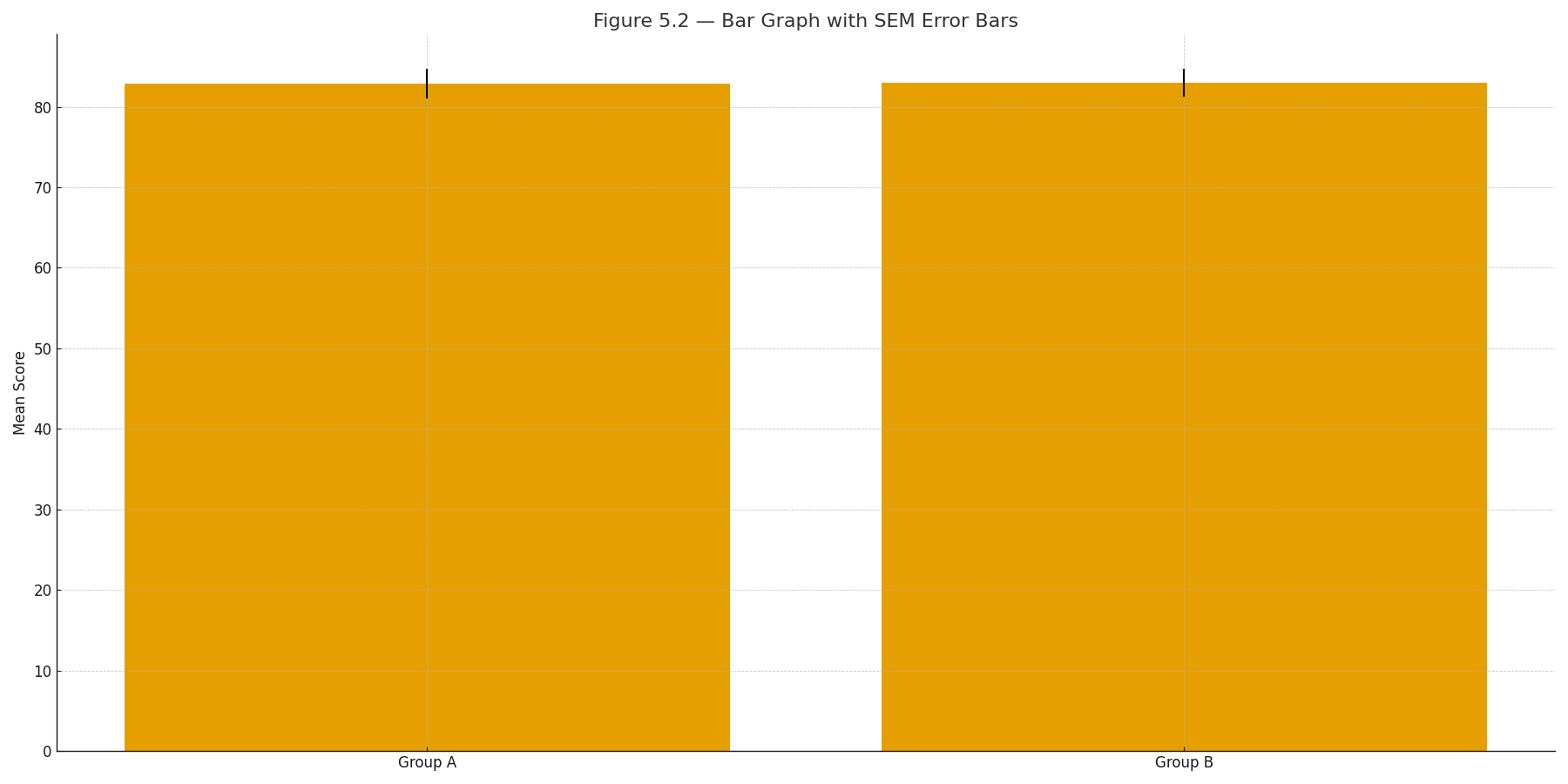
Bar graph of two group means with error bars = SEM

When we take a sample from a population, the sample mean is not always equal to the population mean.
If we took many samples, the sample means would vary.
The Standard Error of the Mean (SEM) tells us how much.

It is the standard deviation of the sampling distribution of the mean.


Formula for the SEM

Symbolic formula:
$$\mathrm{SEM} = \frac{s}{\sqrt{n}}$$

Formula in words:
$$\text{SEM} = \frac{\text{standard deviation}}{\sqrt{\text{number of scores}}}$$

Where:

  • $$s$$ = standard deviation of the sample
  • $$n$$ = number of scores in the sample

Example

A class has test scores with:

  • Mean = 80
  • Standard deviation = 10
  • Sample size = 25

Then:

$$\mathrm{SEM} = \frac{10}{\sqrt{25}} = \frac{10}{5} = 2$$

The SEM is 2.
This means that the mean of repeated samples of 25 students would typically vary about 2 points from the population mean.


Definition

  • Standard Error of the Mean (SEM): the expected variability of a sample mean compared to the true population mean.


Why This Matters

The SEM is crucial for inference.

Visuals

Figure 5.1A — Distribution of individual scores with mean and ±1 SD marked.

Figure 5.1B — Distribution of sample means (n = 25) with mean and ±1 SEM marked; note the narrower spread.

Figure 5.2 — Bar graph of two group means with error bars = SEM.

  • It shows how reliable our sample mean is as an estimate of the population mean.
  • A smaller SEM means a more precise estimate.
  • The SEM appears in formulas for confidence intervals and t-tests.

Practice self-test quiz

In the space below, please find practice problems and self-test quizzes. For full access, please signup free.

Lesson 4 — The Standard Normal Curve

z score
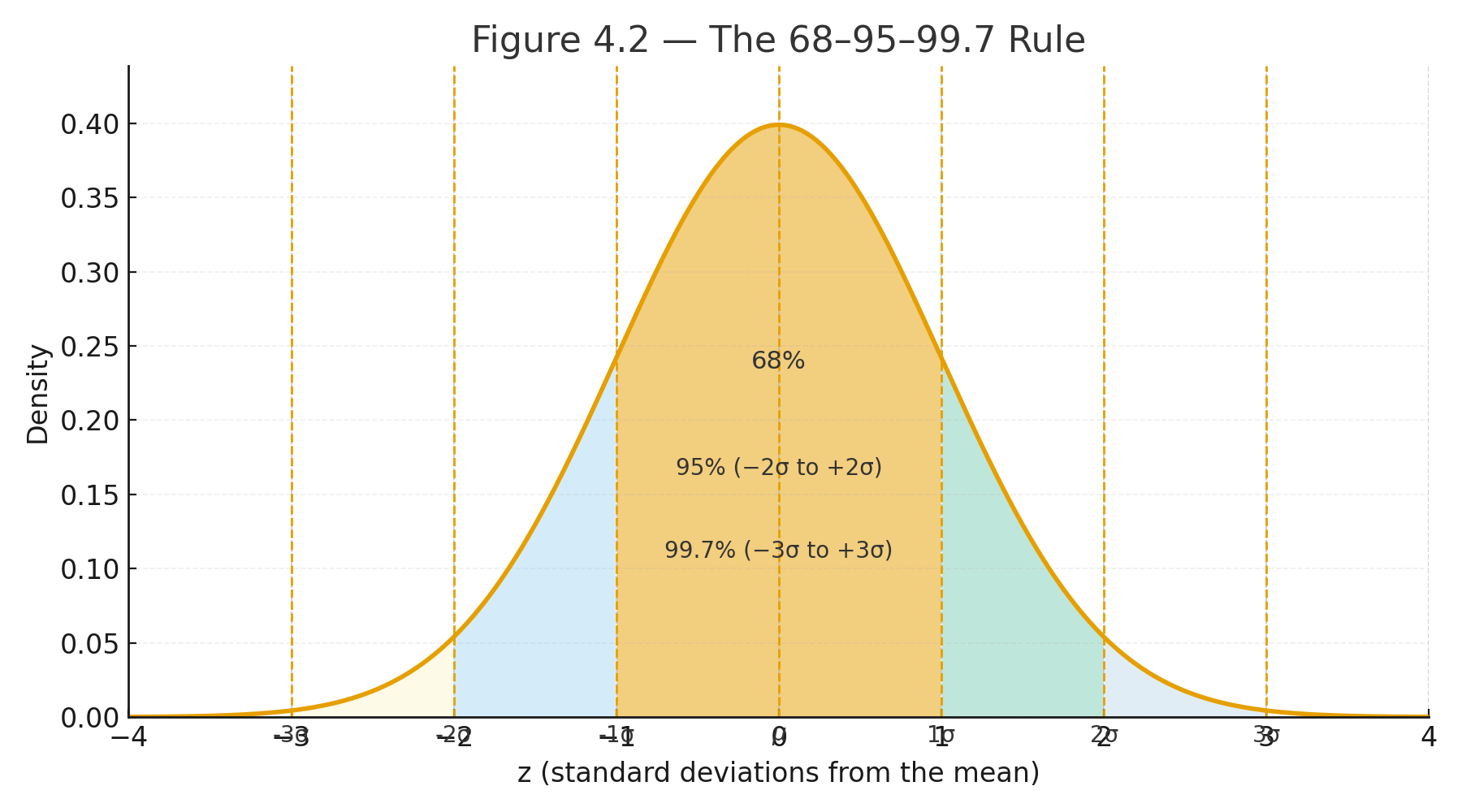
The normal curve. The 68 95 99 rule
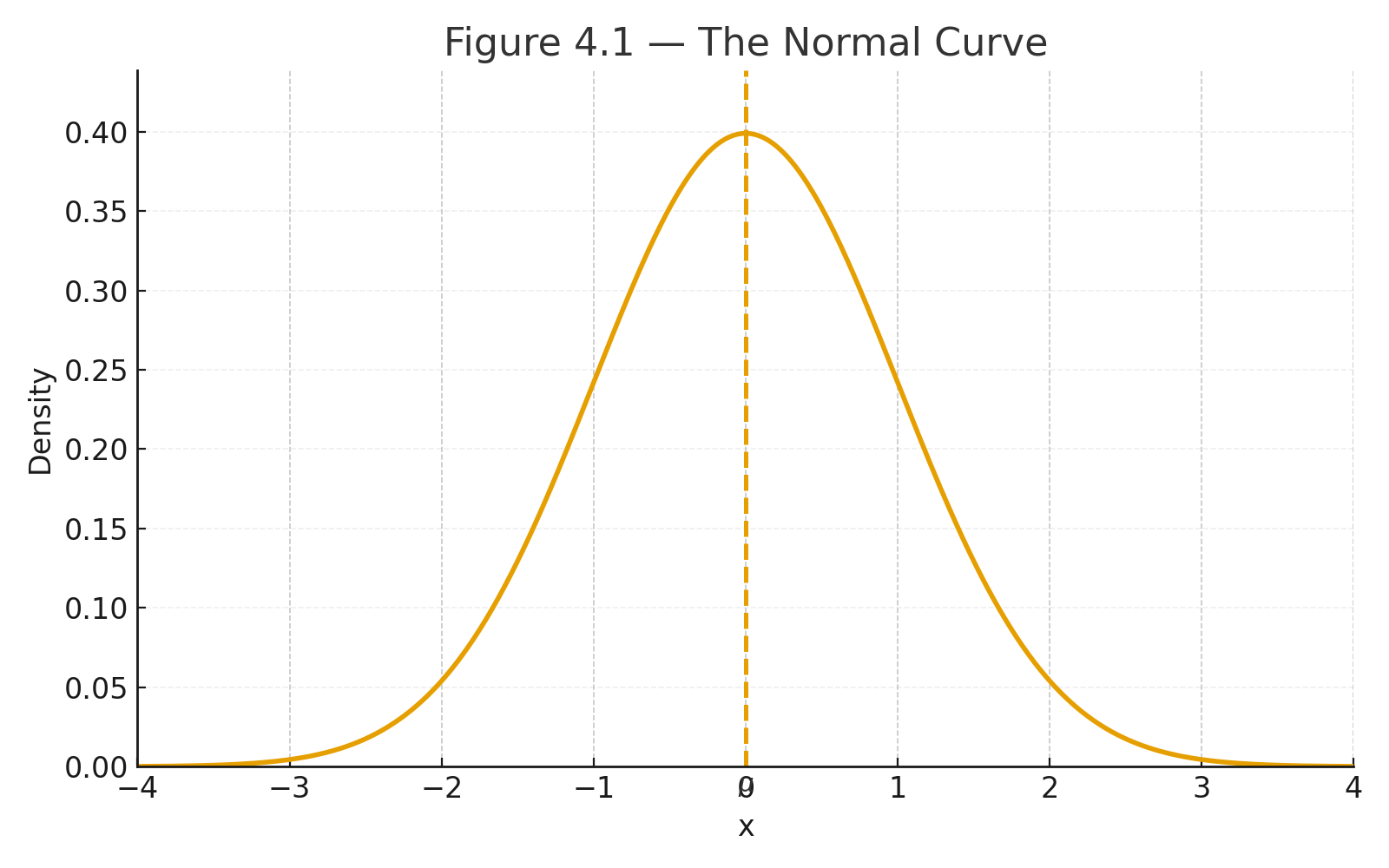
The normal curve

The normal curve (bell curve) is one of the most important shapes in statistics. It appears when many small, independent factors combine: height, test scores, measurement errors.

For a simple, intuitive presentation go to Part 2


Properties of the Normal Curve

  1. Symmetrical around the mean
  2. Unimodal (one peak)
  3. Mean = Median = Mode
  4. The total area under the curve = 1 (or 100%)

Formula for the Normal Distribution

Unless you are in Mathematical Statistics, you will never be asked to reproduce it, or otherwise work with it.

Symbolic formula:
$$f(x) = \frac{1}{\sigma \sqrt{2\pi}} e^{-\frac{(x - \mu)^2}{2\sigma^2}}$$

Formula in words:
$$\text{Probability density} = \frac{1}{\text{standard deviation} \times \sqrt{2\pi}} \times e^{-\frac{(\text{score} - \text{mean})^2}{2 \times (\text{standard deviation})^2}}$$

Where:

  • $$\mu$$ = mean
  • $$\sigma$$ = standard deviation
  • $$x$$ = a value on the curve

Standardization (z-scores)

Symbolic formula:
$$z = \frac{x - \mu}{\sigma}$$

Formula in words:
$$z = \frac{\text{score} - \text{mean}}{\text{standard deviation}}$$

A z-score tells us how many standard deviations a score is above or below the mean.


Key Percentages

Under the normal curve:

  • About 68% of scores are within 1 standard deviation of the mean
  • About 95% are within 2 standard deviations
  • About 99.7% are within 3 standard deviations

This is called the 68–95–99.7 rule.


Example

Suppose test scores are normally distributed with

  • $$\mu = 100$$
  • $$\sigma = 15$$

What is the z-score for a student who scored 115?

$$z = \frac{115 - 100}{15} = \frac{15}{15} = 1$$

This means the student is 1 standard deviation above the mean.


Visuals

Figure 4.1 — The Normal Curve. A bell-shaped curve centered at the mean (μ).

Figure 4.2 — The 68–95–99.7 Rule. A normal curve with shaded regions for ±1σ, ±2σ, ±3σ.

Figure 4.3 — z-Score Example. Normal curve with shaded area to the left of z = 1.0, labeled 0.8413.


Why This Matters

The normal curve is the foundation of inferential statistics.

  • It allows us to compute probabilities.
  • It underlies the t-test, ANOVA, and confidence intervals.
  • By using z-scores, we can compare scores across different tests and distributions.

Practice self-test quiz

In the space below, please find practice problems and self-test quizzes. For full access, please signup free.
Lesson 3 — Variance & Standard Deviation

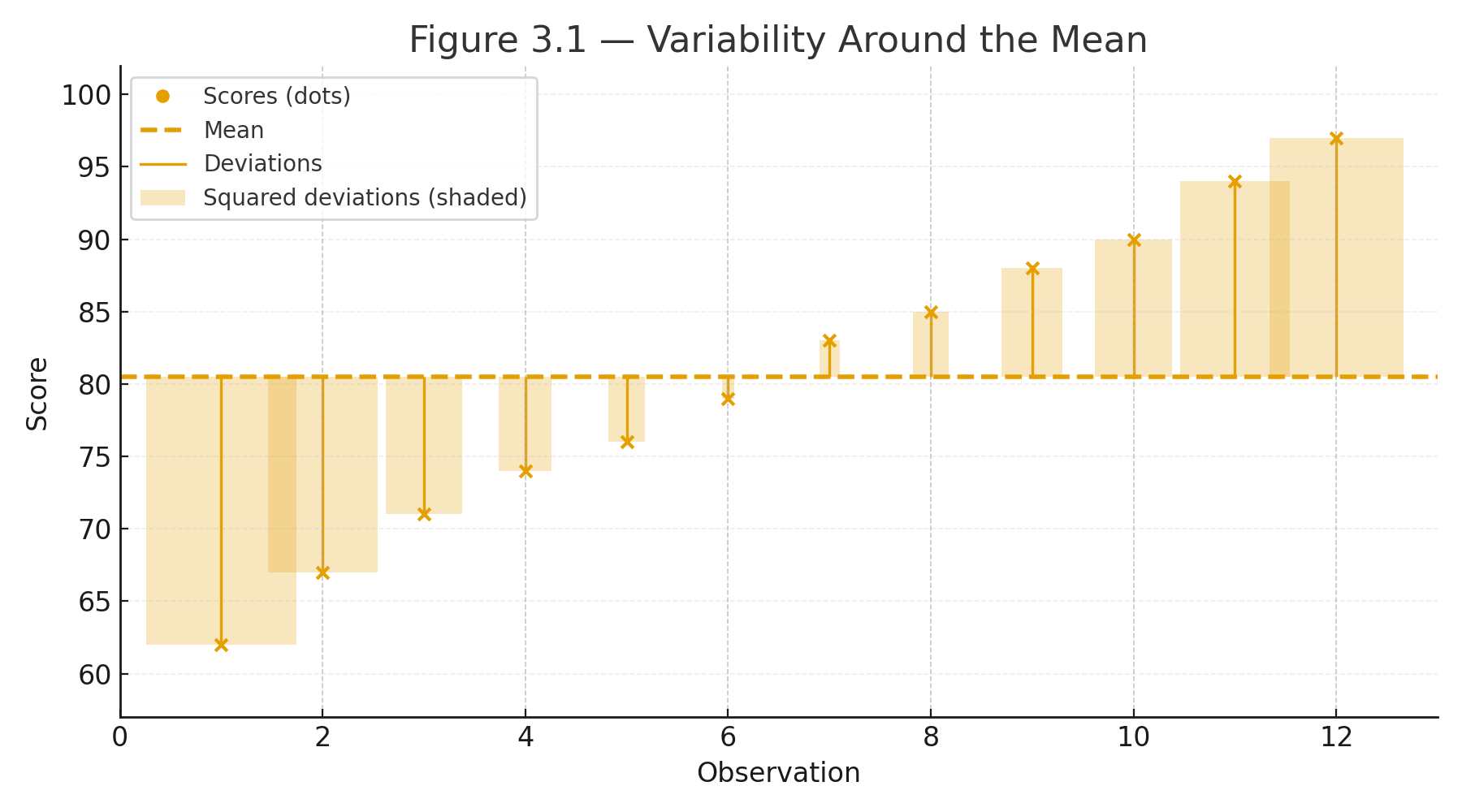
variability around the mean

After finding the mean, the next question is: How much do the scores vary around that mean?
Variation tells us whether data are tightly clustered or widely spread. Two common measures are the variance and the standard deviation.


Variance and standard deviation - formal level

Variance and standard deviation - intuitive level

Variance

Variance is the average squared distance of each score from the mean.

Symbolic formula:
$$s^2 = \frac{\sum (X - \bar{X})^2}{n - 1}$$

Formula in words:
$$\text{Variance} = \frac{\text{sum of squared deviations from the mean}}{\text{number of scores} - 1}$$

Where:

  • $$s^2$$ = variance
  • $$X$$ = each score
  • $$\bar{X}$$ = mean
  • $$n$$ = number of scores

Example: Data: 6, 8, 10

  • Mean = 8
  • Deviations: (6–8) = –2, (8–8) = 0, (10–8) = 2
  • Squared deviations: 4, 0, 4
  • Sum = 8

Variance = $$\tfrac{8}{3-1} = 4$$


Standard Deviation

The standard deviation is the square root of the variance.

Symbolic formula:
$$s = \sqrt{\frac{\sum (X - \bar{X})^2}{n - 1}}$$

Formula in words:
$$\text{Standard deviation} = \sqrt{\frac{\text{sum of squared deviations from the mean}}{\text{number of scores} - 1}}$$

Example continued:
Variance = 4 → Standard deviation = $$\sqrt{4} = 2$$

So, on average, scores are about 2 units away from the mean.


Definition

  • Variance: average squared distance from the mean.
  • Standard Deviation: square root of variance; typical distance from the mean.

Visuals

Figure 3.1 — Variability Around the Mean. A dot plot of scores with the mean marked, vertical lines showing deviations, and shaded boxes for squared deviations.


Why This Matters

Two sets of data can have the same mean but very different spreads.
Variance and standard deviation give us the language to describe that spread.
They are the foundation for most inferential tests in statistics.

Practice self-test quiz

In the space below, please find practice problems and self-test quizzes. For full access, please signup free.
Lesson 2 — The Averages

mean mode median

When we look at a set of numbers, the first question is: What is the typical value?
Statistics gives us three common answers — the mean, the median, and the mode.

Each describes “typical” in a different way.


The Mean

The mean is the arithmetic average — the balance point of the data.

Symbolic formula:
$$\bar{X} = \frac{\sum X}{n}$$

Formula in words:
$$\text{Mean} = \frac{\text{sum of scores}}{\text{number of scores}}$$

Where:

  • $$\bar{X}$$ = mean (X bar)
  • $$\sum X$$ = sum of all scores
  • $$n$$ = number of scores

Example: Scores: 10, 8, 7

$$\bar{X} = \frac{10 + 8 + 7}{3} = \frac{25}{3} = 8.33$$

So the mean is about 8.3.


The Median

The median is the middle value when the numbers are placed in order.

Steps:

  1. Arrange the scores from smallest to largest.
  2. If there are an odd number of scores, the median is the middle one.
  3. If there are an even number of scores, the median is the average of the two middle ones.

Examples:

  • Data: 5, 7, 9 → Median = 7
  • Data: 4, 6, 10, 12 → Median = (6 + 10)/2 = 8

The Mode

The mode is the most frequent score.

Example: Data: 2, 2, 4, 5, 5, 5, 7 → Mode = 5


Definition

  • Mean: arithmetic average; balance point.
  • Median: middle score; divides data in half.
  • Mode: most frequent score.

Visuals

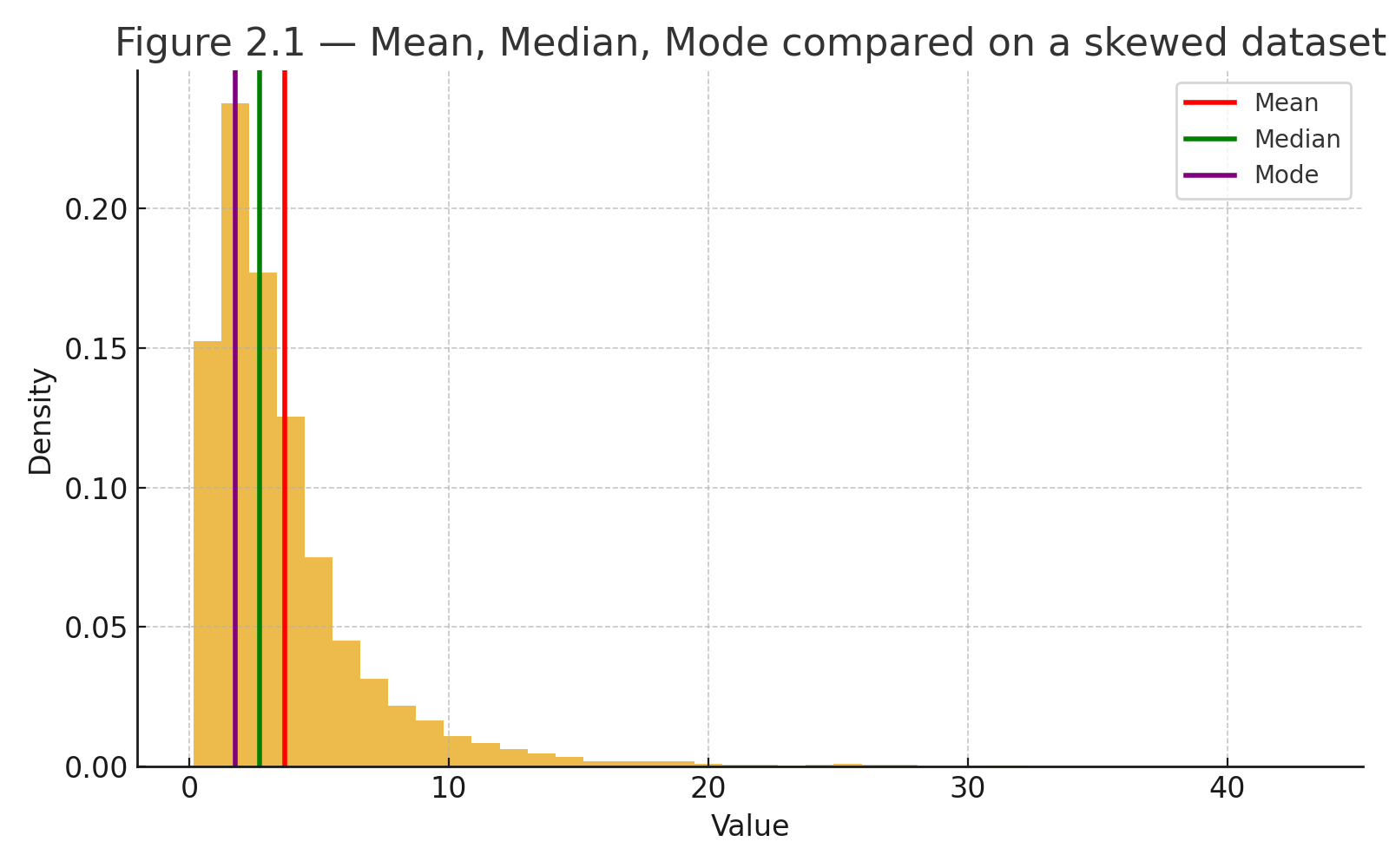
Figure 2.1 — Mean, Median, Mode compared on a skewed dataset. Histogram with three markers: red line = mean, green line = median, purple line = mode.


Why These Matter

  • The mean is sensitive to extreme values.
  • The median resists extremes and can better represent a “typical” score.
  • The mode is useful for categorical or count data.

Together, the three averages give us a rounded view of what is typical in a dataset.

Practice self-test quiz

In the space below, please find practice problems and self-test quizzes. For full access, please signup free.
Lesson 1: What Is Statistics? Why Does It Matter?

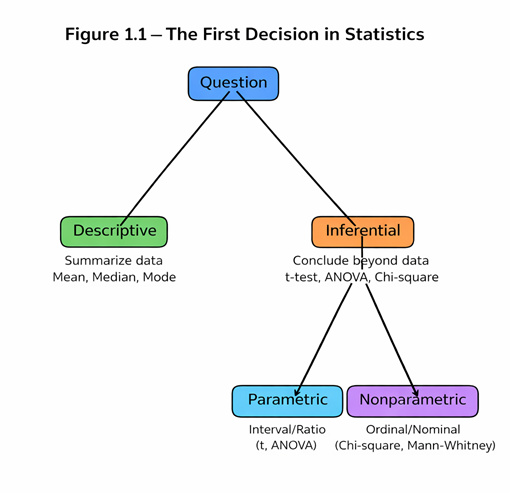
Flowchart illustrating the first decision in statistics: descriptive versus inferential methods, with inferential statistics divided into parametric and nonparametric analyses.es.


Statistics is the science of learning from data. It provides the tools to decide whether what we observe is real or accidental, and whether a difference is large enough to matter.

When a scientist runs an experiment, or when a pollster surveys a group of voters, the results always vary. Statistics gives us a way to interpret that variation and to draw conclusions.

The Two Branches of Statistics

  • Descriptive Statistics describe and summarize what we see.
    Example: “The average score on the math test was 78.”
  • Inferential Statistics use a sample to make conclusions about a larger group.
    Example: “Based on this sample, we estimate the average score for all students in the district.”

Definition:

  • Descriptive statistics = picture of the data.
  • Inferential statistics = prediction about the population.

Parametric vs. Non-parametric Statistics

There are two main families of tests:

  • Parametric tests (such as the t-test or ANOVA) assume certain conditions in the data, like normal distribution and interval/ratio measurement.
  • Non-parametric tests (such as Chi-square or Mann–Whitney) require fewer assumptions and are used when data are ranks (ordinal) or categories (nominal).

Simple rule of thumb:

  • If data are interval or ratio (e.g., test scores, heights), use parametric tests.
  • If data are ordinal or nominal (e.g., ranks, categories), use non-parametric tests.

First Formula in Statistics: The Mean

The mean is our first step toward summarizing data.

Symbolic formula:
$$\bar{X} = \frac{\sum X}{n}$$

Formula in words:
$$\text{Mean} = \frac{\text{sum of scores}}{\text{number of scores}}$$

Where:

  • $$\bar{X}$$ = mean (X bar)
  • $$\sum X$$ = sum of all scores
  • $$n$$ = number of scores

Example: Data: 6, 8, 10

$$\bar{X} = \frac{6 + 8 + 10}{3} = \frac{24}{3} = 8$$

So the mean is 8.

Visual

Figure 1.1 — The First Decision in Statistics. A flowchart: Descriptive vs. Inferential → Parametric vs. Non-parametric, with examples inside each box.

Why This Matters

Before you can choose the right statistical test, you must know:

  1. What kind of data you have (descriptive vs. inferential).
  2. How those data are measured (nominal, ordinal, interval, ratio).
  3. Which family of tests applies (parametric vs. non-parametric).

This chapter sets the stage. The rest of the book builds from here, using only a small set of simple formulas to unlock the logic of statistics.

Practice self-test quiz

In the space below, please find practice problems and self-test quizzes. For full access, please signup free.
Part 1 — Theory • Concepts • Statistical Tests

Welcome to Part 1 — Theory • Concepts • Statistical Tests of this free online statistics textbook. This foundational section is devoted to the formal concepts and core tools of statistical analysis. It introduces what statistics is, why it matters, and how statistical reasoning is expressed through definitions, measures, distributions, and test procedures.

The emphasis in Part 1 is conceptual and structural rather than experimental. Students learn how fundamental statistical quantities are defined, how variability is measured, and how classical statistical tests are constructed and interpreted. Topics such as descriptive statistics, the normal distribution, standard error, hypothesis testing, and degrees of freedom are developed as elements of a coherent theoretical framework.

Part 1 is designed to answer a central question: What statistical methods exist, and what do they mean? By focusing on formal ideas, canonical tests, and their logical foundations, this section provides the conceptual grounding required for AP Statistics and introductory college-level coursework. It establishes the vocabulary, assumptions, and inferential logic that later applications depend upon.

Lessons in Part 1: Theory • Concepts • Statistical Tests

  1. What Is Statistics? Why Does It Matter? – An introduction to statistical reasoning, data, variability, and the role of statistics in science and everyday life.
  2. The Averages – Understanding mean, median, and mode, including when each measure is most appropriate.
  3. Variance and Standard Deviation – Developing intuition for variability through visual reasoning and step-by-step calculations.
  4. The Standard Normal Curve – Exploring the properties of the normal distribution and standard scores.
  5. Standard Error of the Mean (SEM) – Understanding sampling variability and the logic of statistical inference.
  6. The t-test – Hypothesis testing for means, including assumptions, test statistics, and interpretation.
  7. Analysis of Variance (ANOVA) – Comparing multiple group means by partitioning variance.
  8. Post Hoc Tests – Identifying which groups differ after a significant ANOVA result.
  9. Correlation – Measuring the strength and direction of relationships between variables.
  10. Regression – Modeling relationships using linear regression and interpreting slope and intercept.
  11. Non-Parametric Tests – Statistical alternatives used when parametric assumptions are violated.
  12. Chi-Square Tests – Analyzing categorical data using goodness-of-fit and tests of independence.
  13. Degrees of Freedom Cookbook – A practical guide to determining degrees of freedom across common statistical tests.